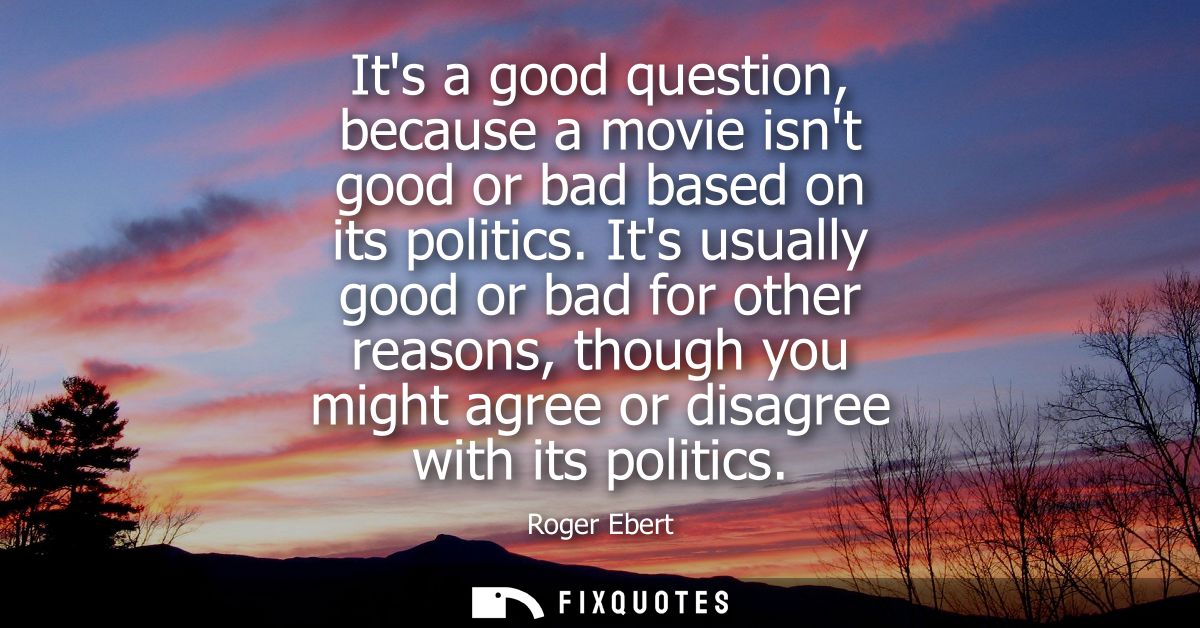
"It's a good question, because a movie isn't good or bad based on its politics. It's usually good or bad for other reasons, though you might agree or disagree with its politics"
About this Quote
The subtext is a critique of ideological shortcutting. Ebert isn’t claiming politics are irrelevant; he’s refusing the lazy syllogism that the “right” politics guarantee quality or the “wrong” politics guarantee failure. His phrase “usually good or bad for other reasons” points to craft: storytelling, performance, rhythm, image-making, moral complexity. Politics can be a theme, but craft is the delivery system. A film with sympathetic politics can still be clumsy propaganda; a film with objectionable politics can still be formally brilliant, which is precisely why it can be dangerous, persuasive, or culturally sticky.
Context matters: Ebert reviewed everything from overt political cinema to mainstream entertainment that smuggled in assumptions about class, race, gender, and war. His line recognizes that disagreement with a film’s worldview is a legitimate reaction, but not a substitute for analysis. It’s a defense of criticism as criticism - not just consumer guidance, not just ideological refereeing, but an attempt to describe how a movie works on you and why.
Quote Details
| Topic | Movie |
|---|---|
| Source | Help us find the source |
| Cite |
Citation Formats
APA Style (7th ed.)
Ebert, Roger. (2026, January 15). It's a good question, because a movie isn't good or bad based on its politics. It's usually good or bad for other reasons, though you might agree or disagree with its politics. FixQuotes. https://fixquotes.com/quotes/its-a-good-question-because-a-movie-isnt-good-or-58429/
Chicago Style
Ebert, Roger. "It's a good question, because a movie isn't good or bad based on its politics. It's usually good or bad for other reasons, though you might agree or disagree with its politics." FixQuotes. January 15, 2026. https://fixquotes.com/quotes/its-a-good-question-because-a-movie-isnt-good-or-58429/.
MLA Style (9th ed.)
"It's a good question, because a movie isn't good or bad based on its politics. It's usually good or bad for other reasons, though you might agree or disagree with its politics." FixQuotes, 15 Jan. 2026, https://fixquotes.com/quotes/its-a-good-question-because-a-movie-isnt-good-or-58429/. Accessed 7 Apr. 2026.