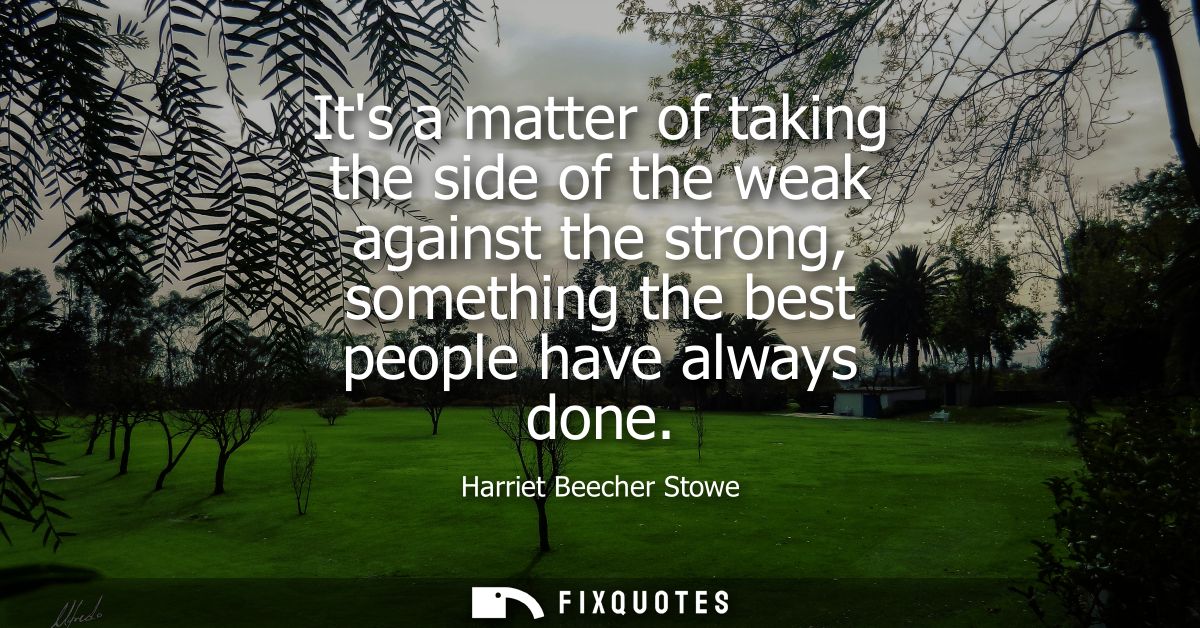
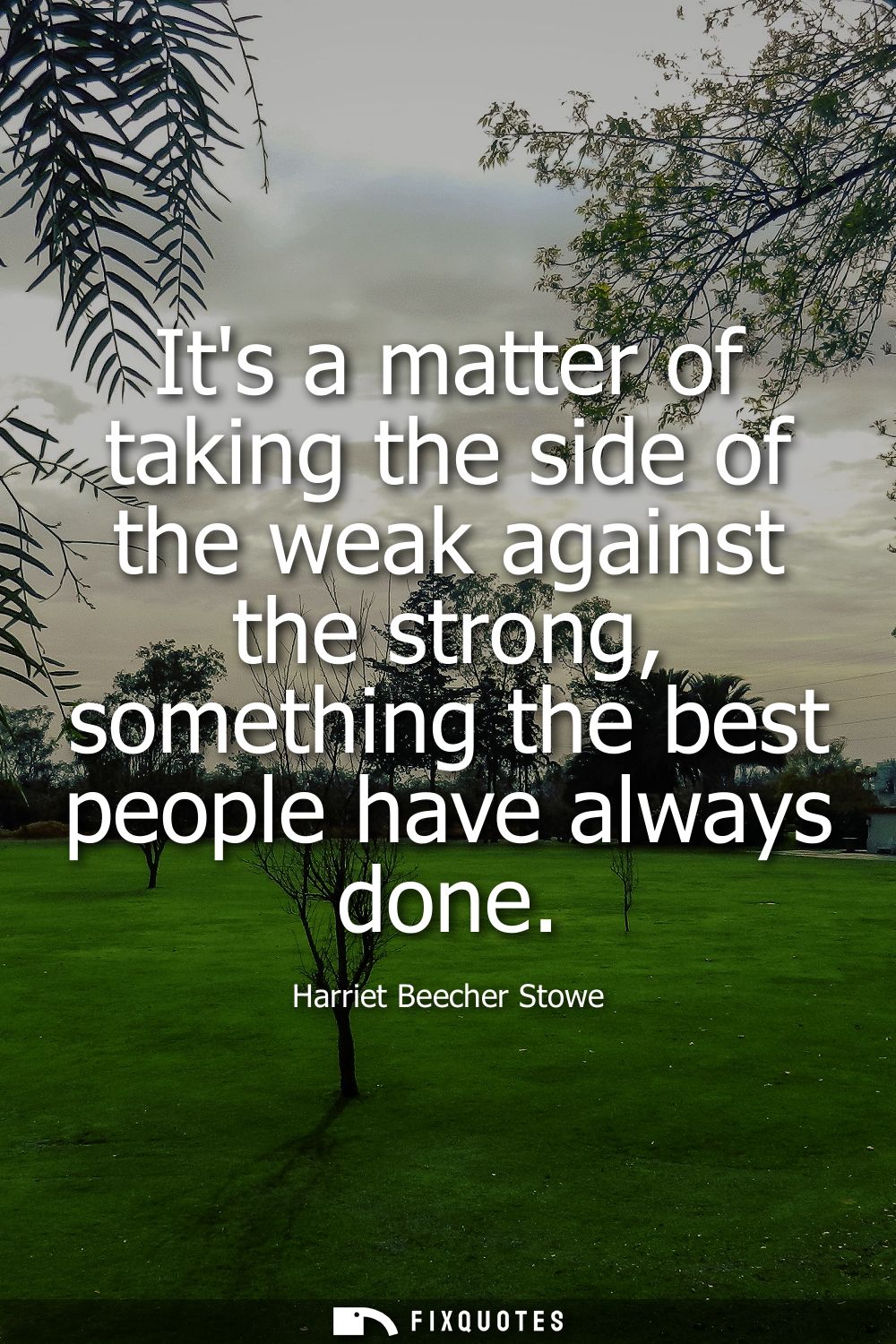
"It's a matter of taking the side of the weak against the strong, something the best people have always done"
About this Quote
Abolition, in Stowe's hands, isn’t pitched as a niche political preference but as a moral reflex: you see power bearing down, you step between. The line works because it frames justice as alignment, not abstraction. “Taking the side” is intimate and physical; it suggests choosing company, risking reputation, entering the fight. Stowe doesn’t flatter the reader with neutrality. She implies that not choosing is itself a choice - and usually one that benefits the strong.
The sly hinge is “the best people.” It’s both a compliment and a provocation. Stowe is recruiting: she offers a prestigious identity to anyone willing to stand with the vulnerable. But she’s also indicting the respectable classes who claim goodness while benefiting from systems of coercion. In a 19th-century America that prized order, property, and “moderation,” this is a rebuke to the genteel habit of moral outsourcing: let politics handle it, let courts handle it, let someone else take the heat. Stowe insists that the heat is the point.
Context matters: as the author of Uncle Tom’s Cabin, she wrote into a culture where slavery was defended as tradition, economics, even paternal care. Her sentence punctures those rationalizations by reducing the situation to a clean asymmetry: weak versus strong. That simplification is strategic. It denies the powerful the comforting complexity they use as camouflage, and it gives ordinary people a story sturdy enough to act on.
The sly hinge is “the best people.” It’s both a compliment and a provocation. Stowe is recruiting: she offers a prestigious identity to anyone willing to stand with the vulnerable. But she’s also indicting the respectable classes who claim goodness while benefiting from systems of coercion. In a 19th-century America that prized order, property, and “moderation,” this is a rebuke to the genteel habit of moral outsourcing: let politics handle it, let courts handle it, let someone else take the heat. Stowe insists that the heat is the point.
Context matters: as the author of Uncle Tom’s Cabin, she wrote into a culture where slavery was defended as tradition, economics, even paternal care. Her sentence punctures those rationalizations by reducing the situation to a clean asymmetry: weak versus strong. That simplification is strategic. It denies the powerful the comforting complexity they use as camouflage, and it gives ordinary people a story sturdy enough to act on.
Quote Details
| Topic | Justice |
|---|---|
| Source | Help us find the source |
More Quotes by Harriet
Add to List