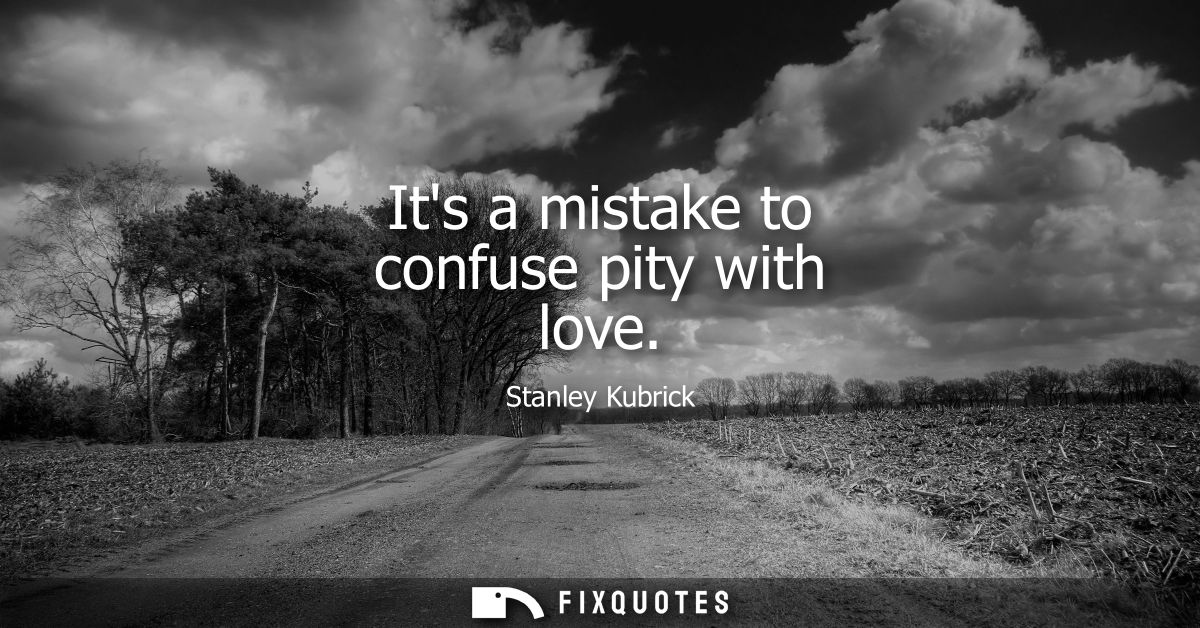
"It's a mistake to confuse pity with love"
About this Quote
Kubrick’s line cuts with the chilly precision of his films: it’s not anti-compassion, it’s anti-self-deception. Pity is an emotion that looks down; love is a commitment that looks across. Confusing the two doesn’t just muddle feelings - it quietly reorganizes power. The person who “loves” through pity gets to be the rescuer, the moral superior, the one who stays because they’re needed. The person being “loved” becomes a project. That arrangement can feel tender in the moment, even virtuous, but it’s structurally unequal, and Kubrick is allergic to comforting structures.
The intent reads like a warning about how easily care turns into control. Pity flatters the giver: it offers a clean narrative where your presence is inherently noble. Love is messier; it requires seeing the other person as fully agentic, capable of choices you might dislike. Kubrick’s work is crowded with relationships poisoned by imbalance - from the transactional intimacy of Eyes Wide Shut to the clinical manipulation in A Clockwork Orange. His characters often mistake proximity for understanding and obligation for affection. Pity fits that pattern: it’s closeness without risk, empathy without surrender.
Context matters, too: a 20th-century director watching modern life turn human beings into cases, problems, inputs. Kubrick’s worlds are full of institutions that claim benevolence while practicing domination. “Pity” can be the soft vocabulary of the same impulse. The line lands because it punctures the comforting idea that feeling sorry is automatically moral. Sometimes it’s just a way to keep someone smaller than you.
The intent reads like a warning about how easily care turns into control. Pity flatters the giver: it offers a clean narrative where your presence is inherently noble. Love is messier; it requires seeing the other person as fully agentic, capable of choices you might dislike. Kubrick’s work is crowded with relationships poisoned by imbalance - from the transactional intimacy of Eyes Wide Shut to the clinical manipulation in A Clockwork Orange. His characters often mistake proximity for understanding and obligation for affection. Pity fits that pattern: it’s closeness without risk, empathy without surrender.
Context matters, too: a 20th-century director watching modern life turn human beings into cases, problems, inputs. Kubrick’s worlds are full of institutions that claim benevolence while practicing domination. “Pity” can be the soft vocabulary of the same impulse. The line lands because it punctures the comforting idea that feeling sorry is automatically moral. Sometimes it’s just a way to keep someone smaller than you.
Quote Details
| Topic | Love |
|---|---|
| Source | Help us find the source |
| Cite |
Citation Formats
APA Style (7th ed.)
Kubrick, Stanley. (2026, January 15). It's a mistake to confuse pity with love. FixQuotes. https://fixquotes.com/quotes/its-a-mistake-to-confuse-pity-with-love-89172/
Chicago Style
Kubrick, Stanley. "It's a mistake to confuse pity with love." FixQuotes. January 15, 2026. https://fixquotes.com/quotes/its-a-mistake-to-confuse-pity-with-love-89172/.
MLA Style (9th ed.)
"It's a mistake to confuse pity with love." FixQuotes, 15 Jan. 2026, https://fixquotes.com/quotes/its-a-mistake-to-confuse-pity-with-love-89172/. Accessed 15 Mar. 2026.
More Quotes by Stanley
Add to List