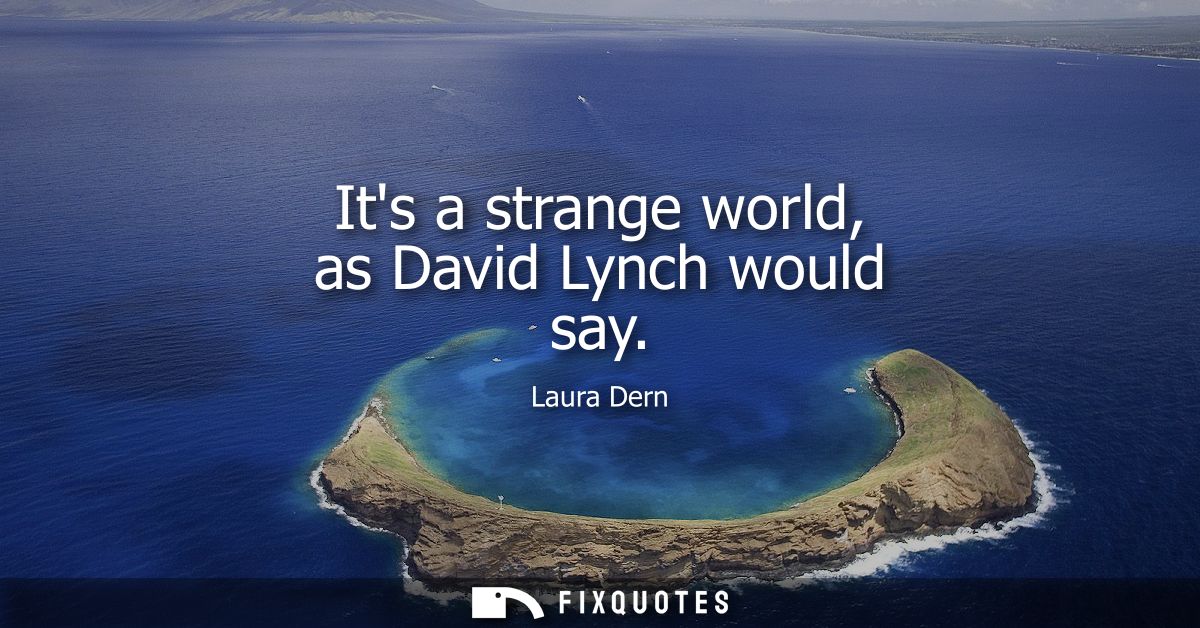
"It's a strange world, as David Lynch would say"
About this Quote
"It’s a strange world" is a pocket-sized mantra, but the tag "as David Lynch would say" is the real payload. Laura Dern isn’t just describing reality; she’s invoking a shared aesthetic vocabulary - one where the ordinary is never merely ordinary, where small-town pleasantries can hide a scream behind the wallpaper. In six words, she borrows Lynch’s passport stamp: dream logic, dread, slapstick, beauty, rot. If you know, you know.
The intent reads like a wink to collaborators and fans, but it’s also a defense mechanism. Calling the world "strange" can be a way of staying tender without getting flattened by the chaos of the moment. It reframes confusion as atmosphere rather than failure. Dern’s delivery (often in interviews, red carpets, post-project reflections) tends to treat artistry as a kind of emotional fieldwork; tethering the thought to Lynch turns a banal observation into a signal of allegiance to a sensibility that prizes ambiguity.
There’s subtext about authorship and influence, too. Actors are routinely asked to translate their work into neat lessons; this sidesteps the demand. "Lynch would say" licenses mystery, implying that the most honest response to absurdity is not explanation but recognition. It also quietly honors a creative partnership: Dern isn’t name-dropping to elevate herself; she’s placing her own worldview inside a lineage where the weird isn’t a glitch - it’s the point.
Contextually, it lands in a culture that wants clean narratives and hot takes. Dern gestures at something messier: the truth might be uncanny, and that doesn’t make it less true.
The intent reads like a wink to collaborators and fans, but it’s also a defense mechanism. Calling the world "strange" can be a way of staying tender without getting flattened by the chaos of the moment. It reframes confusion as atmosphere rather than failure. Dern’s delivery (often in interviews, red carpets, post-project reflections) tends to treat artistry as a kind of emotional fieldwork; tethering the thought to Lynch turns a banal observation into a signal of allegiance to a sensibility that prizes ambiguity.
There’s subtext about authorship and influence, too. Actors are routinely asked to translate their work into neat lessons; this sidesteps the demand. "Lynch would say" licenses mystery, implying that the most honest response to absurdity is not explanation but recognition. It also quietly honors a creative partnership: Dern isn’t name-dropping to elevate herself; she’s placing her own worldview inside a lineage where the weird isn’t a glitch - it’s the point.
Contextually, it lands in a culture that wants clean narratives and hot takes. Dern gestures at something messier: the truth might be uncanny, and that doesn’t make it less true.
Quote Details
| Topic | Deep |
|---|---|
| Source | Help us find the source |
More Quotes by Laura
Add to List