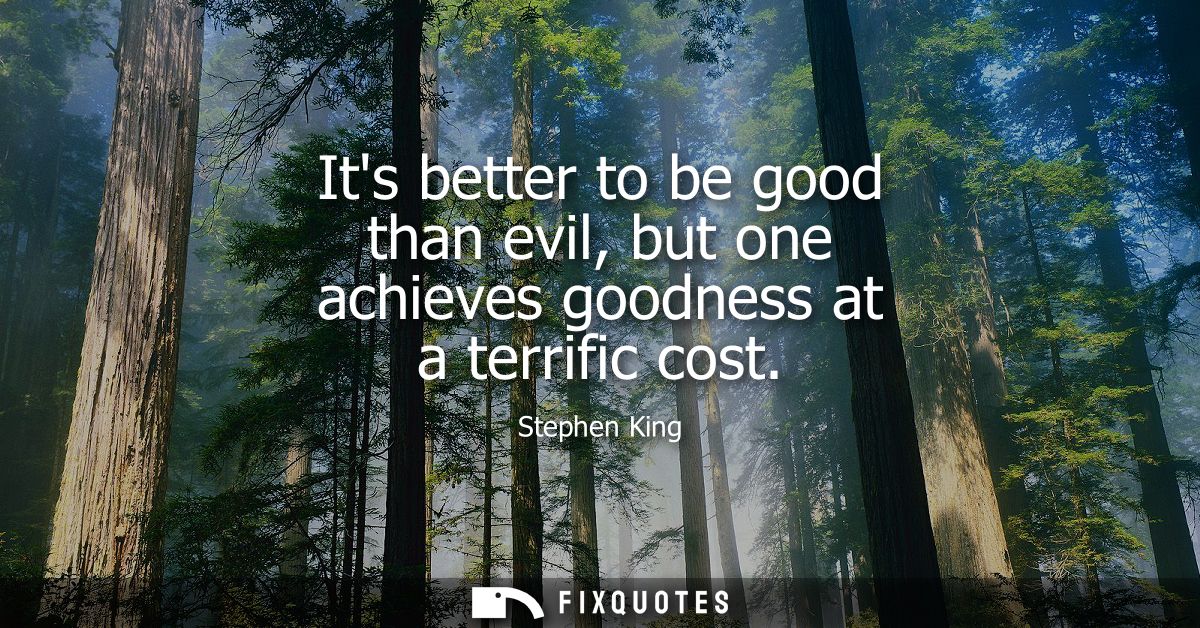
"It's better to be good than evil, but one achieves goodness at a terrific cost"
About this Quote
The subtext is anti-sainthood. King isn’t arguing that morality is glamorous or even emotionally rewarding. He’s suggesting that being “good” is less an identity than a series of losses you agree to absorb so someone else doesn’t have to. That’s why “terrific” matters: it implies both terror and magnitude. The price isn’t just steep; it’s frightening, because goodness requires you to stay human in situations designed to make you numb.
Contextually, this tracks with King’s recurring setup: ordinary people drafted into extraordinary horror. In The Stand, It, or Pet Sematary, the ethical fight isn’t against a villain’s ideology as much as against the seductive relief of giving in - to revenge, to grief, to cruelty. King’s intent feels bluntly democratic: moral heroism is available to anyone, but it won’t be free, and the receipt is written in what you were tempted to become.
Quote Details
| Topic | Ethics & Morality |
|---|---|
| Source | Help us find the source |
| Cite |
Citation Formats
APA Style (7th ed.)
King, Stephen. (2026, January 15). It's better to be good than evil, but one achieves goodness at a terrific cost. FixQuotes. https://fixquotes.com/quotes/its-better-to-be-good-than-evil-but-one-achieves-1841/
Chicago Style
King, Stephen. "It's better to be good than evil, but one achieves goodness at a terrific cost." FixQuotes. January 15, 2026. https://fixquotes.com/quotes/its-better-to-be-good-than-evil-but-one-achieves-1841/.
MLA Style (9th ed.)
"It's better to be good than evil, but one achieves goodness at a terrific cost." FixQuotes, 15 Jan. 2026, https://fixquotes.com/quotes/its-better-to-be-good-than-evil-but-one-achieves-1841/. Accessed 2 Apr. 2026.