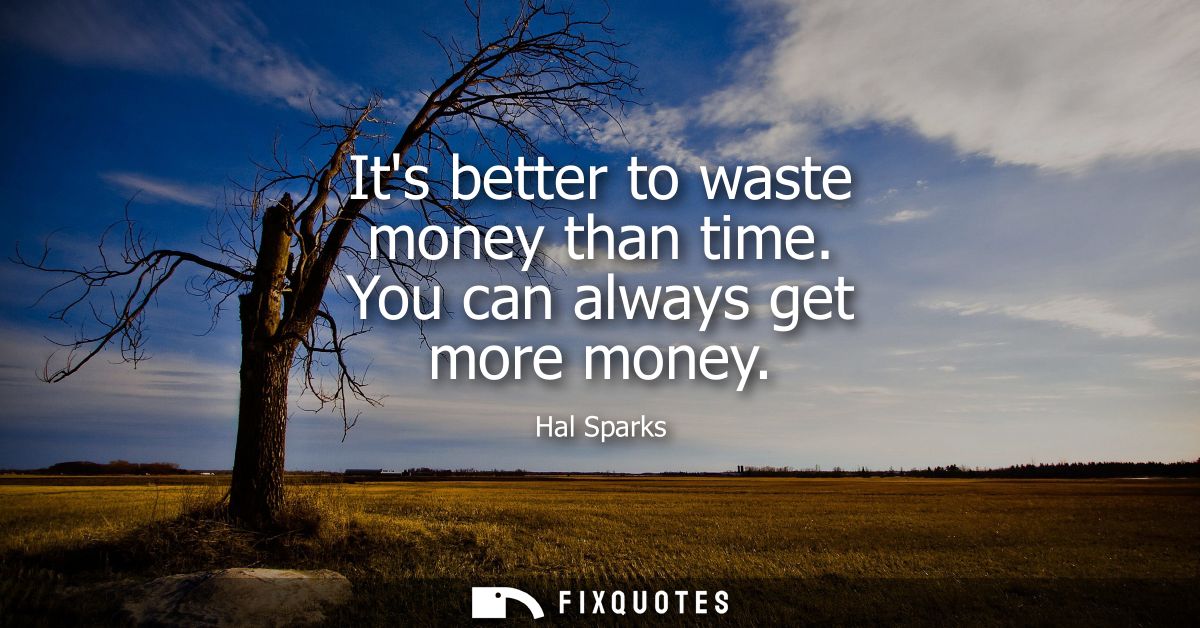
"It's better to waste money than time. You can always get more money"
About this Quote
Hal Sparks turns a grind-culture shibboleth into something closer to a life hack with teeth: the most precious resource isn’t cash, it’s attention. Coming from an actor and comedian, the line reads less like a spreadsheet truth and more like a backstage principle. In entertainment, “time” isn’t abstract; it’s the audition you miss, the momentum you lose, the relationship you neglect while chasing a deal. Money can be recouped with the next gig. A wasted day can’t be re-shot.
The quote works because it quietly reframes what people call “being responsible.” Most of us are trained to treat spending as the moral failure and busyness as virtue. Sparks flips that: penny-pinching that costs you hours, energy, or sanity is its own kind of indulgence. The subtext isn’t “be reckless,” it’s “stop acting like frugality is automatically wisdom.” Paying for convenience, help, or a shortcut can be an investment in the only non-renewable thing you own: your finite span of usable hours.
There’s also a bit of cultural pushback here against the fantasy of total control. You can budget money. You can’t budget fate, traffic, illness, burnout. “You can always get more money” is intentionally provocative because it’s not universally true; it’s aspirational and situational. That exaggeration is the point. It jolts you into asking where you’re trading your life for savings, and whether the bargain is actually yours to make.
The quote works because it quietly reframes what people call “being responsible.” Most of us are trained to treat spending as the moral failure and busyness as virtue. Sparks flips that: penny-pinching that costs you hours, energy, or sanity is its own kind of indulgence. The subtext isn’t “be reckless,” it’s “stop acting like frugality is automatically wisdom.” Paying for convenience, help, or a shortcut can be an investment in the only non-renewable thing you own: your finite span of usable hours.
There’s also a bit of cultural pushback here against the fantasy of total control. You can budget money. You can’t budget fate, traffic, illness, burnout. “You can always get more money” is intentionally provocative because it’s not universally true; it’s aspirational and situational. That exaggeration is the point. It jolts you into asking where you’re trading your life for savings, and whether the bargain is actually yours to make.
Quote Details
| Topic | Time |
|---|---|
| Source | Help us find the source |
| Cite |
Citation Formats
APA Style (7th ed.)
Sparks, Hal. (2026, January 15). It's better to waste money than time. You can always get more money. FixQuotes. https://fixquotes.com/quotes/its-better-to-waste-money-than-time-you-can-169945/
Chicago Style
Sparks, Hal. "It's better to waste money than time. You can always get more money." FixQuotes. January 15, 2026. https://fixquotes.com/quotes/its-better-to-waste-money-than-time-you-can-169945/.
MLA Style (9th ed.)
"It's better to waste money than time. You can always get more money." FixQuotes, 15 Jan. 2026, https://fixquotes.com/quotes/its-better-to-waste-money-than-time-you-can-169945/. Accessed 27 Mar. 2026.
More Quotes by Hal
Add to List