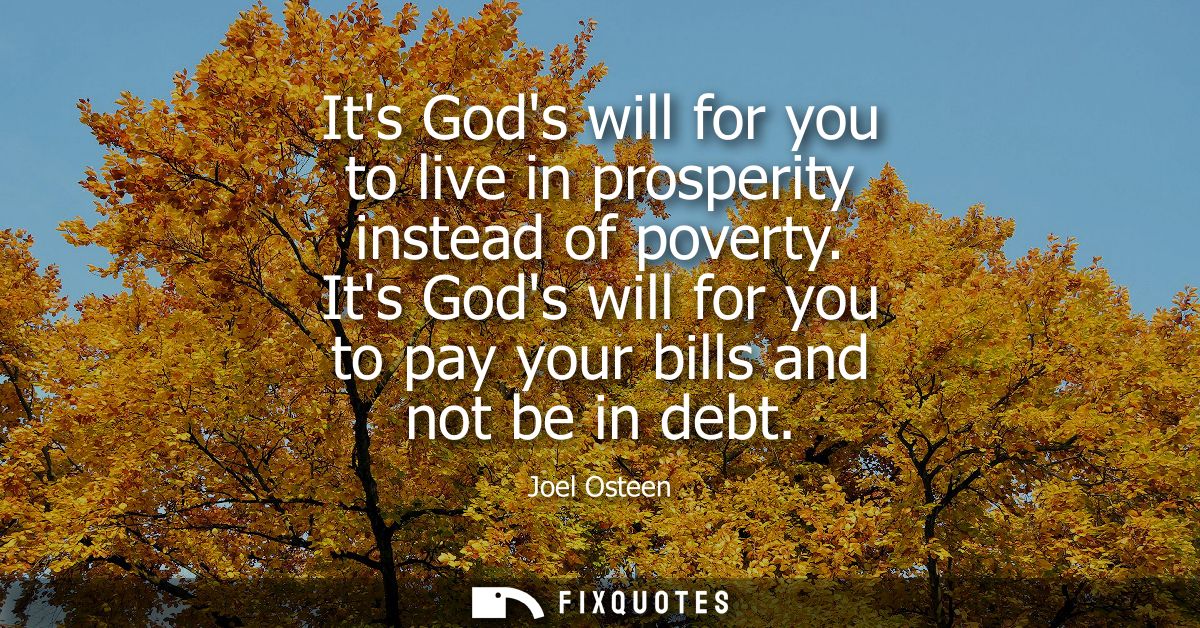
"It's God's will for you to live in prosperity instead of poverty. It's God's will for you to pay your bills and not be in debt"
About this Quote
The intent is motivational and disciplinary at once. By declaring prosperity “God’s will,” Osteen swaps the messy moral complexity of money for a clean spiritual mandate. Prosperity becomes not just a hope but a duty, and poverty isn’t merely hardship; it’s implicitly a condition out of alignment. The subtext is powerful: if you’re struggling, the problem is not primarily wages, healthcare costs, predatory lending, or the fact that whole regions have been economically gutted. The problem is spiritual posture, belief, obedience, maybe even your expectations.
Context matters. Osteen’s rise tracks with a late-20th/early-21st-century American religious marketplace shaped by self-help culture, suburban megachurch aesthetics, and an economy where debt is normalized and insecurity is constant. In that landscape, “God wants you out of debt” is both balm and brand: it offers agency to people who feel trapped, while quietly harmonizing Christianity with the American success script.
It works rhetorically because it reframes financial anxiety as a story with a villain (poverty), a hero (you), and an omnipotent sponsor (God). The risk is the flip side of empowerment: when prosperity is promised as providence, misfortune starts to look like personal failure wearing a theological mask.
Quote Details
| Topic | Financial Freedom |
|---|---|
| Source | Help us find the source |
| Cite |
Citation Formats
APA Style (7th ed.)
Osteen, Joel. (2026, January 18). It's God's will for you to live in prosperity instead of poverty. It's God's will for you to pay your bills and not be in debt. FixQuotes. https://fixquotes.com/quotes/its-gods-will-for-you-to-live-in-prosperity-19715/
Chicago Style
Osteen, Joel. "It's God's will for you to live in prosperity instead of poverty. It's God's will for you to pay your bills and not be in debt." FixQuotes. January 18, 2026. https://fixquotes.com/quotes/its-gods-will-for-you-to-live-in-prosperity-19715/.
MLA Style (9th ed.)
"It's God's will for you to live in prosperity instead of poverty. It's God's will for you to pay your bills and not be in debt." FixQuotes, 18 Jan. 2026, https://fixquotes.com/quotes/its-gods-will-for-you-to-live-in-prosperity-19715/. Accessed 10 Mar. 2026.