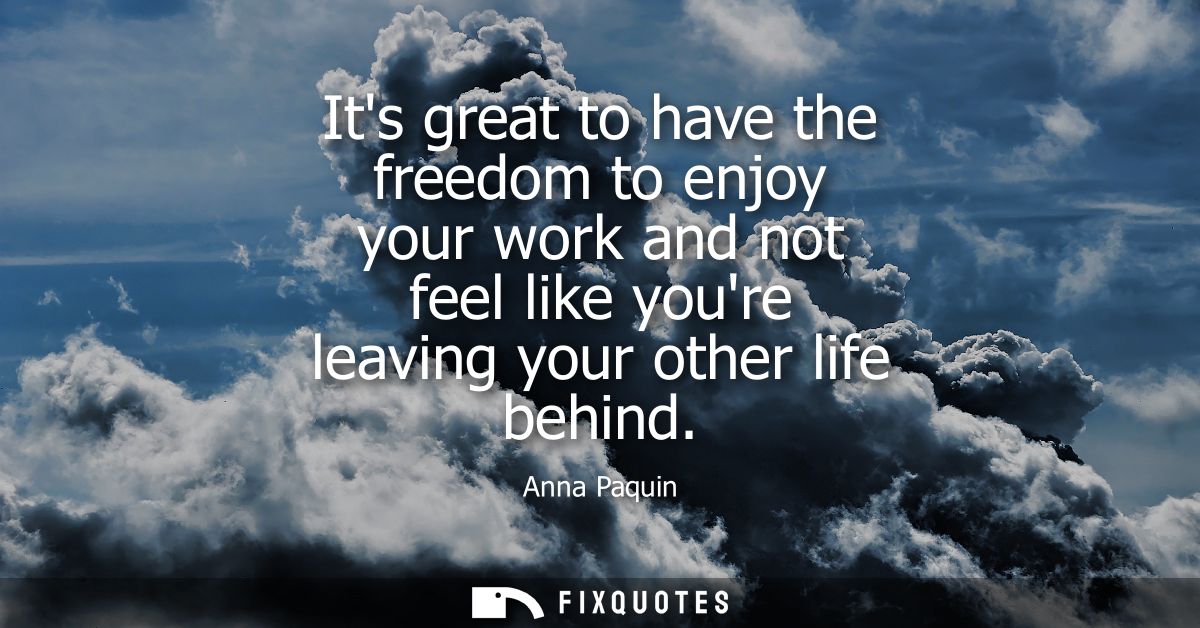
"It's great to have the freedom to enjoy your work and not feel like you're leaving your other life behind"
About this Quote
The key phrase is "other life". Paquin frames personhood as something that can be misplaced, like a coat checked at the stage door. That image lands because it maps onto how fame and production schedules operate: long shoots, travel, press, publicity, the constant soft demand to be "on". Freedom here isn't abstract, political freedom; it's the intimate permission to remain a whole person while being productive.
Paquin's intent reads less like a manifesto and more like a corrective to glamour narratives. Actors are often sold to us as people who get paid to play; she points to the labor and the emotional cost, then quietly suggests what good work actually requires: sustainability. The line also hints at creative longevity. Enjoyment isn't just pleasure; it's a signal that the work environment isn't stripping you of the relationships, routines, and privacy that make performance feel human rather than extractive.
In a culture that confuses devotion with self-erasure, Paquin's sentence is radical in its modesty: you shouldn't have to abandon your life to earn your living.
Quote Details
| Topic | Work-Life Balance |
|---|---|
| Source | Help us find the source |
| Cite |
Citation Formats
APA Style (7th ed.)
Paquin, Anna. (2026, January 17). It's great to have the freedom to enjoy your work and not feel like you're leaving your other life behind. FixQuotes. https://fixquotes.com/quotes/its-great-to-have-the-freedom-to-enjoy-your-work-44175/
Chicago Style
Paquin, Anna. "It's great to have the freedom to enjoy your work and not feel like you're leaving your other life behind." FixQuotes. January 17, 2026. https://fixquotes.com/quotes/its-great-to-have-the-freedom-to-enjoy-your-work-44175/.
MLA Style (9th ed.)
"It's great to have the freedom to enjoy your work and not feel like you're leaving your other life behind." FixQuotes, 17 Jan. 2026, https://fixquotes.com/quotes/its-great-to-have-the-freedom-to-enjoy-your-work-44175/. Accessed 11 Mar. 2026.