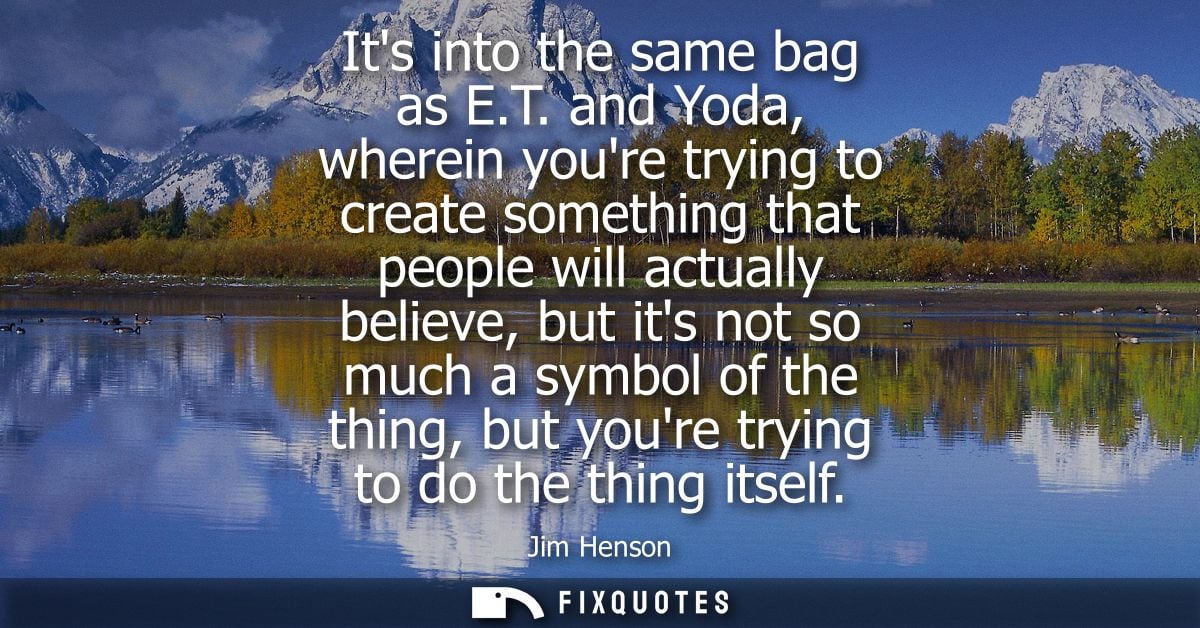
"It's into the same bag as E.T. and Yoda, wherein you're trying to create something that people will actually believe, but it's not so much a symbol of the thing, but you're trying to do the thing itself"
About this Quote
The key move is his distinction between a “symbol” and “the thing itself.” A symbol is legible at a distance; you recognize it, you decode it, you move on. “The thing itself” is riskier and more intimate: it asks viewers to suspend their adult defenses and respond as if a felt face has interiority, as if a rubber brow can think. Henson’s subtext is craft pride, but also an ethical commitment to sincerity. The goal isn’t to impress you with technique; it’s to make you forget technique exists.
Context matters: Henson is working in an era when blockbuster filmmaking is perfecting believable nonhuman companions, and he’s staking a claim for puppetry as peer to cinema’s most advanced illusions. He’s also articulating why these creatures endure culturally. E.T. and Yoda aren’t just designs; they’re presences. Their “believability” is less about realism than about behavioral truth: timing, breath, hesitation, gentleness. Henson is naming the magic trick and insisting it’s not a trick at all. It’s an act of creation that only works if it’s played straight.
Quote Details
| Topic | Movie |
|---|---|
| Source | Help us find the source |
| Cite |
Citation Formats
APA Style (7th ed.)
Henson, Jim. (2026, January 17). It's into the same bag as E.T. and Yoda, wherein you're trying to create something that people will actually believe, but it's not so much a symbol of the thing, but you're trying to do the thing itself. FixQuotes. https://fixquotes.com/quotes/its-into-the-same-bag-as-et-and-yoda-wherein-68004/
Chicago Style
Henson, Jim. "It's into the same bag as E.T. and Yoda, wherein you're trying to create something that people will actually believe, but it's not so much a symbol of the thing, but you're trying to do the thing itself." FixQuotes. January 17, 2026. https://fixquotes.com/quotes/its-into-the-same-bag-as-et-and-yoda-wherein-68004/.
MLA Style (9th ed.)
"It's into the same bag as E.T. and Yoda, wherein you're trying to create something that people will actually believe, but it's not so much a symbol of the thing, but you're trying to do the thing itself." FixQuotes, 17 Jan. 2026, https://fixquotes.com/quotes/its-into-the-same-bag-as-et-and-yoda-wherein-68004/. Accessed 2 Apr. 2026.