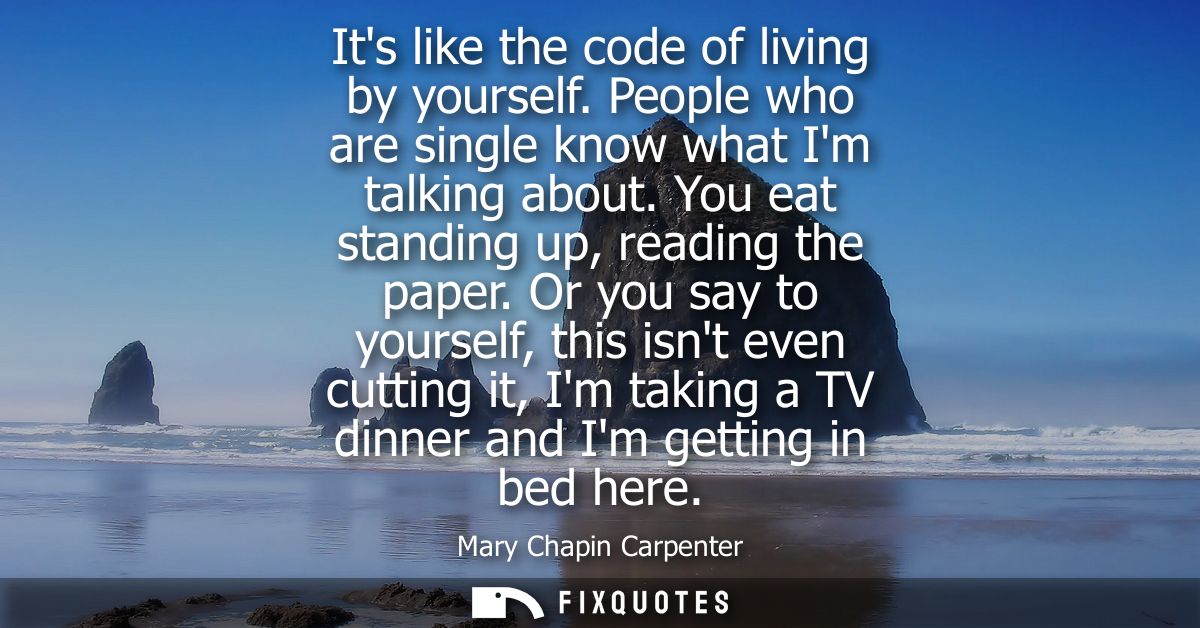
"It's like the code of living by yourself. People who are single know what I'm talking about. You eat standing up, reading the paper. Or you say to yourself, this isn't even cutting it, I'm taking a TV dinner and I'm getting in bed here"
About this Quote
The specificity does the heavy lifting: standing up, reading the paper, then the escalation to a TV dinner taken into bed. These aren't just quirks; they're markers of how quickly self-care can slide into bare-minimum maintenance when you don't have an audience or a shared routine. Carpenter isn't moralizing about single life. She's clocking the way loneliness can masquerade as convenience, and how independence can drift into a kind of soft surrender.
The line "People who are single know what I'm talking about" is a little wink of coalition-building, a miniature chorus of recognition. It's also a subtle rebuke to the coupled world that treats domestic life as inherently more "real". Carpenter dignifies the messy, slightly sad, slightly hilarious reality: the rituals of being alone aren't tragic, but they do reveal what companionship quietly structures - not romance as fantasy, but the everyday impulse to set a table.
Quote Details
| Topic | Loneliness |
|---|---|
| Source | Help us find the source |
| Cite |
Citation Formats
APA Style (7th ed.)
Carpenter, Mary Chapin. (2026, January 16). It's like the code of living by yourself. People who are single know what I'm talking about. You eat standing up, reading the paper. Or you say to yourself, this isn't even cutting it, I'm taking a TV dinner and I'm getting in bed here. FixQuotes. https://fixquotes.com/quotes/its-like-the-code-of-living-by-yourself-people-104536/
Chicago Style
Carpenter, Mary Chapin. "It's like the code of living by yourself. People who are single know what I'm talking about. You eat standing up, reading the paper. Or you say to yourself, this isn't even cutting it, I'm taking a TV dinner and I'm getting in bed here." FixQuotes. January 16, 2026. https://fixquotes.com/quotes/its-like-the-code-of-living-by-yourself-people-104536/.
MLA Style (9th ed.)
"It's like the code of living by yourself. People who are single know what I'm talking about. You eat standing up, reading the paper. Or you say to yourself, this isn't even cutting it, I'm taking a TV dinner and I'm getting in bed here." FixQuotes, 16 Jan. 2026, https://fixquotes.com/quotes/its-like-the-code-of-living-by-yourself-people-104536/. Accessed 8 Apr. 2026.