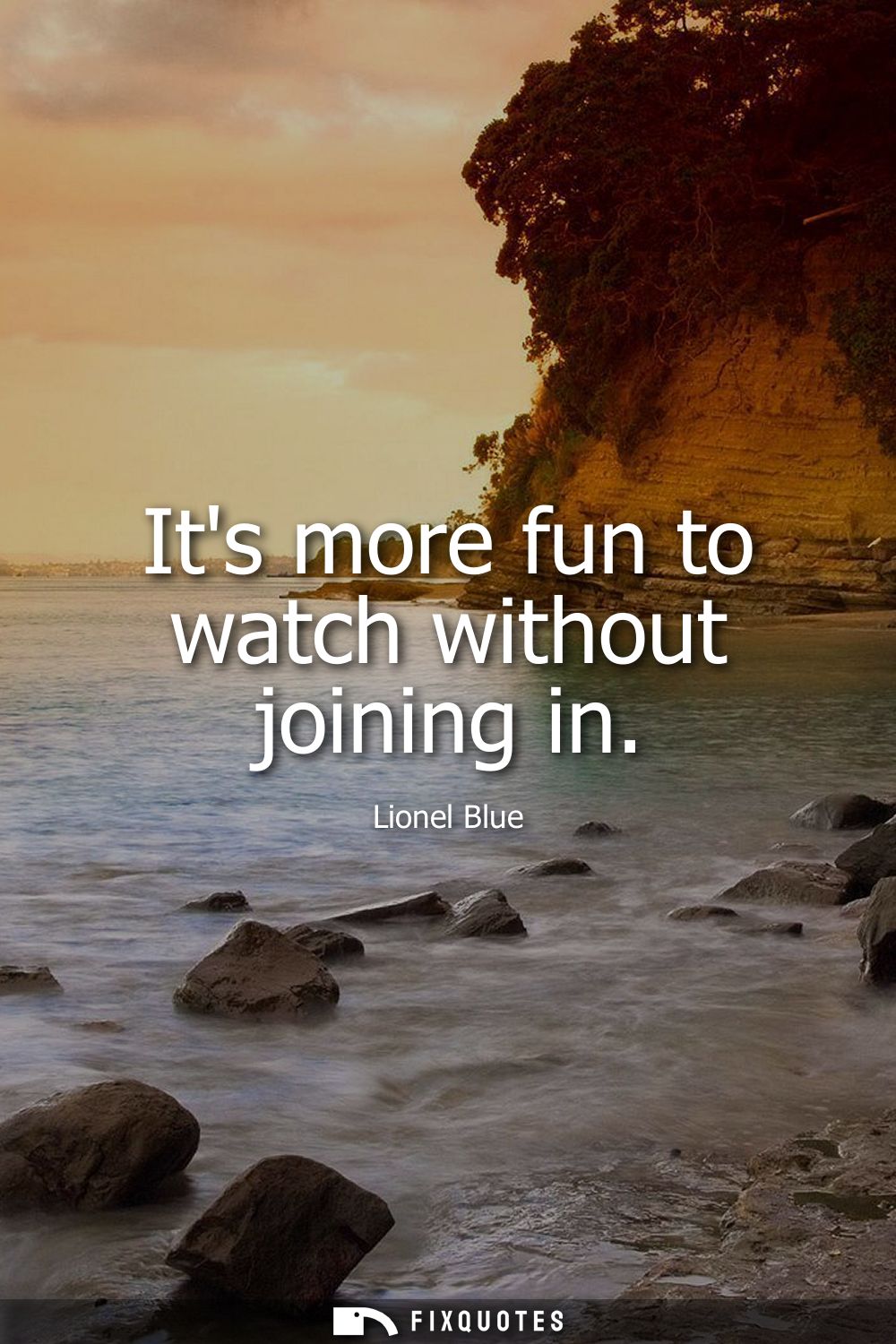
"It's more fun to watch without joining in"
About this Quote
A cleric admitting that spectatorship can be the higher pleasure is a small act of heresy, and Lionel Blue knows it. Coming from someone whose job description leans toward participation - worship, community, obligation - the line teases a confession most institutions try to shame out of us: detachment can feel cleaner, safer, even happier. Blue packages that confession as whimsy, but the wit has teeth.
The intent is double-edged. On the surface, its a shrug about parties, sports, or any social scene where the pressure to perform is louder than the music. Underneath, its a critique of moral cultures that equate virtue with joining in. Blue suggests a different economy of enjoyment: watching offers the pleasure of comprehension without the cost of exposure. Participation risks humiliation, compromise, sin, responsibility. Watching lets you keep your hands clean and your identity intact.
As a clergyman - and, in Blues case, a public figure who often wrote with dry candor about faith and outsiderhood - the subtext sharpens. There is something distinctly religious about preferring the balcony: the observer stance resembles the stance of God, or at least the stance religion trains in you when it asks for judgment, reflection, restraint. Its also a warning. A life spent only watching can become a sanctified alibi: you never fail because you never try, never harm because you never touch.
The line works because it flatters our modern habit of commentary over commitment, then quietly exposes what that habit costs.
The intent is double-edged. On the surface, its a shrug about parties, sports, or any social scene where the pressure to perform is louder than the music. Underneath, its a critique of moral cultures that equate virtue with joining in. Blue suggests a different economy of enjoyment: watching offers the pleasure of comprehension without the cost of exposure. Participation risks humiliation, compromise, sin, responsibility. Watching lets you keep your hands clean and your identity intact.
As a clergyman - and, in Blues case, a public figure who often wrote with dry candor about faith and outsiderhood - the subtext sharpens. There is something distinctly religious about preferring the balcony: the observer stance resembles the stance of God, or at least the stance religion trains in you when it asks for judgment, reflection, restraint. Its also a warning. A life spent only watching can become a sanctified alibi: you never fail because you never try, never harm because you never touch.
The line works because it flatters our modern habit of commentary over commitment, then quietly exposes what that habit costs.
Quote Details
| Topic | Witty One-Liners |
|---|---|
| Source | Help us find the source |
| Cite |
Citation Formats
APA Style (7th ed.)
Blue, Lionel. (2026, January 18). It's more fun to watch without joining in. FixQuotes. https://fixquotes.com/quotes/its-more-fun-to-watch-without-joining-in-18075/
Chicago Style
Blue, Lionel. "It's more fun to watch without joining in." FixQuotes. January 18, 2026. https://fixquotes.com/quotes/its-more-fun-to-watch-without-joining-in-18075/.
MLA Style (9th ed.)
"It's more fun to watch without joining in." FixQuotes, 18 Jan. 2026, https://fixquotes.com/quotes/its-more-fun-to-watch-without-joining-in-18075/. Accessed 26 Mar. 2026.
More Quotes by Lionel
Add to List