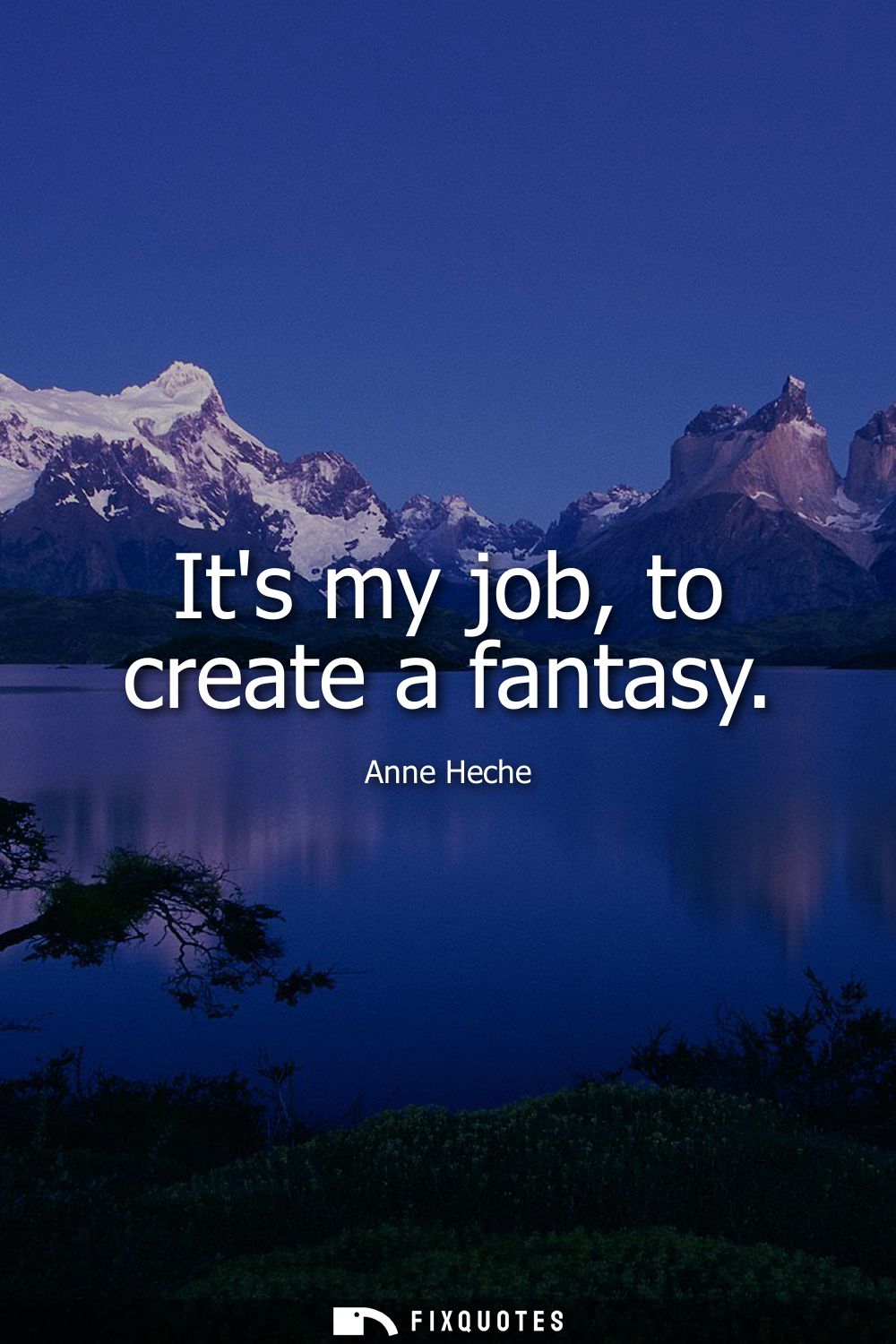
"It's my job, to create a fantasy"
About this Quote
There’s a bracing candor in “It’s my job, to create a fantasy” that cuts against the soft-focus mythology we usually pin on actors. Anne Heche isn’t selling acting as sacred self-expression; she’s naming it as labor. The comma does real work: “It’s my job” lands like a boundary, a corrective to the public’s hunger for access, confession, and “realness.” Then “to create a fantasy” reframes what audiences often treat as truth. Not authenticity, not morality, not a diary entry: a constructed illusion, delivered on deadline.
The intent feels twofold. First, it’s a professional claim: acting is craft, not accident. Second, it’s a quiet refusal. If the culture wants the performer to be the product, Heche points to the product as make-believe, not her private life. That subtext reads especially sharply given how celebrity media has long treated actresses as both screens and suspects, expected to provide emotional transparency while being punished for any messiness that leaks out.
In context, the line also echoes Hollywood’s long transaction: the public pays for feelings, not facts. Heche’s phrasing acknowledges the bargain without romanticizing it. Fantasy isn’t “lying”; it’s a consensual illusion that lets viewers rehearse desire, fear, and redemption from a safe distance. She’s reminding us that the spell is engineered. The unsettling implication: if fantasy is the job, our job as an audience is to stop confusing the worker with the workplace.
The intent feels twofold. First, it’s a professional claim: acting is craft, not accident. Second, it’s a quiet refusal. If the culture wants the performer to be the product, Heche points to the product as make-believe, not her private life. That subtext reads especially sharply given how celebrity media has long treated actresses as both screens and suspects, expected to provide emotional transparency while being punished for any messiness that leaks out.
In context, the line also echoes Hollywood’s long transaction: the public pays for feelings, not facts. Heche’s phrasing acknowledges the bargain without romanticizing it. Fantasy isn’t “lying”; it’s a consensual illusion that lets viewers rehearse desire, fear, and redemption from a safe distance. She’s reminding us that the spell is engineered. The unsettling implication: if fantasy is the job, our job as an audience is to stop confusing the worker with the workplace.
Quote Details
| Topic | Movie |
|---|
More Quotes by Anne
Add to List