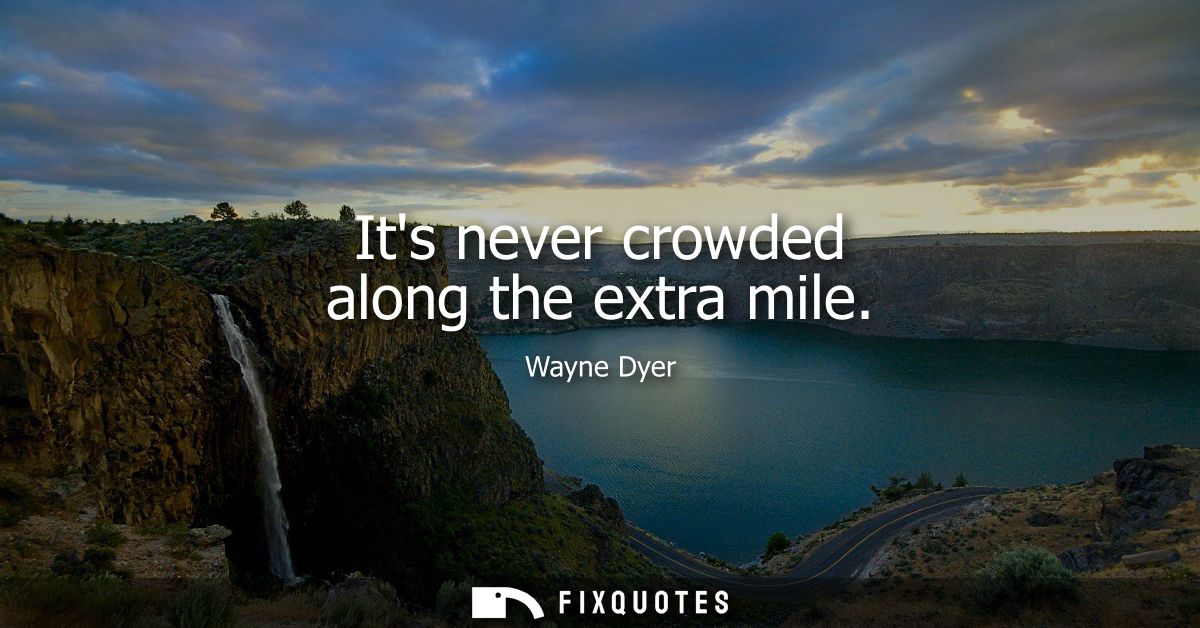
"It's never crowded along the extra mile"
About this Quote
“It’s never crowded along the extra mile” flatters you with a small, elegant promise: if you do just a bit more than what’s required, you’ll immediately separate yourself from the pack. Dyer, the self-help-era psychologist who translated therapeutic language into motivational currency, is deploying a bit of behavioral economics disguised as folksy wisdom. The line works because it turns excellence into a choice that feels accessible. Not genius, not privilege, not destiny. Just another mile.
The subtext is competitive, even if it’s wrapped in uplift. “Crowded” implies most people are content with minimum viable effort, and that mediocrity is a kind of traffic jam. The “extra mile” becomes a psychological moat: fewer people are willing to tolerate discomfort, uncertainty, or delayed reward. Dyer’s intent is to recruit you into that smaller group by making the challenge sound oddly pleasant. Who wouldn’t want an open road?
Context matters: Dyer emerged in a late-20th-century America obsessed with self-actualization, productivity, and personal agency. His language borrows from therapeutic self-responsibility while aligning neatly with workplace meritocracy. That alignment is part of the appeal and the tension. As a motivator, it’s potent because it reframes effort as identity: the kind of person who goes further. As a cultural script, it can quietly ignore structural constraints, suggesting the road is equally open to everyone.
Still, the quote endures because it nails a real human pattern: most ambition dies in the second lap, not the first. The “extra mile” is less a distance than a willingness to be briefly lonely.
The subtext is competitive, even if it’s wrapped in uplift. “Crowded” implies most people are content with minimum viable effort, and that mediocrity is a kind of traffic jam. The “extra mile” becomes a psychological moat: fewer people are willing to tolerate discomfort, uncertainty, or delayed reward. Dyer’s intent is to recruit you into that smaller group by making the challenge sound oddly pleasant. Who wouldn’t want an open road?
Context matters: Dyer emerged in a late-20th-century America obsessed with self-actualization, productivity, and personal agency. His language borrows from therapeutic self-responsibility while aligning neatly with workplace meritocracy. That alignment is part of the appeal and the tension. As a motivator, it’s potent because it reframes effort as identity: the kind of person who goes further. As a cultural script, it can quietly ignore structural constraints, suggesting the road is equally open to everyone.
Still, the quote endures because it nails a real human pattern: most ambition dies in the second lap, not the first. The “extra mile” is less a distance than a willingness to be briefly lonely.
Quote Details
| Topic | Motivational |
|---|---|
| Source | Help us find the source |
| Cite |
Citation Formats
APA Style (7th ed.)
Dyer, Wayne. (2026, January 18). It's never crowded along the extra mile. FixQuotes. https://fixquotes.com/quotes/its-never-crowded-along-the-extra-mile-10760/
Chicago Style
Dyer, Wayne. "It's never crowded along the extra mile." FixQuotes. January 18, 2026. https://fixquotes.com/quotes/its-never-crowded-along-the-extra-mile-10760/.
MLA Style (9th ed.)
"It's never crowded along the extra mile." FixQuotes, 18 Jan. 2026, https://fixquotes.com/quotes/its-never-crowded-along-the-extra-mile-10760/. Accessed 26 Mar. 2026.
More Quotes by Wayne
Add to List