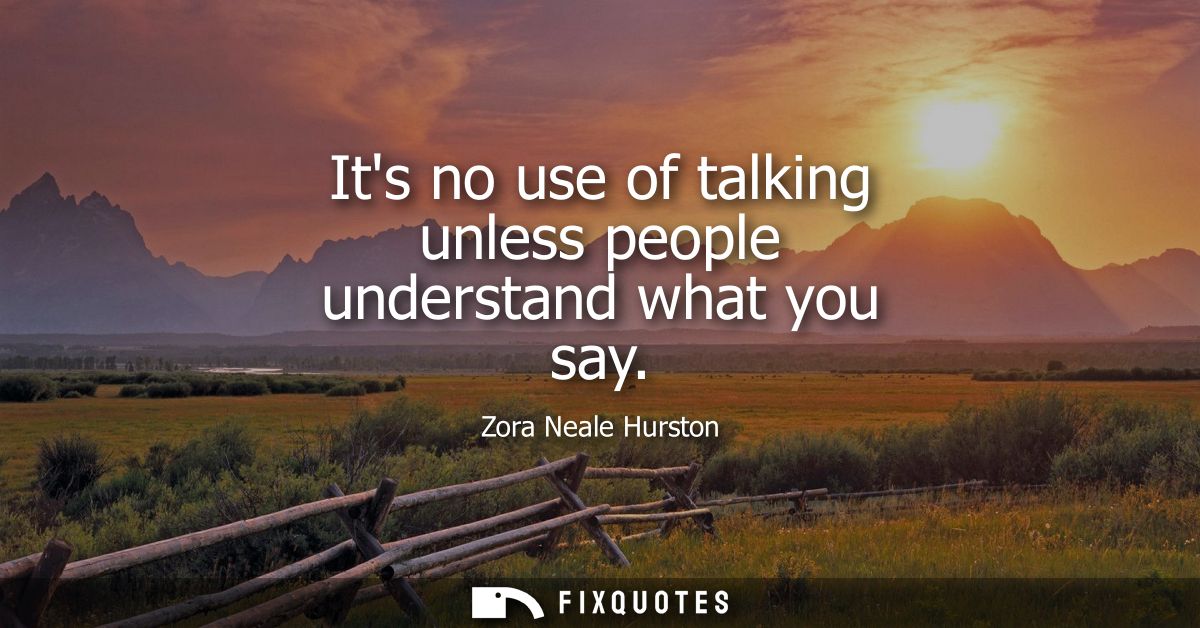
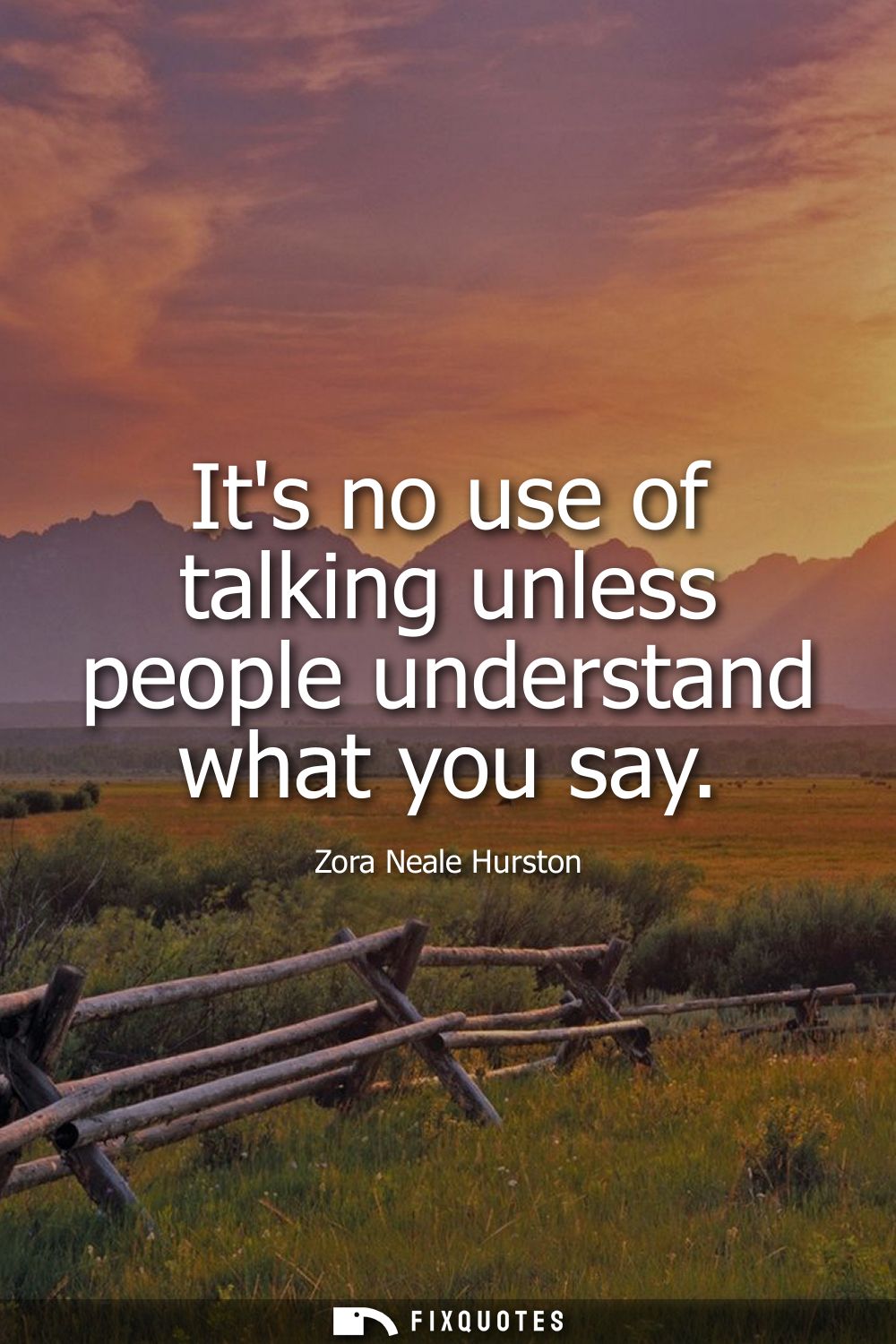
"It's no use of talking unless people understand what you say"
About this Quote
Communication isn’t performance; it’s a contract. Hurston’s line is blunt enough to sound like common sense, then sharp enough to sting: speech that doesn’t land is not “almost” communication, it’s wasted motion. The target isn’t merely bad diction. It’s the comfortable belief that speaking equals being heard, that the act of taking the floor is identical to making meaning.
Hurston, a dramatist and a chronicler of Black vernacular life, understood how power hides inside “understanding.” Who gets to be understood on their own terms, and who is forced to translate themselves into a sanctioned dialect before they’re granted legitimacy? The quote carries a double edge: a practical playwright’s discipline (dialogue must reach an audience) and a cultural critique (audiences often refuse to understand what doesn’t flatter their assumptions). In Hurston’s world, misunderstanding is rarely accidental; it’s a social choice, a way to dismiss people without the inconvenience of arguing with them.
The subtext is almost teasing: if you care about being understood, you can’t just talk at people. You have to meet them where they are, anticipate misreadings, shape the frame. That’s craft. But Hurston also implies a harsher truth: sometimes “people” won’t understand because they don’t want to. Then the question becomes political. Is it your job to keep translating, or to insist that your language, your cadence, your worldview deserves comprehension without apology?
Hurston, a dramatist and a chronicler of Black vernacular life, understood how power hides inside “understanding.” Who gets to be understood on their own terms, and who is forced to translate themselves into a sanctioned dialect before they’re granted legitimacy? The quote carries a double edge: a practical playwright’s discipline (dialogue must reach an audience) and a cultural critique (audiences often refuse to understand what doesn’t flatter their assumptions). In Hurston’s world, misunderstanding is rarely accidental; it’s a social choice, a way to dismiss people without the inconvenience of arguing with them.
The subtext is almost teasing: if you care about being understood, you can’t just talk at people. You have to meet them where they are, anticipate misreadings, shape the frame. That’s craft. But Hurston also implies a harsher truth: sometimes “people” won’t understand because they don’t want to. Then the question becomes political. Is it your job to keep translating, or to insist that your language, your cadence, your worldview deserves comprehension without apology?
Quote Details
| Topic | Teaching |
|---|---|
| Source | Help us find the source |
| Cite |
Citation Formats
APA Style (7th ed.)
Hurston, Zora Neale. (2026, January 15). It's no use of talking unless people understand what you say. FixQuotes. https://fixquotes.com/quotes/its-no-use-of-talking-unless-people-understand-10145/
Chicago Style
Hurston, Zora Neale. "It's no use of talking unless people understand what you say." FixQuotes. January 15, 2026. https://fixquotes.com/quotes/its-no-use-of-talking-unless-people-understand-10145/.
MLA Style (9th ed.)
"It's no use of talking unless people understand what you say." FixQuotes, 15 Jan. 2026, https://fixquotes.com/quotes/its-no-use-of-talking-unless-people-understand-10145/. Accessed 28 Mar. 2026.
More Quotes by Zora
Add to List