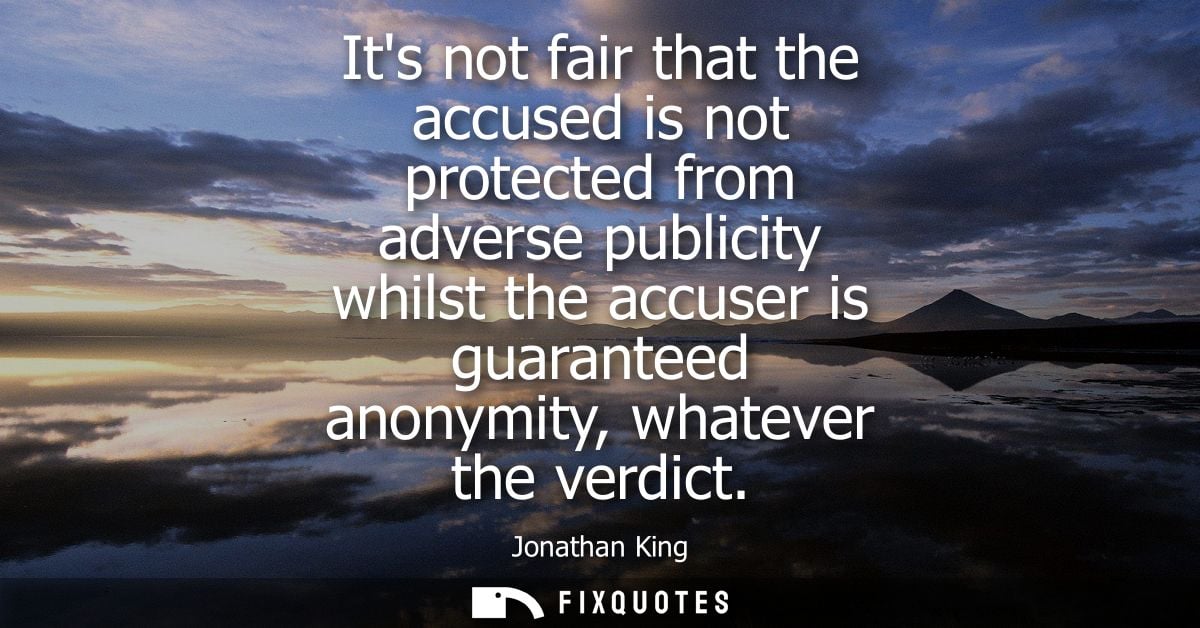
"It's not fair that the accused is not protected from adverse publicity whilst the accuser is guaranteed anonymity, whatever the verdict"
About this Quote
The wording does a lot of quiet work. “Adverse publicity” is passive, as if tabloids and public appetite are weather events rather than a culture we choose. Meanwhile “the accused” and “the accuser” are roles, not people, inviting listeners to map themselves onto the former. It’s a rhetorical tactic common to celebrity scandal: treat scrutiny as punishment and visibility as injustice, while shifting attention away from the underlying allegation.
Context matters because King isn’t a neutral commentator; he’s a pop-industry figure whose own public life has intersected with sexual-offence proceedings and the media machine. That proximity makes the quote feel less like policy critique than reputational self-defense dressed up as principle. The real intent is to recast anonymity not as protection for the vulnerable but as privilege for the claimant, and to suggest that the legal system’s moral ledger should include the accused’s public image as something the court ought to safeguard. It’s savvy, emotive, and strategically incomplete.
Quote Details
| Topic | Justice |
|---|---|
| Source | Help us find the source |
| Cite |
Citation Formats
APA Style (7th ed.)
King, Jonathan. (2026, January 16). It's not fair that the accused is not protected from adverse publicity whilst the accuser is guaranteed anonymity, whatever the verdict. FixQuotes. https://fixquotes.com/quotes/its-not-fair-that-the-accused-is-not-protected-86137/
Chicago Style
King, Jonathan. "It's not fair that the accused is not protected from adverse publicity whilst the accuser is guaranteed anonymity, whatever the verdict." FixQuotes. January 16, 2026. https://fixquotes.com/quotes/its-not-fair-that-the-accused-is-not-protected-86137/.
MLA Style (9th ed.)
"It's not fair that the accused is not protected from adverse publicity whilst the accuser is guaranteed anonymity, whatever the verdict." FixQuotes, 16 Jan. 2026, https://fixquotes.com/quotes/its-not-fair-that-the-accused-is-not-protected-86137/. Accessed 27 Mar. 2026.