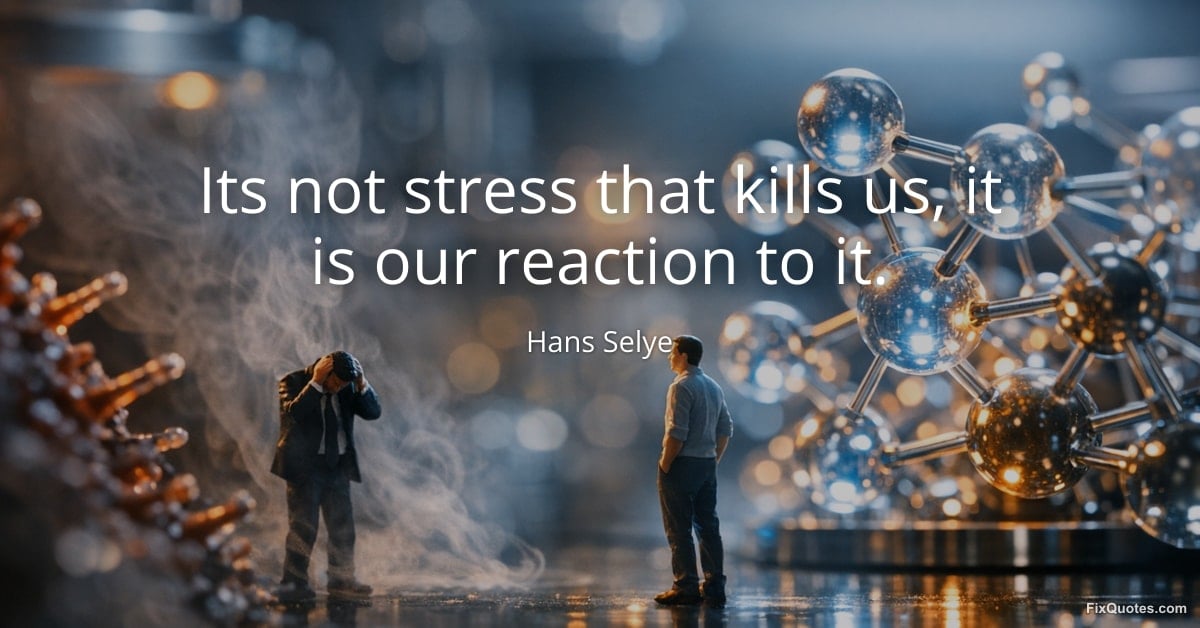
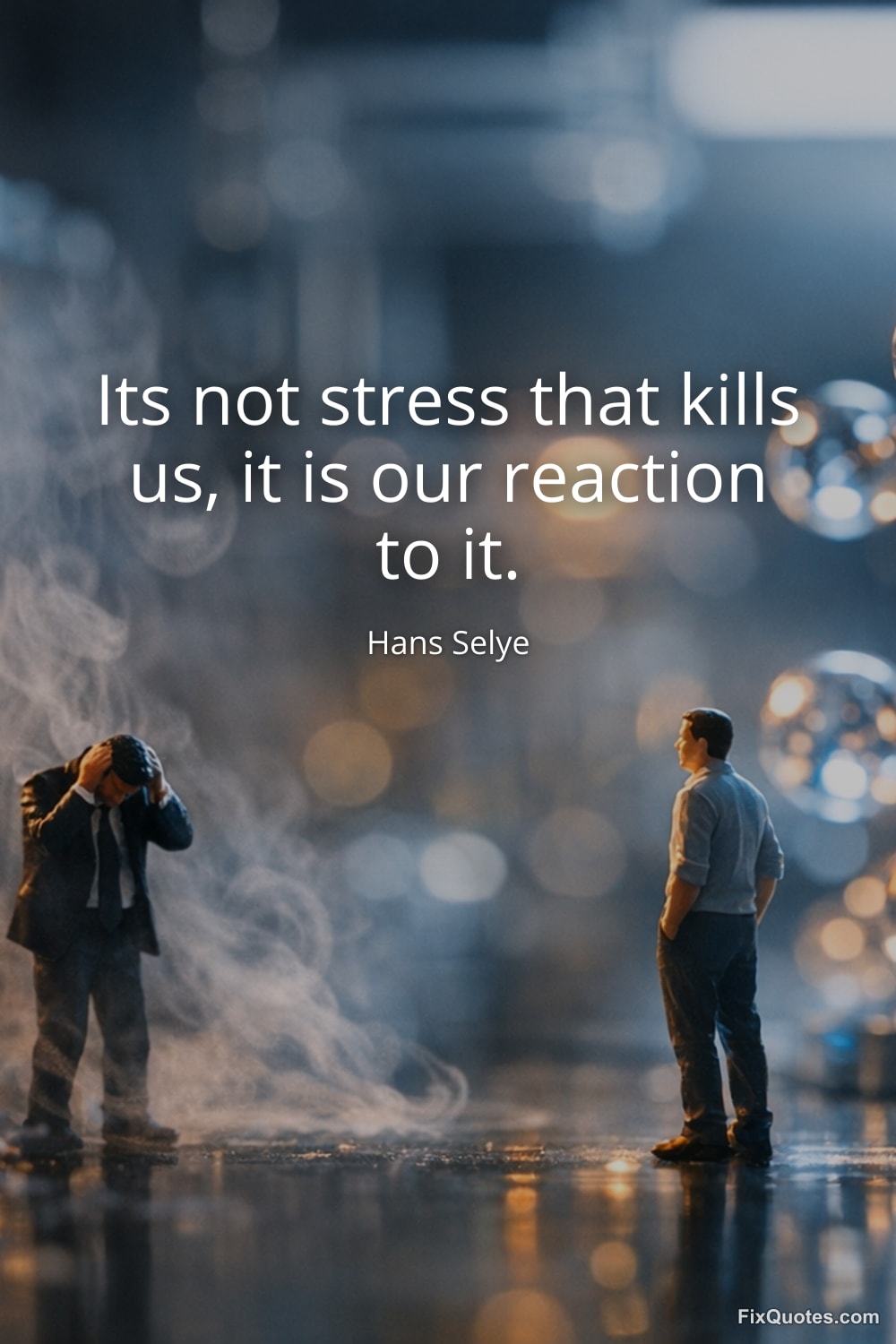
"It's not stress that kills us, it is our reaction to it"
About this Quote
The line lands like a rebuke disguised as reassurance: the enemy is not the world’s pressure but your own nervous system’s interpretation of it. Coming from Hans Selye, the scientist who helped popularize “stress” as a biological concept, that pivot is strategic. He isn’t minimizing hardship; he’s relocating the battleground from external events (often uncontrollable) to internal response (at least partially trainable). It’s a rhetorical move that gives agency without resorting to cheerfulness.
Selye’s context matters. Mid-20th-century medicine was learning to describe how the body pays for chronic alarm: hormones, inflammation, wear-and-tear. His “general adaptation syndrome” framed stress as a physiological process, not merely a mood. So when he says reaction kills, he’s pointing to the long tail of sustained activation - the body stuck in “on.” The subtext is clinical: the same stimulus can be metabolized as challenge or as threat, and those pathways have different costs.
There’s also an ethical edge. The quote anticipates a culture that sells calm as a consumer choice and risks blaming individuals for systemic strain. Read carefully, it’s not a mandate to “relax” through sheer willpower; it’s a reminder that appraisal, coping, social support, sleep, and meaning-making are legitimate interventions. Selye’s intent is practical, almost engineering-minded: you may not control the load, but you can redesign the response so the organism survives.
Selye’s context matters. Mid-20th-century medicine was learning to describe how the body pays for chronic alarm: hormones, inflammation, wear-and-tear. His “general adaptation syndrome” framed stress as a physiological process, not merely a mood. So when he says reaction kills, he’s pointing to the long tail of sustained activation - the body stuck in “on.” The subtext is clinical: the same stimulus can be metabolized as challenge or as threat, and those pathways have different costs.
There’s also an ethical edge. The quote anticipates a culture that sells calm as a consumer choice and risks blaming individuals for systemic strain. Read carefully, it’s not a mandate to “relax” through sheer willpower; it’s a reminder that appraisal, coping, social support, sleep, and meaning-making are legitimate interventions. Selye’s intent is practical, almost engineering-minded: you may not control the load, but you can redesign the response so the organism survives.
Quote Details
| Topic | Stress |
|---|---|
| Source | Later attribution: To Think Without Thinking The Mindweb Way: A Thinking Bre... (Eka Wartana, 2016) modern compilationISBN: 9786020351421 · ID: qMtGDwAAQBAJ
Evidence:
... Acts Anticipa tion Emotion Result Its not stress that kills us , it is our reaction to it " . -Hans Selye— Prediction by Intuition Is intuition dominated by certain people only. THE BENEFIT OF TO THINK WITHOUT THINKING THE MINDWEB WAY 165. |
| Cite |
Citation Formats
APA Style (7th ed.)
Selye, Hans. (2026, February 16). It's not stress that kills us, it is our reaction to it. FixQuotes. https://fixquotes.com/quotes/its-not-stress-that-kills-us-it-is-our-reaction-48550/
Chicago Style
Selye, Hans. "It's not stress that kills us, it is our reaction to it." FixQuotes. February 16, 2026. https://fixquotes.com/quotes/its-not-stress-that-kills-us-it-is-our-reaction-48550/.
MLA Style (9th ed.)
"It's not stress that kills us, it is our reaction to it." FixQuotes, 16 Feb. 2026, https://fixquotes.com/quotes/its-not-stress-that-kills-us-it-is-our-reaction-48550/. Accessed 4 Apr. 2026.
More Quotes by Hans
Add to List