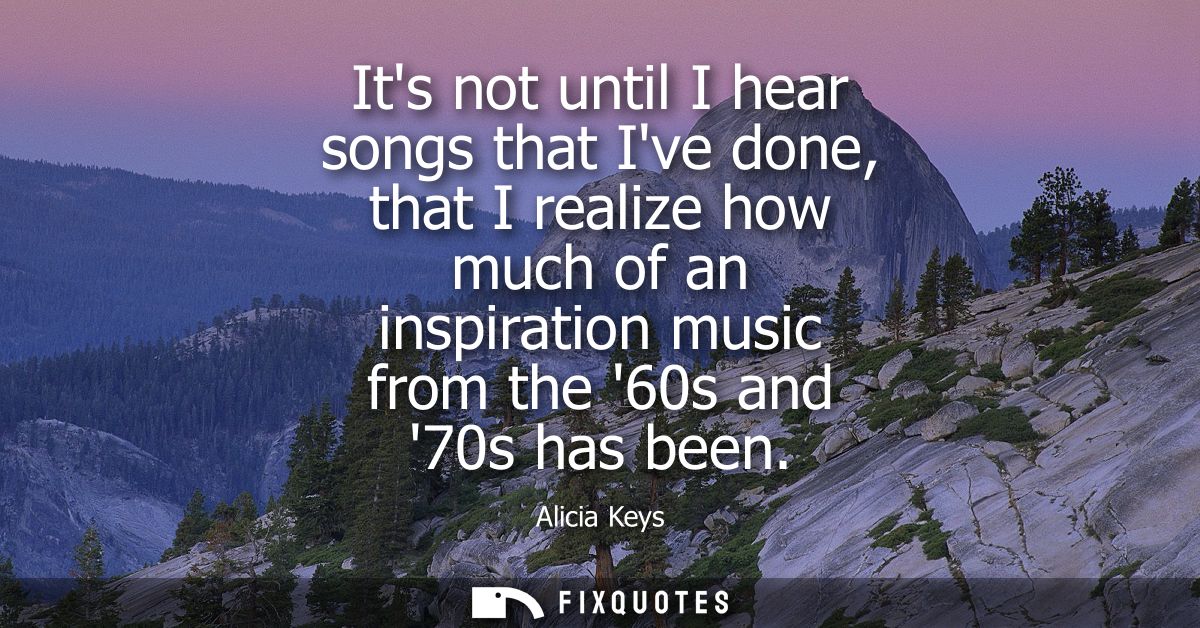
"It's not until I hear songs that I've done, that I realize how much of an inspiration music from the '60s and '70s has been"
About this Quote
The intent is modest on the surface - a respectful nod to the canon - but the subtext is about legitimacy and belonging. Keys is positioning herself as an inheritor of a tradition that’s often treated as sacred: Aretha’s command, Marvin’s intimacy, Stevie’s harmonic generosity, the era when mainstream music could be politically alert and romantically direct without apologizing for either. She’s also quietly describing a common artist’s fear: that originality is a myth you only start believing after you hear your own work echoed back to you.
Contextually, it reads as a defense of continuity in an industry obsessed with novelty. Keys came up in the early 2000s when “retro” was both a compliment and a trap; her brand of classic-minded songwriting could be dismissed as throwback. This line flips that. The influence isn’t cosplay - it’s a baseline, revealed not by intention but by resonance.
Quote Details
| Topic | Music |
|---|---|
| Source | Help us find the source |
| Cite |
Citation Formats
APA Style (7th ed.)
Keys, Alicia. (2026, January 17). It's not until I hear songs that I've done, that I realize how much of an inspiration music from the '60s and '70s has been. FixQuotes. https://fixquotes.com/quotes/its-not-until-i-hear-songs-that-ive-done-that-i-39529/
Chicago Style
Keys, Alicia. "It's not until I hear songs that I've done, that I realize how much of an inspiration music from the '60s and '70s has been." FixQuotes. January 17, 2026. https://fixquotes.com/quotes/its-not-until-i-hear-songs-that-ive-done-that-i-39529/.
MLA Style (9th ed.)
"It's not until I hear songs that I've done, that I realize how much of an inspiration music from the '60s and '70s has been." FixQuotes, 17 Jan. 2026, https://fixquotes.com/quotes/its-not-until-i-hear-songs-that-ive-done-that-i-39529/. Accessed 30 Mar. 2026.