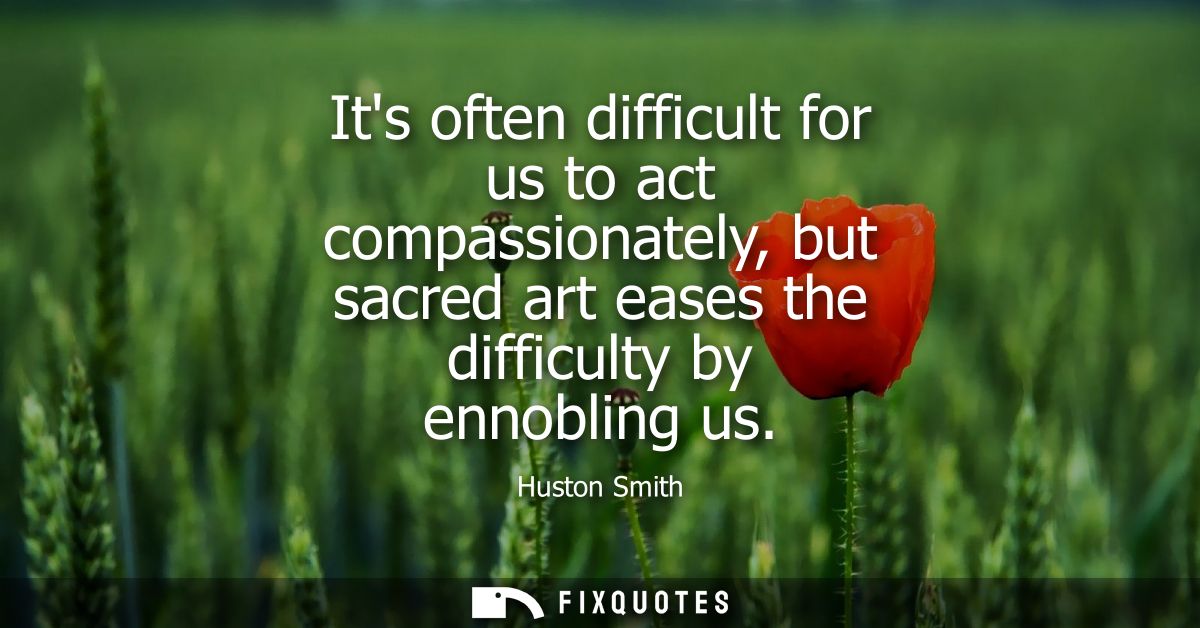
"It's often difficult for us to act compassionately, but sacred art eases the difficulty by ennobling us"
About this Quote
The intent is quietly corrective. Modern culture often casts art as self-expression or entertainment, something that mirrors us back to ourselves. Smith flips that. Sacred art, in his framing, is valuable precisely because it interrupts the self. It “ennobles” by making the viewer briefly inhabit a larger scale of meaning - one in which suffering, dignity, and interdependence are harder to ignore. The subtext is that ethical behavior is not just a matter of better arguments or stronger rules; it’s a matter of formation. We become compassionate not only through sermons and policies, but through repeated encounters with images, music, architecture, and ritual that train attention toward what deserves reverence.
Context matters: Smith spent a career translating religious traditions for a skeptical, late-20th-century audience. This sentence is part bridge, part defense. It suggests that even if you’re allergic to doctrine, the aesthetic dimension of religion still performs a public good. Sacred art “eases the difficulty” because it doesn’t nag; it seduces, elevates, and steadies. It makes decency feel less like compliance and more like aspiration.
Quote Details
| Topic | Kindness |
|---|---|
| Source | Help us find the source |
| Cite |
Citation Formats
APA Style (7th ed.)
Smith, Huston. (2026, January 18). It's often difficult for us to act compassionately, but sacred art eases the difficulty by ennobling us. FixQuotes. https://fixquotes.com/quotes/its-often-difficult-for-us-to-act-compassionately-9469/
Chicago Style
Smith, Huston. "It's often difficult for us to act compassionately, but sacred art eases the difficulty by ennobling us." FixQuotes. January 18, 2026. https://fixquotes.com/quotes/its-often-difficult-for-us-to-act-compassionately-9469/.
MLA Style (9th ed.)
"It's often difficult for us to act compassionately, but sacred art eases the difficulty by ennobling us." FixQuotes, 18 Jan. 2026, https://fixquotes.com/quotes/its-often-difficult-for-us-to-act-compassionately-9469/. Accessed 6 Mar. 2026.