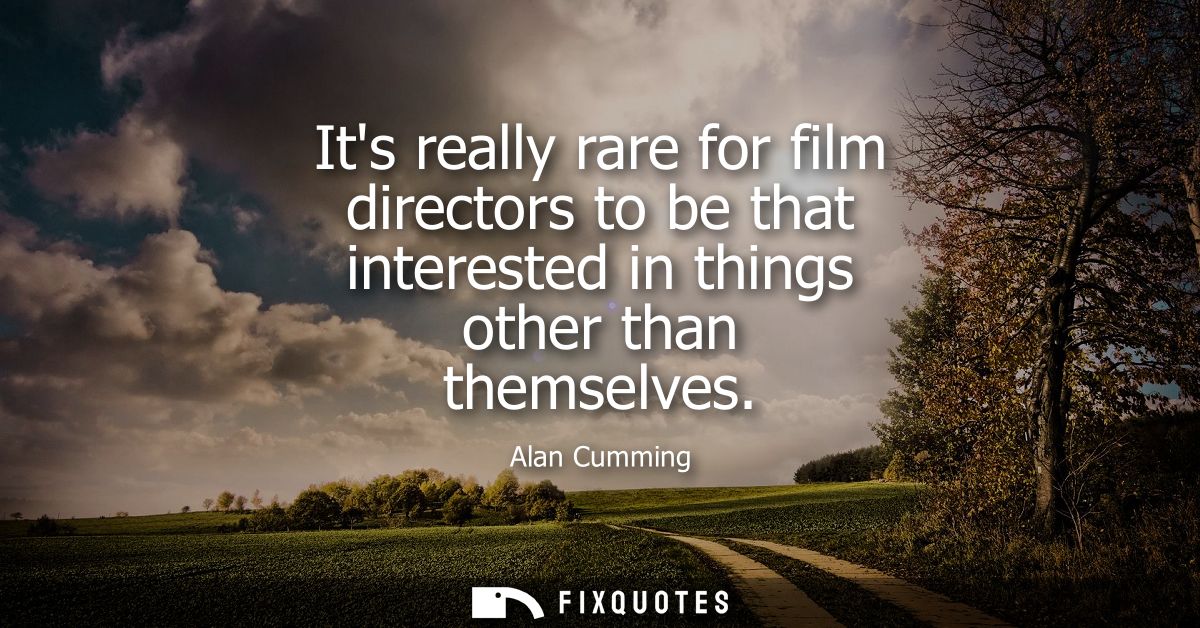
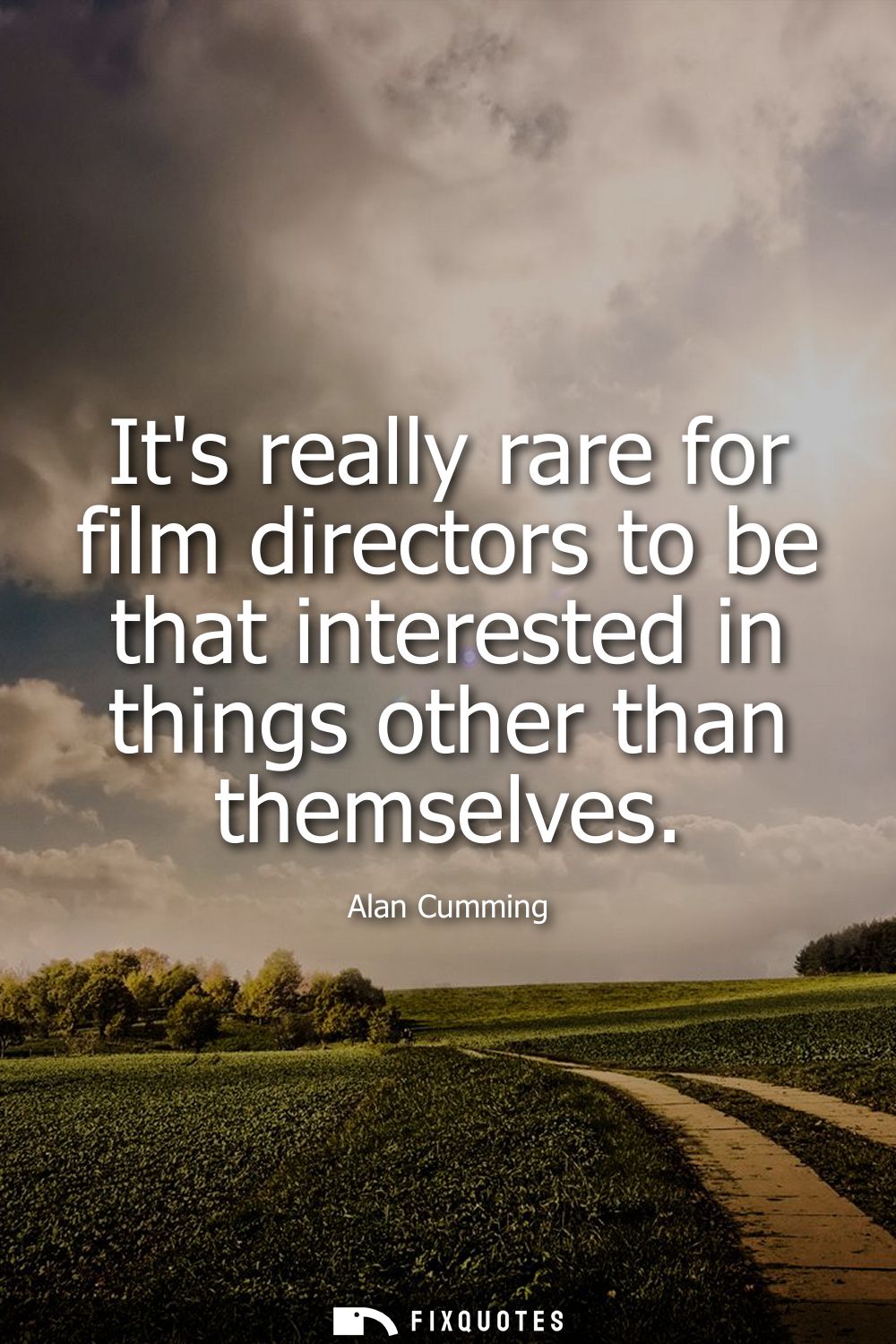
"It's really rare for film directors to be that interested in things other than themselves"
About this Quote
There is bite hiding in Alan Cumming's offhand phrasing: the little shrug of "really rare" lands like an industry diagnosis. As an actor, he’s speaking from the receiving end of the camera, where a director’s curiosity can feel less like a personality trait and more like a working condition. The line isn’t a cheap dunk on auteurs; it’s an inventory of incentives. Film culture still trains directors to treat the set as a kingdom, the movie as a signature, the world as raw material to be bent into a personal vision. In that ecosystem, being interested in other people - their interior lives, their rhythms, their uncertainty - becomes optional, even inefficient.
Cumming’s intent is also quietly strategic: he’s praising the exception by indicting the norm. The remark flatters the rare director who looks up from their own mythology long enough to see collaborators as more than replaceable instruments. Subtextually, it points to the power imbalance baked into filmmaking. Actors are asked to be porous, emotionally available, improvisational; directors are rewarded for certainty, control, and a brand of ego that reads as "leadership". When those traits curdle into self-absorption, everyone else gets reduced to a deliverable.
Context matters: Cumming came up across theater, film, and TV, spaces with different power dynamics. Theater often forces mutual attention; screen work can isolate, with hierarchy enforced by budgets and schedules. His line is a reminder that the best directing isn’t just taste - it’s empathy operationalized, the ability to make a room full of people feel seen while you’re asking them to perform.
Cumming’s intent is also quietly strategic: he’s praising the exception by indicting the norm. The remark flatters the rare director who looks up from their own mythology long enough to see collaborators as more than replaceable instruments. Subtextually, it points to the power imbalance baked into filmmaking. Actors are asked to be porous, emotionally available, improvisational; directors are rewarded for certainty, control, and a brand of ego that reads as "leadership". When those traits curdle into self-absorption, everyone else gets reduced to a deliverable.
Context matters: Cumming came up across theater, film, and TV, spaces with different power dynamics. Theater often forces mutual attention; screen work can isolate, with hierarchy enforced by budgets and schedules. His line is a reminder that the best directing isn’t just taste - it’s empathy operationalized, the ability to make a room full of people feel seen while you’re asking them to perform.
Quote Details
| Topic | Movie |
|---|
More Quotes by Alan
Add to List