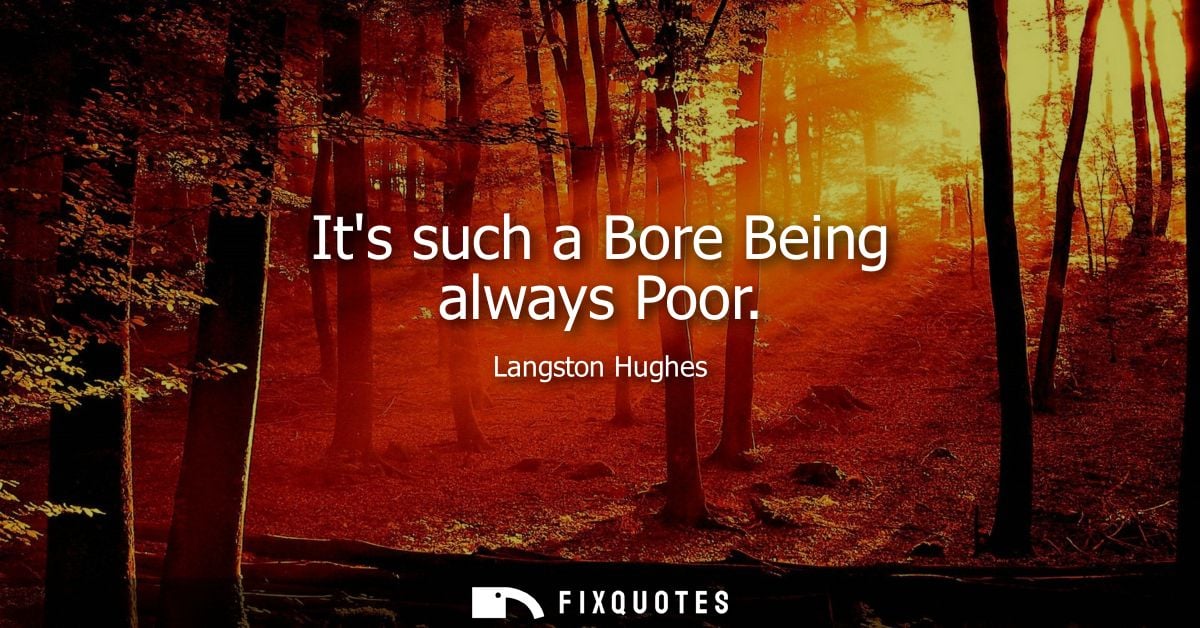
"It's such a bore being always poor"
About this Quote
A complaint that doubles as a trap: you nod at the plainspoken misery, then realize Hughes has smuggled an indictment of the entire system into a single, almost sing-song line. "Bore" is the key word. Poverty isn’t framed as tragedy or noble suffering; it’s monotonous, grinding, repetitive. Hughes deflates the sentimental theater that American culture often builds around hardship. Being poor isn’t ennobling. It’s tedious. It eats time, imagination, and attention until even your pain starts to feel like stale air.
That choice of diction also hints at performance. "It’s such a bore" sounds like the language of the blasé or privileged, the sort of person allowed to be lightly irritated by life. Hughes twists that voice into something acid: the poor are denied comfort, yet they’re also denied the luxury of melodrama. What’s left is an everyday, humiliating persistence - always poor - where the repetition is its own sentence.
Context matters. Hughes wrote inside the Harlem Renaissance and its aftermath, when Black artistry was marketed as cultural novelty even as Black communities were boxed in by low wages, discrimination, and the looming shocks of economic downturn. The line reads like a refusal to be made "inspirational". It insists on material reality, not uplift, not bootstrap myth, not the polite distance of sympathy. The emotional charge comes from how quickly it moves: a shrug that is also a protest, a joke with teeth, boredom as a political diagnosis.
That choice of diction also hints at performance. "It’s such a bore" sounds like the language of the blasé or privileged, the sort of person allowed to be lightly irritated by life. Hughes twists that voice into something acid: the poor are denied comfort, yet they’re also denied the luxury of melodrama. What’s left is an everyday, humiliating persistence - always poor - where the repetition is its own sentence.
Context matters. Hughes wrote inside the Harlem Renaissance and its aftermath, when Black artistry was marketed as cultural novelty even as Black communities were boxed in by low wages, discrimination, and the looming shocks of economic downturn. The line reads like a refusal to be made "inspirational". It insists on material reality, not uplift, not bootstrap myth, not the polite distance of sympathy. The emotional charge comes from how quickly it moves: a shrug that is also a protest, a joke with teeth, boredom as a political diagnosis.
Quote Details
| Topic | Money |
|---|---|
| Source | Help us find the source |
| Cite |
Citation Formats
APA Style (7th ed.)
Hughes, Langston. (2026, February 16). It's such a bore being always poor. FixQuotes. https://fixquotes.com/quotes/its-such-a-bore-being-always-poor-32426/
Chicago Style
Hughes, Langston. "It's such a bore being always poor." FixQuotes. February 16, 2026. https://fixquotes.com/quotes/its-such-a-bore-being-always-poor-32426/.
MLA Style (9th ed.)
"It's such a bore being always poor." FixQuotes, 16 Feb. 2026, https://fixquotes.com/quotes/its-such-a-bore-being-always-poor-32426/. Accessed 26 Mar. 2026.
More Quotes by Langston
Add to List