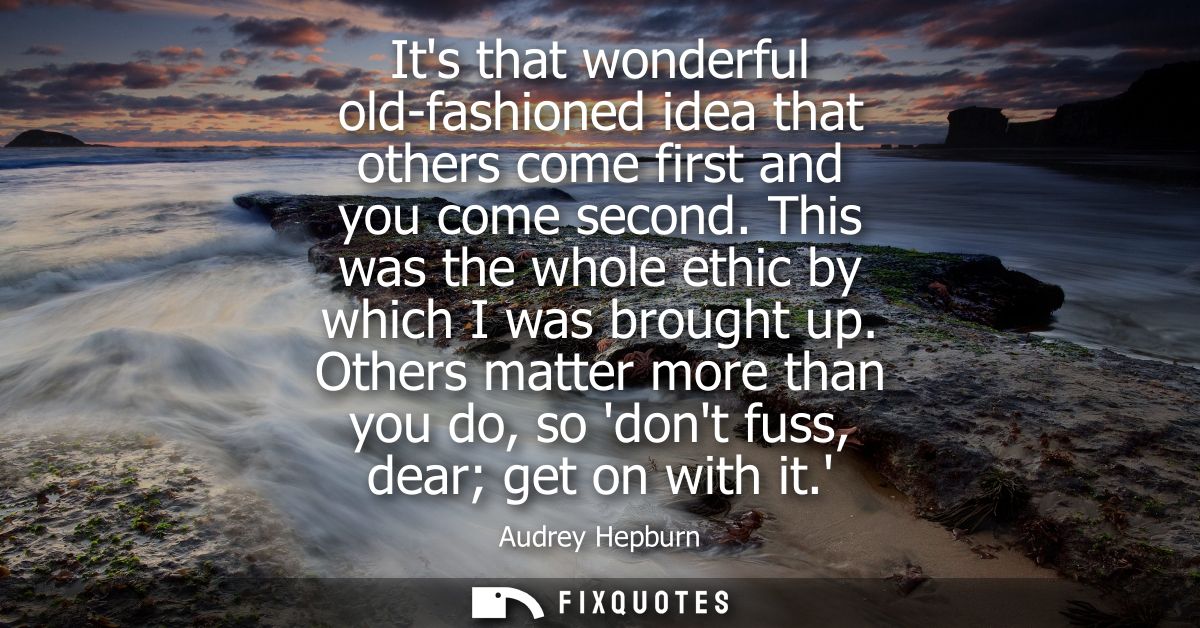
"It's that wonderful old-fashioned idea that others come first and you come second. This was the whole ethic by which I was brought up. Others matter more than you do, so 'don't fuss, dear; get on with it.'"
About this Quote
Context matters because Hepburn’s life straddled catastrophe and spectacle. She grew up during Nazi-occupied Holland, where endurance wasn’t a lifestyle choice but a survival skill. Later, she entered an industry that rewarded women for being pleasing, uncomplaining, and small in the social sense even when they were enormous on screen. The quote reads like a survival strategy that became a brand: the stoic, considerate woman who makes everyone else comfortable.
What makes it work is its double address. On one level it’s personal testimony, the kind that polishes a public persona. On another, it’s an instruction manual for a particular class and gender coding of virtue: selflessness as etiquette. There’s nobility here, but also a warning label. “Others first” can be compassion; it can also be a script that teaches you to minimize your own needs until they vanish. Hepburn’s genius is how lightly she lets that paradox land.
Quote Details
| Topic | Humility |
|---|---|
| Source | Help us find the source |
| Cite |
Citation Formats
APA Style (7th ed.)
Hepburn, Audrey. (2026, January 18). It's that wonderful old-fashioned idea that others come first and you come second. This was the whole ethic by which I was brought up. Others matter more than you do, so 'don't fuss, dear; get on with it.'. FixQuotes. https://fixquotes.com/quotes/its-that-wonderful-old-fashioned-idea-that-others-4434/
Chicago Style
Hepburn, Audrey. "It's that wonderful old-fashioned idea that others come first and you come second. This was the whole ethic by which I was brought up. Others matter more than you do, so 'don't fuss, dear; get on with it.'." FixQuotes. January 18, 2026. https://fixquotes.com/quotes/its-that-wonderful-old-fashioned-idea-that-others-4434/.
MLA Style (9th ed.)
"It's that wonderful old-fashioned idea that others come first and you come second. This was the whole ethic by which I was brought up. Others matter more than you do, so 'don't fuss, dear; get on with it.'." FixQuotes, 18 Jan. 2026, https://fixquotes.com/quotes/its-that-wonderful-old-fashioned-idea-that-others-4434/. Accessed 26 Mar. 2026.