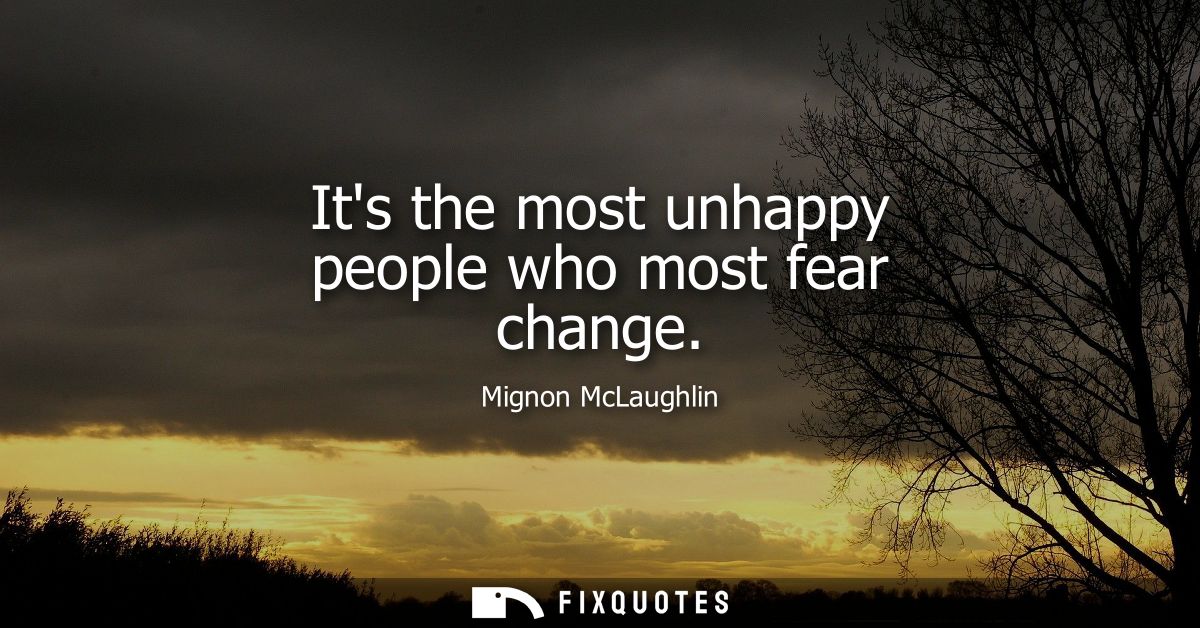
"It's the most unhappy people who most fear change"
About this Quote
Misery has a way of disguising itself as caution. McLaughlin’s line skewers the common fantasy that the people most desperate for improvement will naturally be the first to embrace it. Instead, she points to a darker psychology: unhappiness isn’t just pain, it’s a system you learn to manage. If your life already feels precarious, change doesn’t look like possibility; it looks like one more variable you can’t control.
The intent here is less self-help than social X-ray. McLaughlin, a journalist with a knack for compact provocation, frames fear of change as an emotional investment. The unhappy often cling to routines not because they love them, but because routine is legible. Even disappointment can become familiar territory, a grim kind of competence. The subtext is that despair is conservative: it hoards what it knows. When you have little faith in outcomes, you choose the devil you’ve already met.
There’s also a quiet indictment of how we talk about “resistance.” We like to attribute pushback to ignorance, stubbornness, or malice. McLaughlin suggests it can be a symptom of exhaustion and learned defeat. That reorients blame: the problem isn’t that unhappy people are irrational; it’s that they’re rational within a world that’s taught them hope is expensive.
Contextually, coming from a mid-century American columnist, the line reads as both personal and civic. It fits a culture that sold change as progress while many experienced it as disruption. McLaughlin captures the private cost behind public paralysis.
The intent here is less self-help than social X-ray. McLaughlin, a journalist with a knack for compact provocation, frames fear of change as an emotional investment. The unhappy often cling to routines not because they love them, but because routine is legible. Even disappointment can become familiar territory, a grim kind of competence. The subtext is that despair is conservative: it hoards what it knows. When you have little faith in outcomes, you choose the devil you’ve already met.
There’s also a quiet indictment of how we talk about “resistance.” We like to attribute pushback to ignorance, stubbornness, or malice. McLaughlin suggests it can be a symptom of exhaustion and learned defeat. That reorients blame: the problem isn’t that unhappy people are irrational; it’s that they’re rational within a world that’s taught them hope is expensive.
Contextually, coming from a mid-century American columnist, the line reads as both personal and civic. It fits a culture that sold change as progress while many experienced it as disruption. McLaughlin captures the private cost behind public paralysis.
Quote Details
| Topic | Change |
|---|---|
| Source | Help us find the source |
| Cite | Cite this Quote |
Citation Formats
APA Style (7th ed.)
McLaughlin, Mignon. (n.d.). It's the most unhappy people who most fear change. FixQuotes. https://fixquotes.com/quotes/its-the-most-unhappy-people-who-most-fear-change-70055/
Chicago Style
McLaughlin, Mignon. "It's the most unhappy people who most fear change." FixQuotes. Accessed February 2, 2026. https://fixquotes.com/quotes/its-the-most-unhappy-people-who-most-fear-change-70055/.
MLA Style (9th ed.)
"It's the most unhappy people who most fear change." FixQuotes, https://fixquotes.com/quotes/its-the-most-unhappy-people-who-most-fear-change-70055/. Accessed 2 Feb. 2026.
More Quotes by Mignon
Add to List