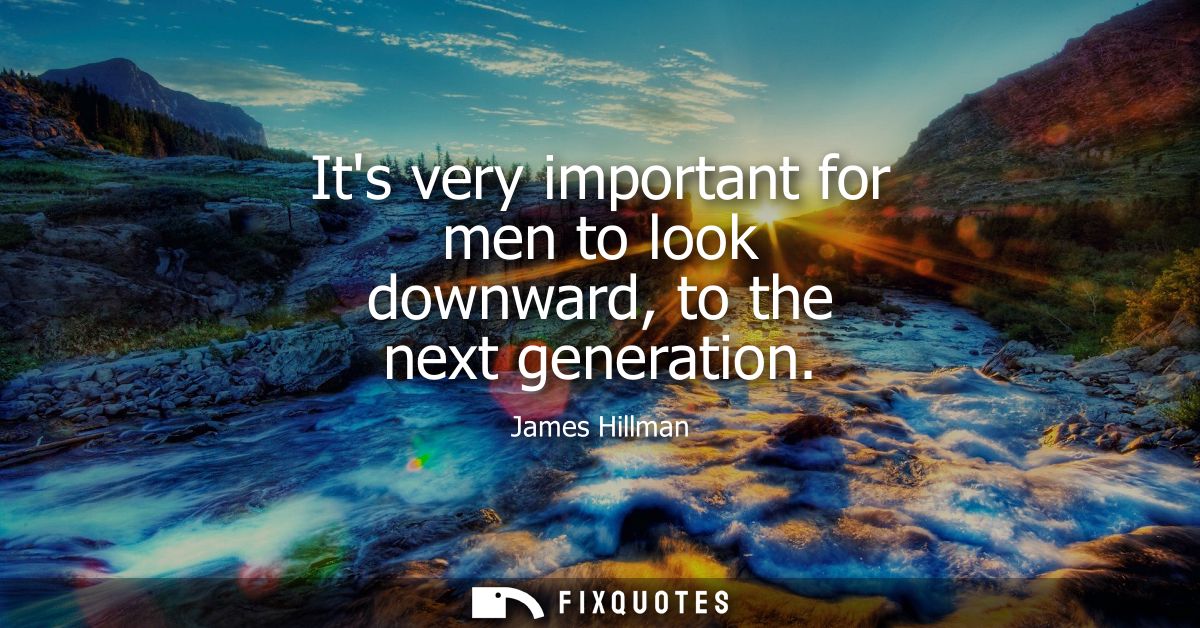
"It's very important for men to look downward, to the next generation"
About this Quote
A deceptively simple directive, Hillman smuggles an entire ethical program into the phrase "look downward". The wording refuses the heroic, self-mythologizing masculinity that looks upward: toward status, transcendence, legacy-as-trophy. "Downward" is earthy, gravitational, even humbling. It hints at rootedness over aspiration, stewardship over conquest. Coming from a psychologist who spent his career pushing against ego-driven narratives, the line reads like a rebuke to the modern male fantasy of escape: from dependency, from limits, from time.
The specific intent is corrective. Hillman is talking to men who have been trained to measure life vertically - promotions, conquests, mastery - and telling them the real test is relational and temporal. "The next generation" is the pivot: not children as extensions of the self, but as future citizens whose inner lives will be shaped by what adults model now. The subtext is that male power, left un-aimed, defaults to self-reference. Hillman aims it at continuity.
Context matters. Hillman emerged from (and often critiqued) mid-century psychology, where the "inner child" and self-actualization became dominant idioms. His twist is to reroute psychic attention away from self-improvement and toward intergenerational responsibility. Read alongside late-20th-century anxieties about absent fathers, cultural drift, and the thinning of civic institutions, the quote functions as a quiet indictment: men have been encouraged to chase adulthood as personal achievement, not as caretaking.
Even the gentleness is strategic. He doesn't say "control" or "lead" the next generation; he says "look" - an insistence on attention before authority.
The specific intent is corrective. Hillman is talking to men who have been trained to measure life vertically - promotions, conquests, mastery - and telling them the real test is relational and temporal. "The next generation" is the pivot: not children as extensions of the self, but as future citizens whose inner lives will be shaped by what adults model now. The subtext is that male power, left un-aimed, defaults to self-reference. Hillman aims it at continuity.
Context matters. Hillman emerged from (and often critiqued) mid-century psychology, where the "inner child" and self-actualization became dominant idioms. His twist is to reroute psychic attention away from self-improvement and toward intergenerational responsibility. Read alongside late-20th-century anxieties about absent fathers, cultural drift, and the thinning of civic institutions, the quote functions as a quiet indictment: men have been encouraged to chase adulthood as personal achievement, not as caretaking.
Even the gentleness is strategic. He doesn't say "control" or "lead" the next generation; he says "look" - an insistence on attention before authority.
Quote Details
| Topic | Legacy & Remembrance |
|---|---|
| Source | Help us find the source |
| Cite |
Citation Formats
APA Style (7th ed.)
Hillman, James. (2026, January 15). It's very important for men to look downward, to the next generation. FixQuotes. https://fixquotes.com/quotes/its-very-important-for-men-to-look-downward-to-149223/
Chicago Style
Hillman, James. "It's very important for men to look downward, to the next generation." FixQuotes. January 15, 2026. https://fixquotes.com/quotes/its-very-important-for-men-to-look-downward-to-149223/.
MLA Style (9th ed.)
"It's very important for men to look downward, to the next generation." FixQuotes, 15 Jan. 2026, https://fixquotes.com/quotes/its-very-important-for-men-to-look-downward-to-149223/. Accessed 2 Apr. 2026.
More Quotes by James
Add to List