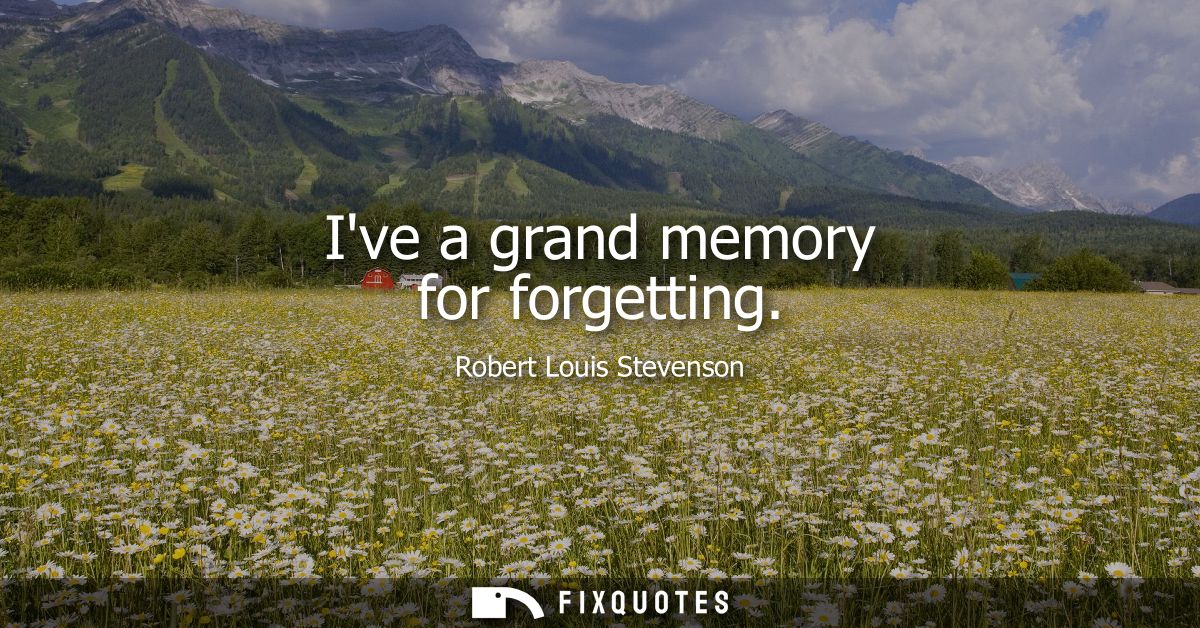
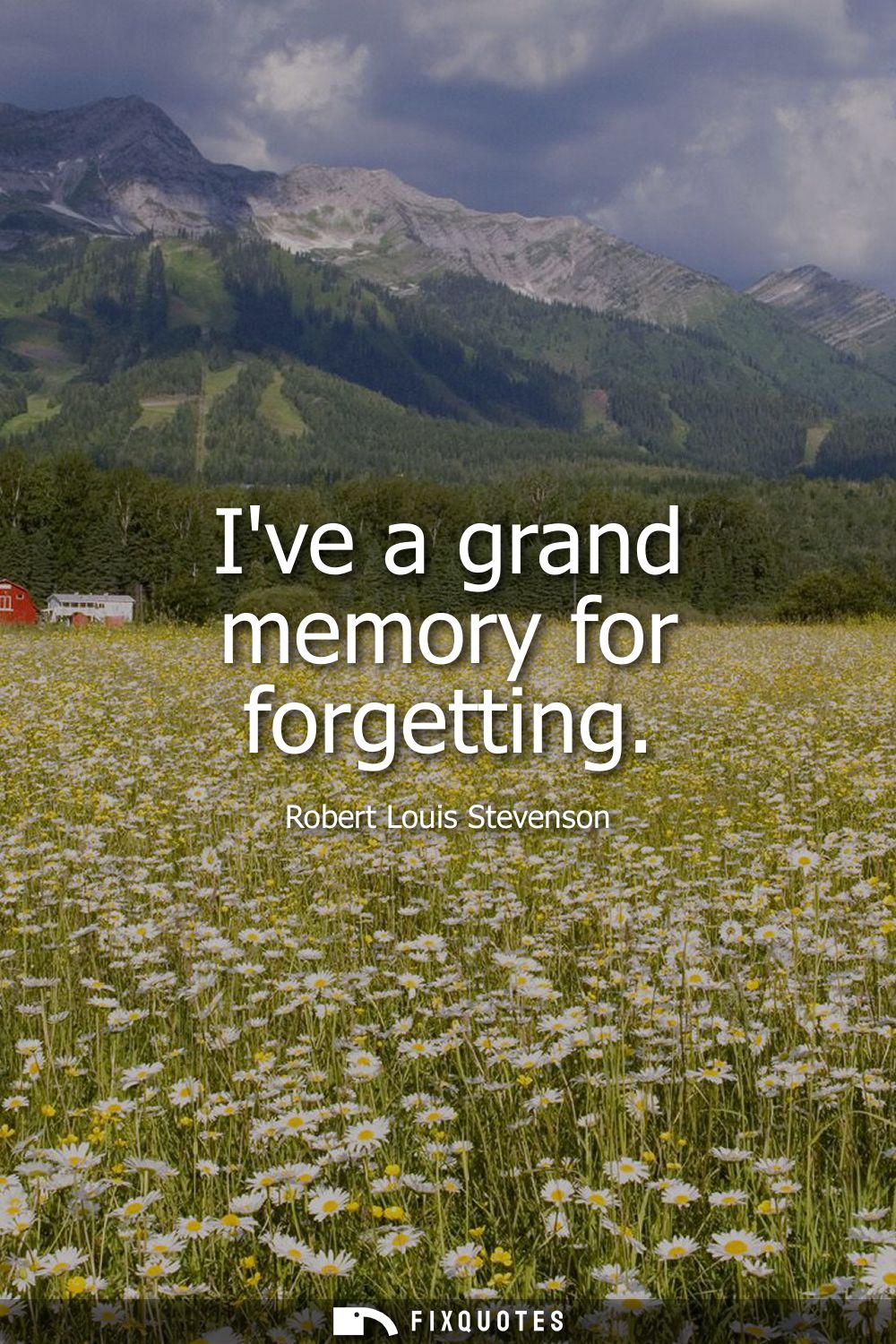
"I've a grand memory for forgetting"
About this Quote
A “grand memory” is supposed to be an asset; Stevenson flips it into a talent for erasure. The line works because it borrows the bragging posture of self-improvement culture before there was a self-help aisle, then undercuts it with a confession that sounds both breezy and faintly guilty. Forgetting becomes a skill, almost an accomplishment, and that double move lets the speaker dodge responsibility while still sounding charming. It’s wit with a pressure valve.
Stevenson’s subtext is less about senility than self-preservation. To claim a “memory for forgetting” is to admit that life is full of material you’d rather not carry: slights, embarrassments, old loyalties, the obligations that accumulate when you remember too well. The phrase hints at selective amnesia as social strategy: you can keep moving, keep reinventing, keep the tone light, as long as you can misplace the inconvenient facts.
Context matters. Stevenson lived with chronic illness and spent much of his adult life in motion, crossing oceans and climates in search of air that would let him breathe. That biography makes forgetting read like a survival tactic, not just a punchline: when the body is fragile and the horizon keeps changing, dwelling can become its own kind of weight. As a writer of adventure and doubleness (Treasure Island, Jekyll and Hyde), he also knew how identity depends on what you edit out. The line’s charm is its moral ambiguity: it’s either an elegant refusal to nurse grudges, or a neat way to evade them. It’s probably both, which is why it lands.
Stevenson’s subtext is less about senility than self-preservation. To claim a “memory for forgetting” is to admit that life is full of material you’d rather not carry: slights, embarrassments, old loyalties, the obligations that accumulate when you remember too well. The phrase hints at selective amnesia as social strategy: you can keep moving, keep reinventing, keep the tone light, as long as you can misplace the inconvenient facts.
Context matters. Stevenson lived with chronic illness and spent much of his adult life in motion, crossing oceans and climates in search of air that would let him breathe. That biography makes forgetting read like a survival tactic, not just a punchline: when the body is fragile and the horizon keeps changing, dwelling can become its own kind of weight. As a writer of adventure and doubleness (Treasure Island, Jekyll and Hyde), he also knew how identity depends on what you edit out. The line’s charm is its moral ambiguity: it’s either an elegant refusal to nurse grudges, or a neat way to evade them. It’s probably both, which is why it lands.
Quote Details
| Topic | Witty One-Liners |
|---|---|
| Source | Help us find the source |
| Cite |
Citation Formats
APA Style (7th ed.)
Stevenson, Robert Louis. (2026, January 18). I've a grand memory for forgetting. FixQuotes. https://fixquotes.com/quotes/ive-a-grand-memory-for-forgetting-20823/
Chicago Style
Stevenson, Robert Louis. "I've a grand memory for forgetting." FixQuotes. January 18, 2026. https://fixquotes.com/quotes/ive-a-grand-memory-for-forgetting-20823/.
MLA Style (9th ed.)
"I've a grand memory for forgetting." FixQuotes, 18 Jan. 2026, https://fixquotes.com/quotes/ive-a-grand-memory-for-forgetting-20823/. Accessed 12 Feb. 2026.
More Quotes by Robert
Add to List