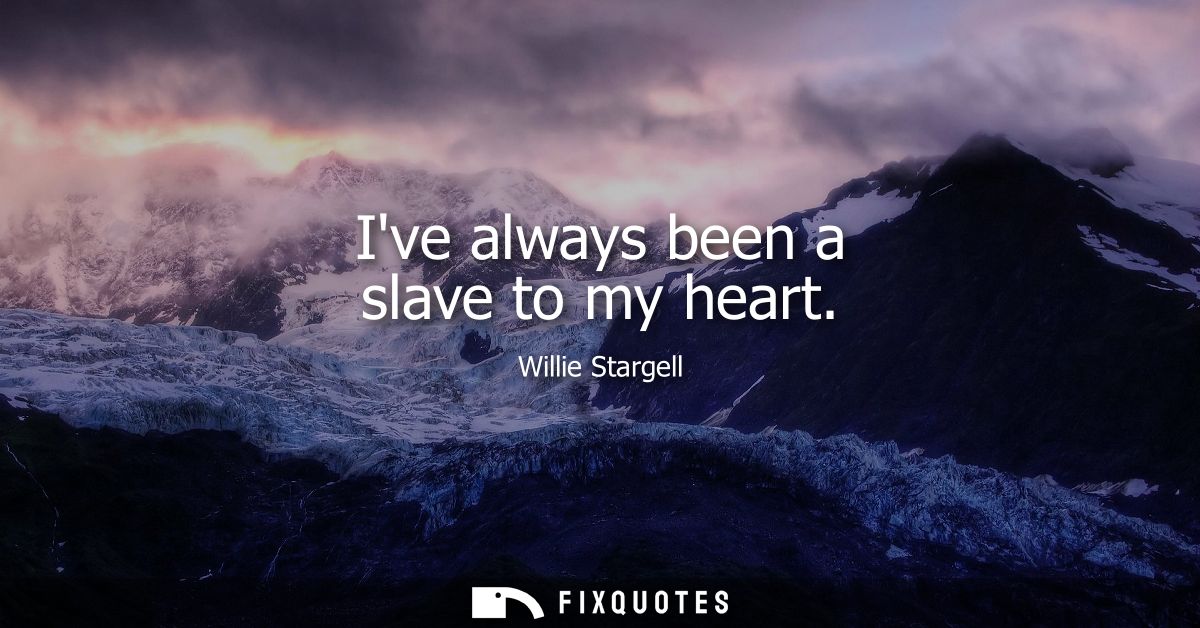
"I've always been a slave to my heart"
About this Quote
"I've always been a slave to my heart" lands like a confession from someone the public trained to be unshakeable. Coming from Willie Stargell - the Pirates' towering "Pops", a clubhouse father figure, a star whose job was literally to keep his head when the pitch came in hard - it flips the expected athlete script. Instead of discipline, strategy, and stoicism, he admits to being governed by feeling. The word "slave" is doing the heavy lifting: it's not romantic surrender so much as a frank acknowledgment of compulsion, the way emotion can overrule the clean logic that sports mythology pretends runs the world.
Stargell's era amplifies the subtext. A Black superstar in 1970s America, he carried more than batting averages: expectations about leadership, respectability, and how much vulnerability a man was allowed. His public persona was warmth and authority; this line hints that the warmth wasn't a brand, it was a cost. To be "Pops" is to give more than you take, to lead with empathy even when it drains you.
The phrase also reads like an athlete's private explanation for choices fans second-guess: playing through pain, trusting teammates, staying loyal, taking criticism personally. It's a quiet rebuke to the idea that greatness is purely willpower. Stargell suggests the engine is messier: devotion, pride, fear, love - the stuff that can't be coached, only survived.
Stargell's era amplifies the subtext. A Black superstar in 1970s America, he carried more than batting averages: expectations about leadership, respectability, and how much vulnerability a man was allowed. His public persona was warmth and authority; this line hints that the warmth wasn't a brand, it was a cost. To be "Pops" is to give more than you take, to lead with empathy even when it drains you.
The phrase also reads like an athlete's private explanation for choices fans second-guess: playing through pain, trusting teammates, staying loyal, taking criticism personally. It's a quiet rebuke to the idea that greatness is purely willpower. Stargell suggests the engine is messier: devotion, pride, fear, love - the stuff that can't be coached, only survived.
Quote Details
| Topic | Love |
|---|---|
| Source | Help us find the source |
| Cite |
Citation Formats
APA Style (7th ed.)
Stargell, Willie. (2026, January 16). I've always been a slave to my heart. FixQuotes. https://fixquotes.com/quotes/ive-always-been-a-slave-to-my-heart-122216/
Chicago Style
Stargell, Willie. "I've always been a slave to my heart." FixQuotes. January 16, 2026. https://fixquotes.com/quotes/ive-always-been-a-slave-to-my-heart-122216/.
MLA Style (9th ed.)
"I've always been a slave to my heart." FixQuotes, 16 Jan. 2026, https://fixquotes.com/quotes/ive-always-been-a-slave-to-my-heart-122216/. Accessed 12 Feb. 2026.
More Quotes by Willie
Add to List