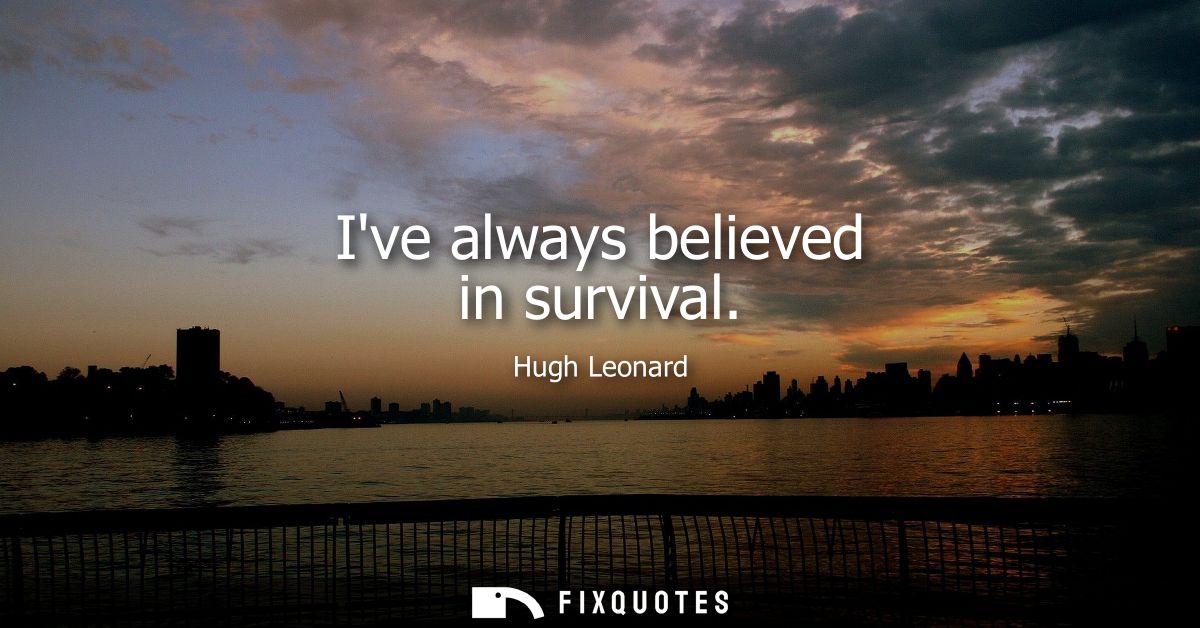
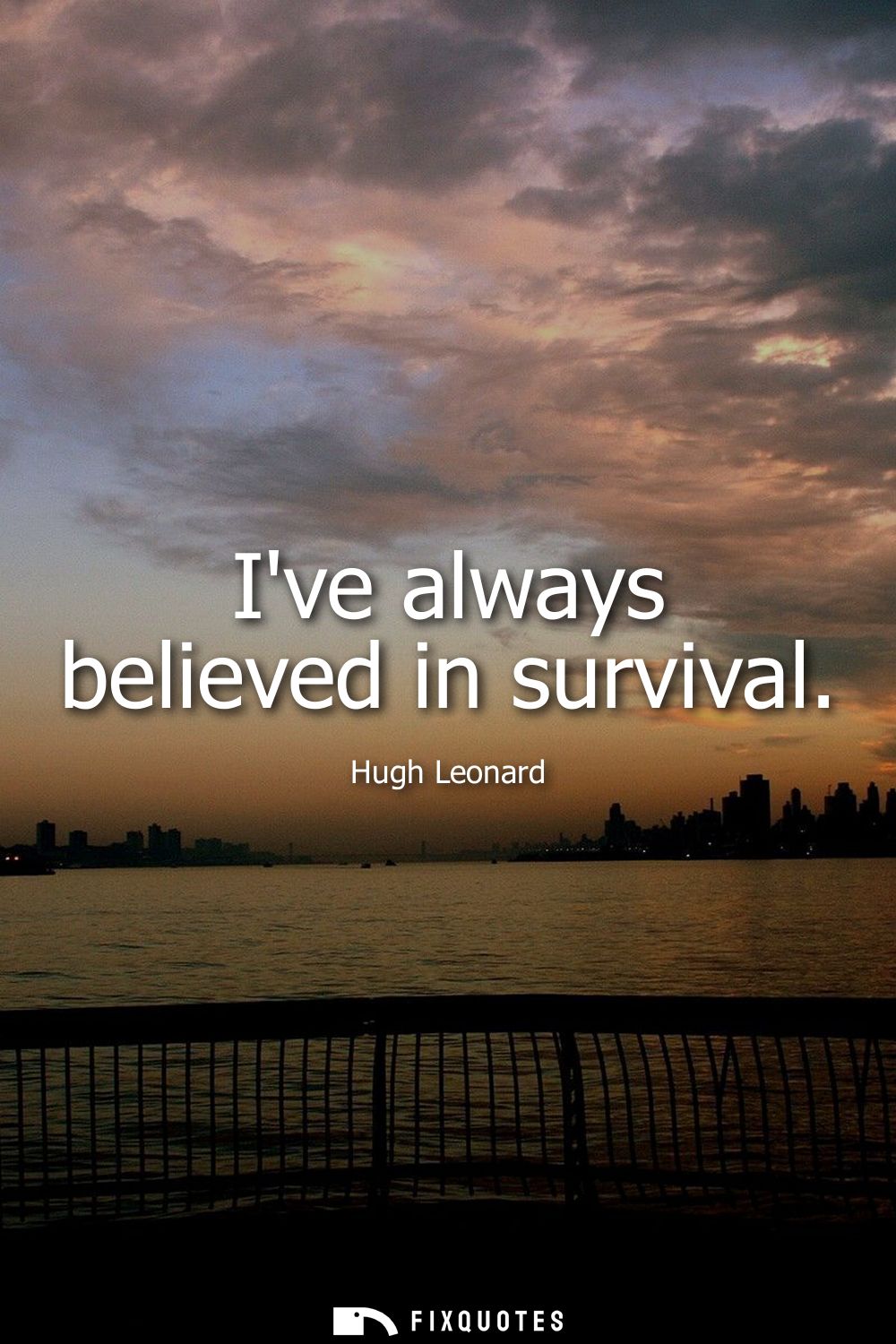
"I've always believed in survival"
About this Quote
Survival is a deceptively modest word for a dramatist to swear by. In Hugh Leonard's mouth it reads less like a macho creed than a stage direction: keep going, keep talking, keep the story moving even when dignity, certainty, or comfort have exited the scene. Coming from an Irish playwright formed in the aftershocks of poverty, clerical authority, and a national culture that prized endurance as a kind of virtue, the line lands with a cool, pragmatic bite. It suggests a worldview where ideals are negotiable but staying upright is nonnegotiable.
The subtext is also theatrical. Drama is built on characters who think they want love, justice, redemption; what they often need is simply to last long enough to see what those words actually cost. "I've always believed" signals not a revelation but a habit, almost a defensive reflex. Belief here isn't spiritual; it's operational. It's the faith of someone who's watched institutions fail and still expects tomorrow to show up demanding rent.
There is a faint, telling irony in the simplicity. Artists are supposed to "believe in" beauty or truth. Leonard chooses the baseline. That choice quietly rebukes romantic narratives of suffering-as-glory: survival isn't poetic, it's persistent. It can mean compromise, humor as camouflage, family myths patched together so they hold. In that sense the quote functions like Leonard's plays often do: a small, plain sentence that smuggles in an entire social history of making do.
The subtext is also theatrical. Drama is built on characters who think they want love, justice, redemption; what they often need is simply to last long enough to see what those words actually cost. "I've always believed" signals not a revelation but a habit, almost a defensive reflex. Belief here isn't spiritual; it's operational. It's the faith of someone who's watched institutions fail and still expects tomorrow to show up demanding rent.
There is a faint, telling irony in the simplicity. Artists are supposed to "believe in" beauty or truth. Leonard chooses the baseline. That choice quietly rebukes romantic narratives of suffering-as-glory: survival isn't poetic, it's persistent. It can mean compromise, humor as camouflage, family myths patched together so they hold. In that sense the quote functions like Leonard's plays often do: a small, plain sentence that smuggles in an entire social history of making do.
Quote Details
| Topic | Resilience |
|---|---|
| Source | Help us find the source |
| Cite |
Citation Formats
APA Style (7th ed.)
Leonard, Hugh. (2026, January 17). I've always believed in survival. FixQuotes. https://fixquotes.com/quotes/ive-always-believed-in-survival-27000/
Chicago Style
Leonard, Hugh. "I've always believed in survival." FixQuotes. January 17, 2026. https://fixquotes.com/quotes/ive-always-believed-in-survival-27000/.
MLA Style (9th ed.)
"I've always believed in survival." FixQuotes, 17 Jan. 2026, https://fixquotes.com/quotes/ive-always-believed-in-survival-27000/. Accessed 4 Apr. 2026.
More Quotes by Hugh
Add to List