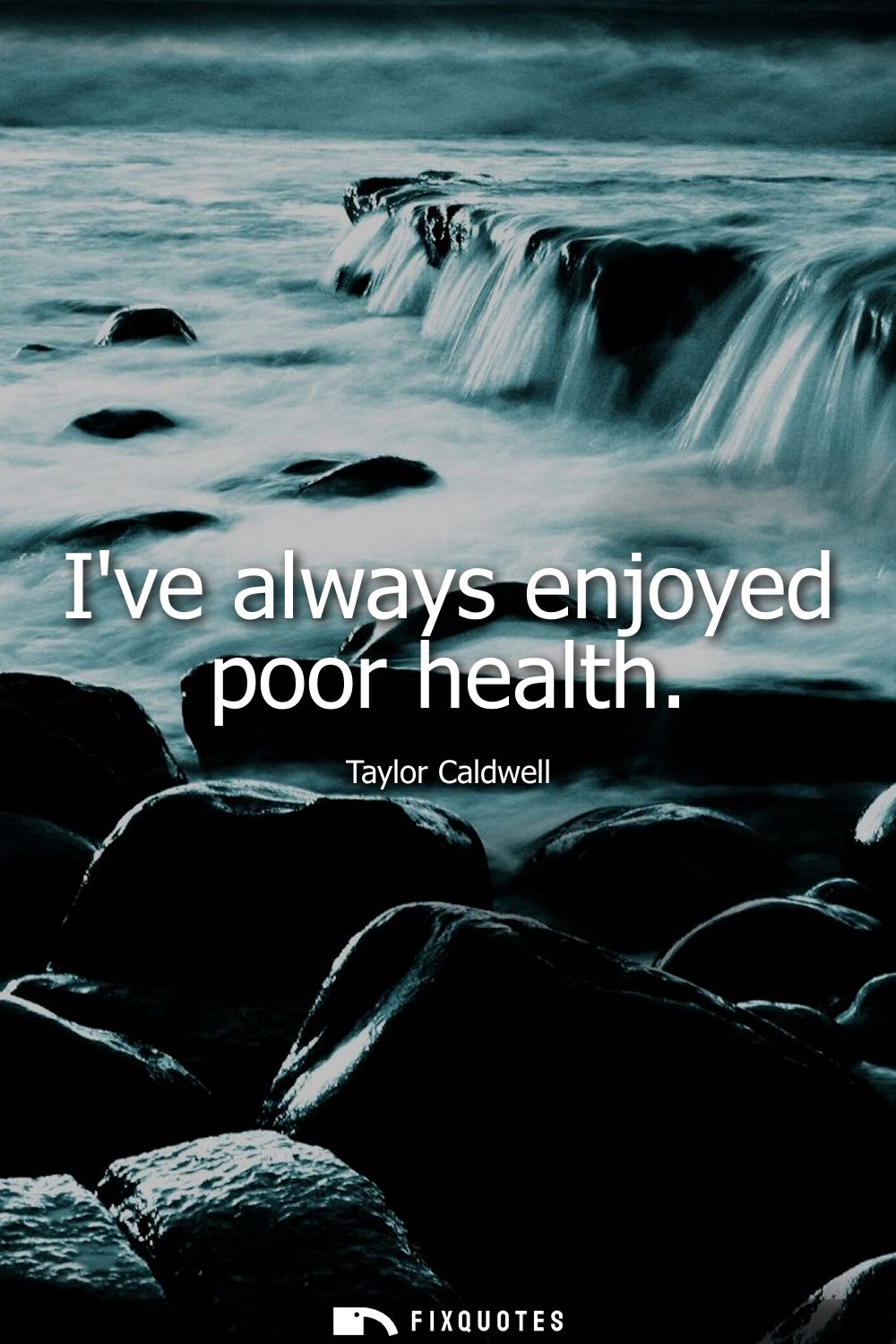
"I've always enjoyed poor health"
About this Quote
A line like "I've always enjoyed poor health" lands because it refuses the moral script we expect around suffering. Caldwell flips the usual confession - illness as burden, stoicism as virtue - into a perverse preference. The phrasing is breezy, almost cocktail-party light, which is exactly the point: she treats a socially sanctioned tragedy as a lifestyle choice. That mismatch generates the bite.
The intent reads less like literal masochism than control. If your body is going to betray you, you can at least own the story it tells. "Enjoyed" is a small act of defiance against pity, unsolicited advice, and the sentimental idea that the sick must be noble. It also slyly indicts the cultural economy around illness: attention, permission to opt out, a ready-made alibi. Poor health can become a passkey to solitude and work, especially for a writer whose currency is time and interiority. Caldwell, a prolific novelist who lived through eras when women's ambition was routinely softened or scolded, hints at how infirmity can function as cover for intensity: you aren't driven, you're unwell.
Subtextually, the joke contains a darker truth about identity. When illness is chronic, it can stop being an interruption and start being the baseline - familiar, even comforting in its predictability. Caldwell's wit compresses that adaptation into one elegant provocation. It's not romanticizing pain; it's exposing how people survive it: by rebranding misfortune as preference, and turning vulnerability into a kind of authorship.
The intent reads less like literal masochism than control. If your body is going to betray you, you can at least own the story it tells. "Enjoyed" is a small act of defiance against pity, unsolicited advice, and the sentimental idea that the sick must be noble. It also slyly indicts the cultural economy around illness: attention, permission to opt out, a ready-made alibi. Poor health can become a passkey to solitude and work, especially for a writer whose currency is time and interiority. Caldwell, a prolific novelist who lived through eras when women's ambition was routinely softened or scolded, hints at how infirmity can function as cover for intensity: you aren't driven, you're unwell.
Subtextually, the joke contains a darker truth about identity. When illness is chronic, it can stop being an interruption and start being the baseline - familiar, even comforting in its predictability. Caldwell's wit compresses that adaptation into one elegant provocation. It's not romanticizing pain; it's exposing how people survive it: by rebranding misfortune as preference, and turning vulnerability into a kind of authorship.
Quote Details
| Topic | Witty One-Liners |
|---|---|
| Source | Help us find the source |
| Cite |
Citation Formats
APA Style (7th ed.)
Caldwell, Taylor. (2026, January 14). I've always enjoyed poor health. FixQuotes. https://fixquotes.com/quotes/ive-always-enjoyed-poor-health-102523/
Chicago Style
Caldwell, Taylor. "I've always enjoyed poor health." FixQuotes. January 14, 2026. https://fixquotes.com/quotes/ive-always-enjoyed-poor-health-102523/.
MLA Style (9th ed.)
"I've always enjoyed poor health." FixQuotes, 14 Jan. 2026, https://fixquotes.com/quotes/ive-always-enjoyed-poor-health-102523/. Accessed 21 Mar. 2026.
More Quotes by Taylor
Add to List