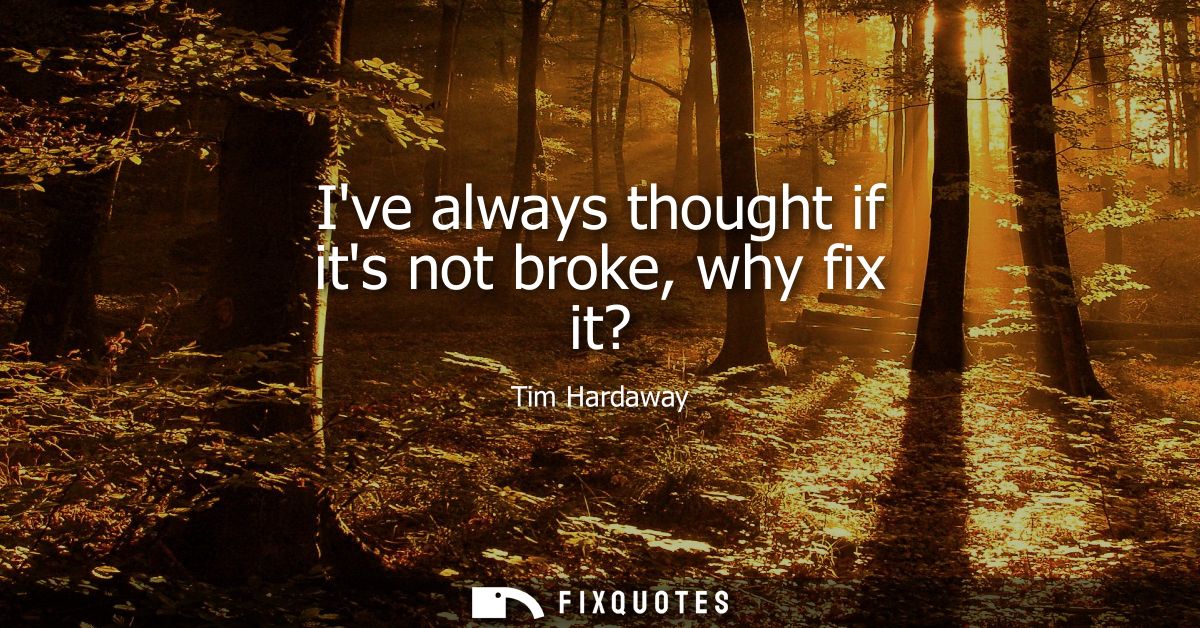
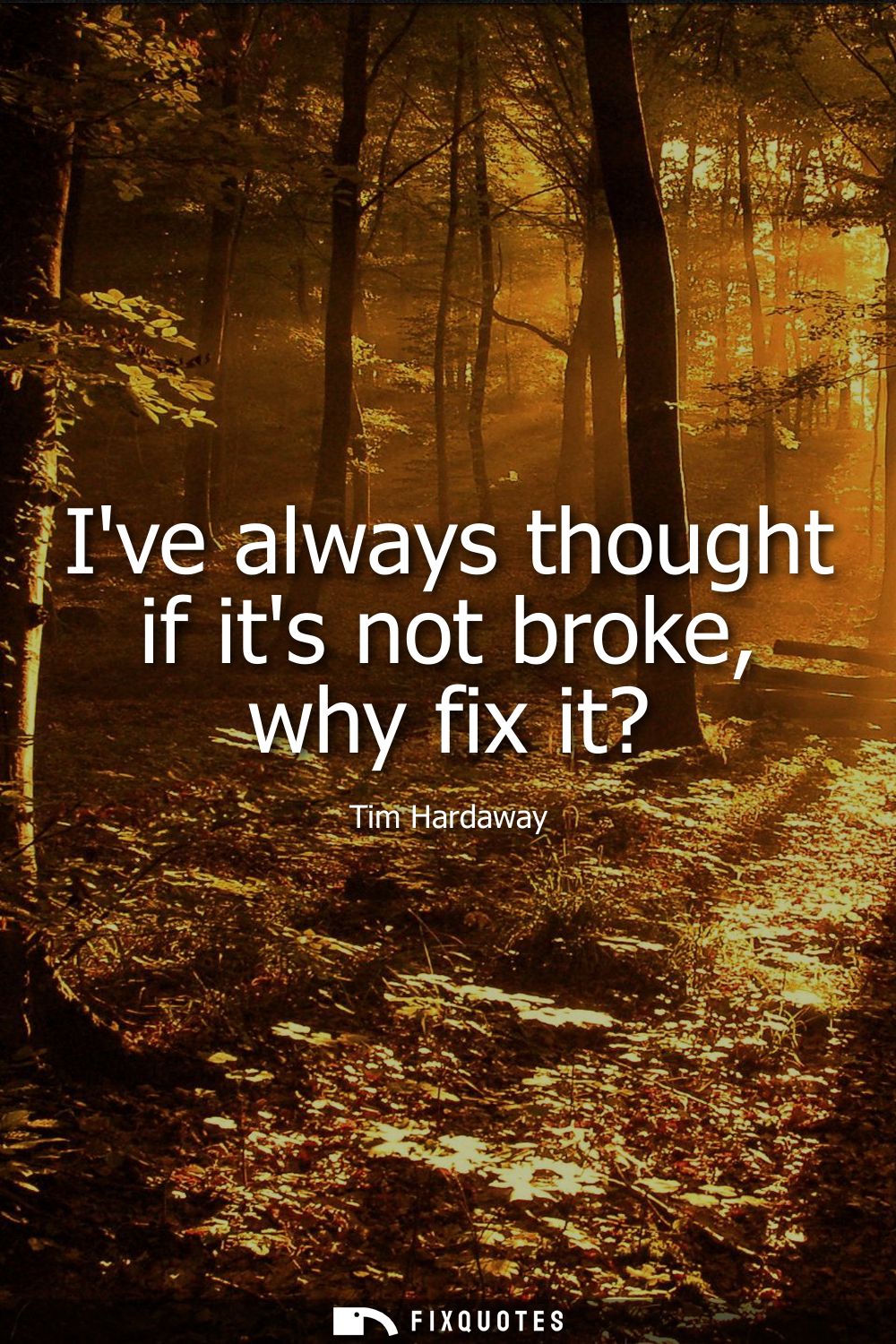
"I've always thought if it's not broke, why fix it?"
About this Quote
Hardaway’s line lands like locker-room common sense, but it’s also a tiny manifesto for how elite athletes survive careers built on repetition. “If it’s not broke” isn’t just about mechanics; it’s about trust. When your livelihood depends on split-second decisions and muscle memory, change isn’t neutral. It’s risk. A tweak to a jumper, a new training regimen, a coach’s “small adjustment” can scramble timing and confidence faster than it improves efficiency.
The phrasing matters: it’s casual, almost dismissive, which is the point. Sports culture worships innovation, yet veterans often know that “innovation” is frequently rebranding: a new system to justify a new staff, a new narrative to explain a slump, a new technique to prove someone is doing something. Hardaway’s skepticism reads like a defense against that churn. It’s also a quiet flex. To say your game isn’t broken is to imply you’ve earned stability through results.
Contextually, this is the athlete’s version of control in an industry that constantly tries to take it away. Players get optimized, analyzed, and rebuilt by outsiders with incentives that don’t always match the player’s. Hardaway’s quote pushes back: don’t touch what’s working, because the cost of disruption is borne by the person on the floor. Under the simplicity is a hard-earned lesson about performance: consistency isn’t stubbornness; it’s strategy.
The phrasing matters: it’s casual, almost dismissive, which is the point. Sports culture worships innovation, yet veterans often know that “innovation” is frequently rebranding: a new system to justify a new staff, a new narrative to explain a slump, a new technique to prove someone is doing something. Hardaway’s skepticism reads like a defense against that churn. It’s also a quiet flex. To say your game isn’t broken is to imply you’ve earned stability through results.
Contextually, this is the athlete’s version of control in an industry that constantly tries to take it away. Players get optimized, analyzed, and rebuilt by outsiders with incentives that don’t always match the player’s. Hardaway’s quote pushes back: don’t touch what’s working, because the cost of disruption is borne by the person on the floor. Under the simplicity is a hard-earned lesson about performance: consistency isn’t stubbornness; it’s strategy.
Quote Details
| Topic | Wisdom |
|---|---|
| Source | Help us find the source |
| Cite |
Citation Formats
APA Style (7th ed.)
Hardaway, Tim. (2026, January 16). I've always thought if it's not broke, why fix it? FixQuotes. https://fixquotes.com/quotes/ive-always-thought-if-its-not-broke-why-fix-it-119584/
Chicago Style
Hardaway, Tim. "I've always thought if it's not broke, why fix it?" FixQuotes. January 16, 2026. https://fixquotes.com/quotes/ive-always-thought-if-its-not-broke-why-fix-it-119584/.
MLA Style (9th ed.)
"I've always thought if it's not broke, why fix it?" FixQuotes, 16 Jan. 2026, https://fixquotes.com/quotes/ive-always-thought-if-its-not-broke-why-fix-it-119584/. Accessed 13 Feb. 2026.
More Quotes by Tim
Add to List