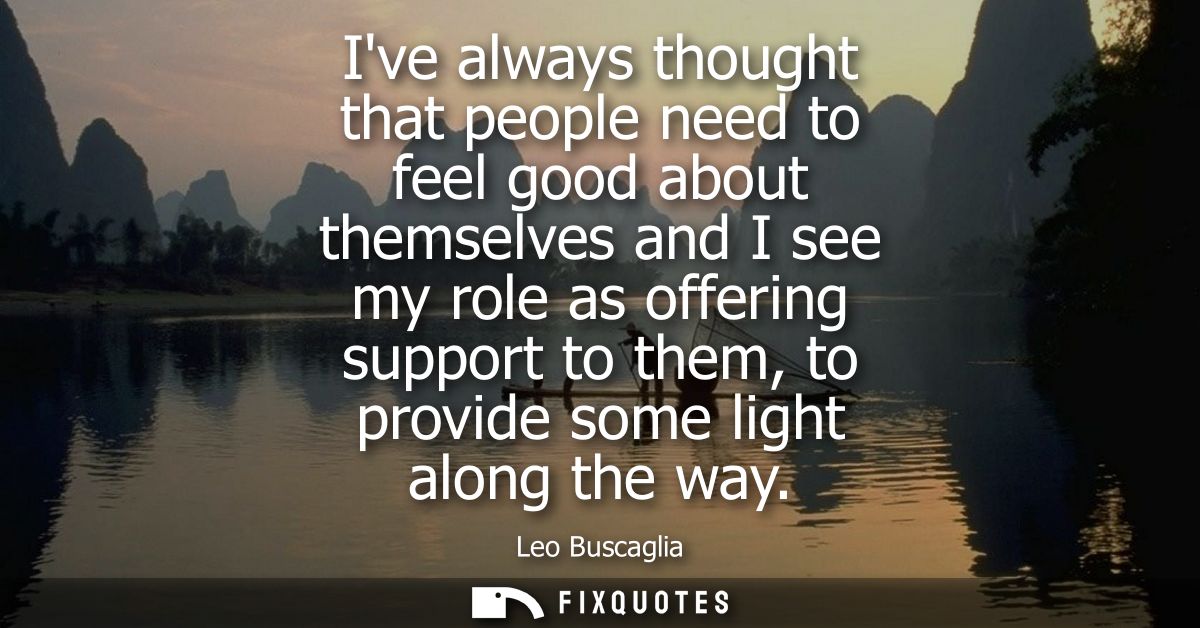
"I've always thought that people need to feel good about themselves, and I see my role as offering support to them, to provide some light along the way"
About this Quote
The real move is the pivot from “people” to “my role.” He’s not just describing a need; he’s positioning himself as a guide. That’s the subtext of the self-help boom: an implicit exchange where vulnerability becomes a market, and the author becomes both witness and caretaker. Buscaglia avoids the authoritarian tone of a guru by choosing “support” over “instruction,” “light” over “answers.” It’s pastoral language, closer to a counselor or minister than a lecturer, and it flatters the reader by suggesting they already have a path - they just can’t see it clearly right now.
“Along the way” is the most telling phrase. It promises companionship rather than transformation, a low-pressure salvation that doesn’t demand you reinvent yourself, only that you keep moving. In a culture increasingly obsessed with achievement and individual responsibility, Buscaglia’s intent is radical in its modesty: feel better, not superior; be steadied, not fixed. It works because it offers relief without shame, and leadership without domination.
Quote Details
| Topic | Kindness |
|---|---|
| Source | Help us find the source |
| Cite |
Citation Formats
APA Style (7th ed.)
Buscaglia, Leo. (2026, February 19). I've always thought that people need to feel good about themselves, and I see my role as offering support to them, to provide some light along the way. FixQuotes. https://fixquotes.com/quotes/ive-always-thought-that-people-need-to-feel-good-32501/
Chicago Style
Buscaglia, Leo. "I've always thought that people need to feel good about themselves, and I see my role as offering support to them, to provide some light along the way." FixQuotes. February 19, 2026. https://fixquotes.com/quotes/ive-always-thought-that-people-need-to-feel-good-32501/.
MLA Style (9th ed.)
"I've always thought that people need to feel good about themselves, and I see my role as offering support to them, to provide some light along the way." FixQuotes, 19 Feb. 2026, https://fixquotes.com/quotes/ive-always-thought-that-people-need-to-feel-good-32501/. Accessed 7 Apr. 2026.