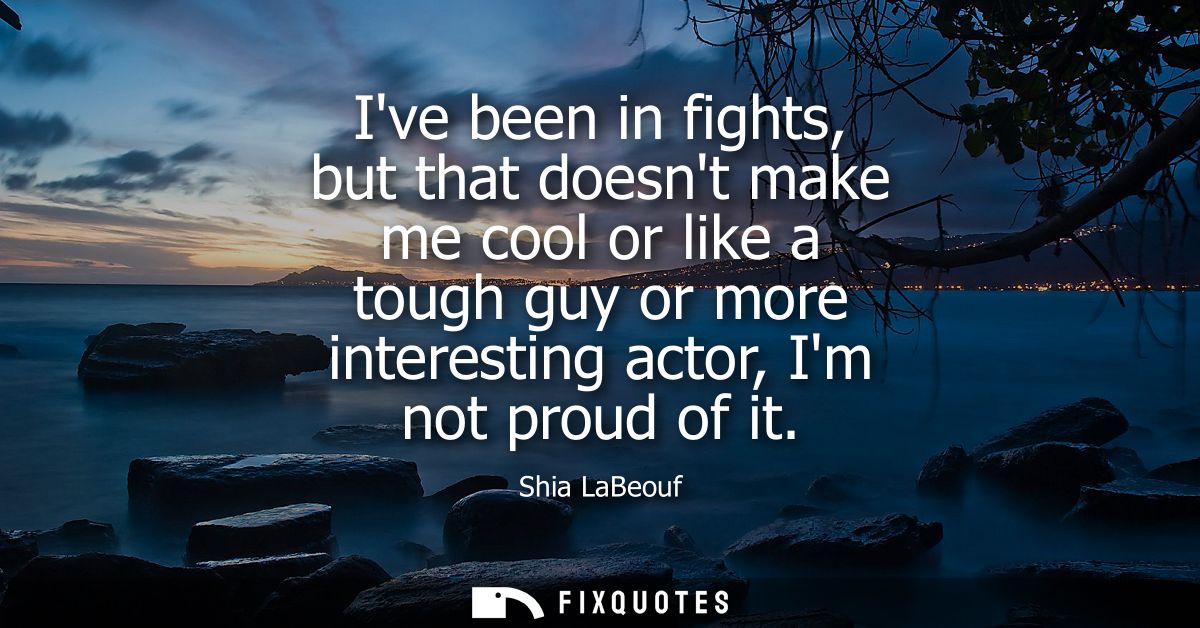
"I've been in fights, but that doesn't make me cool or like a tough guy or more interesting actor, I'm not proud of it"
About this Quote
The phrasing matters. He doesn’t say the fights were wrong because they hurt people; he says they don’t make him “cool,” “tough,” or a “more interesting actor.” That’s not just humility, it’s an indictment of an industry and an audience trained to treat personal dysfunction as an acting credential. In the LaBeouf cinematic universe, pain has often been marketed as proof of depth. Here, he’s disputing the exchange rate.
The subtext is negotiation: don’t romanticize this, but also don’t pretend it didn’t happen. “I’m not proud of it” reads like a moral afterthought, but it’s also a plea to be read as someone attempting adulthood rather than someone performing recklessness. Coming from a celebrity whose public life has included arrests, erratic performances, and serious allegations, the statement functions as reputational triage. It’s an attempt to reclaim narrative authority from memes, gossip, and the old trope that a man’s violence is just another flavor of intensity.
What makes it work is its refusal to convert self-destruction into a brand. It’s not redemption; it’s a line in the sand.
Quote Details
| Topic | Learning from Mistakes |
|---|---|
| Source | Help us find the source |
| Cite |
Citation Formats
APA Style (7th ed.)
LaBeouf, Shia. (2026, January 16). I've been in fights, but that doesn't make me cool or like a tough guy or more interesting actor, I'm not proud of it. FixQuotes. https://fixquotes.com/quotes/ive-been-in-fights-but-that-doesnt-make-me-cool-106650/
Chicago Style
LaBeouf, Shia. "I've been in fights, but that doesn't make me cool or like a tough guy or more interesting actor, I'm not proud of it." FixQuotes. January 16, 2026. https://fixquotes.com/quotes/ive-been-in-fights-but-that-doesnt-make-me-cool-106650/.
MLA Style (9th ed.)
"I've been in fights, but that doesn't make me cool or like a tough guy or more interesting actor, I'm not proud of it." FixQuotes, 16 Jan. 2026, https://fixquotes.com/quotes/ive-been-in-fights-but-that-doesnt-make-me-cool-106650/. Accessed 31 Mar. 2026.