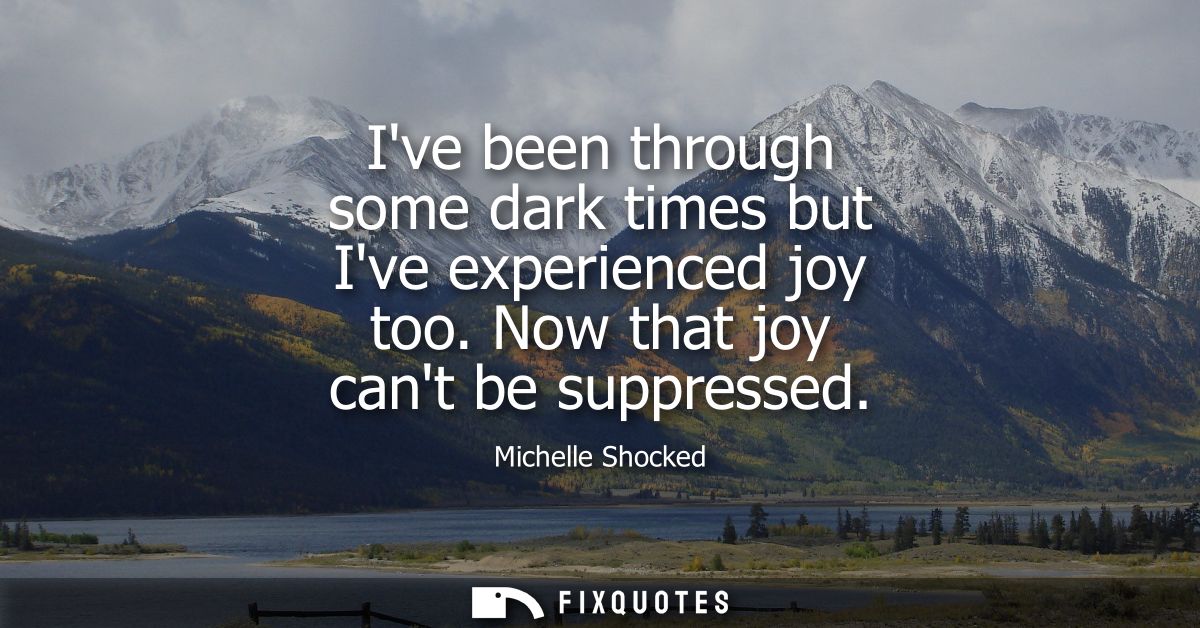
"I've been through some dark times but I've experienced joy too. Now that joy can't be suppressed"
About this Quote
“I’ve been through some dark times” is deliberately unspecific. That vagueness is a shield and an invitation; it lets listeners pour in their own losses without forcing her to perform pain as proof. Then she pivots to “but I’ve experienced joy too,” refusing the cultural script that makes suffering the only credential worth believing. The subtext is quietly defiant: hardship is real, but it doesn’t get the last word, and it doesn’t own the narrative.
The last sentence does the real work. “Now that joy can’t be suppressed” flips joy from a feeling into a force. The “now” signals a threshold moment, the point after which the old controls no longer function. “Can’t” isn’t hope, it’s policy. Read against a broader backdrop of public scrutiny, backlash, and the way women artists are often asked to either repent or disappear, the line insists on an alternative: persistence as pleasure, survival as sound.
It’s also a musician’s move. Joy here isn’t private therapy; it’s volume. Once it’s voiced, it becomes communal, contagious, and harder to police.
Quote Details
| Topic | Joy |
|---|---|
| Source | Help us find the source |
| Cite |
Citation Formats
APA Style (7th ed.)
Shocked, Michelle. (2026, January 15). I've been through some dark times but I've experienced joy too. Now that joy can't be suppressed. FixQuotes. https://fixquotes.com/quotes/ive-been-through-some-dark-times-but-ive-162939/
Chicago Style
Shocked, Michelle. "I've been through some dark times but I've experienced joy too. Now that joy can't be suppressed." FixQuotes. January 15, 2026. https://fixquotes.com/quotes/ive-been-through-some-dark-times-but-ive-162939/.
MLA Style (9th ed.)
"I've been through some dark times but I've experienced joy too. Now that joy can't be suppressed." FixQuotes, 15 Jan. 2026, https://fixquotes.com/quotes/ive-been-through-some-dark-times-but-ive-162939/. Accessed 7 Apr. 2026.