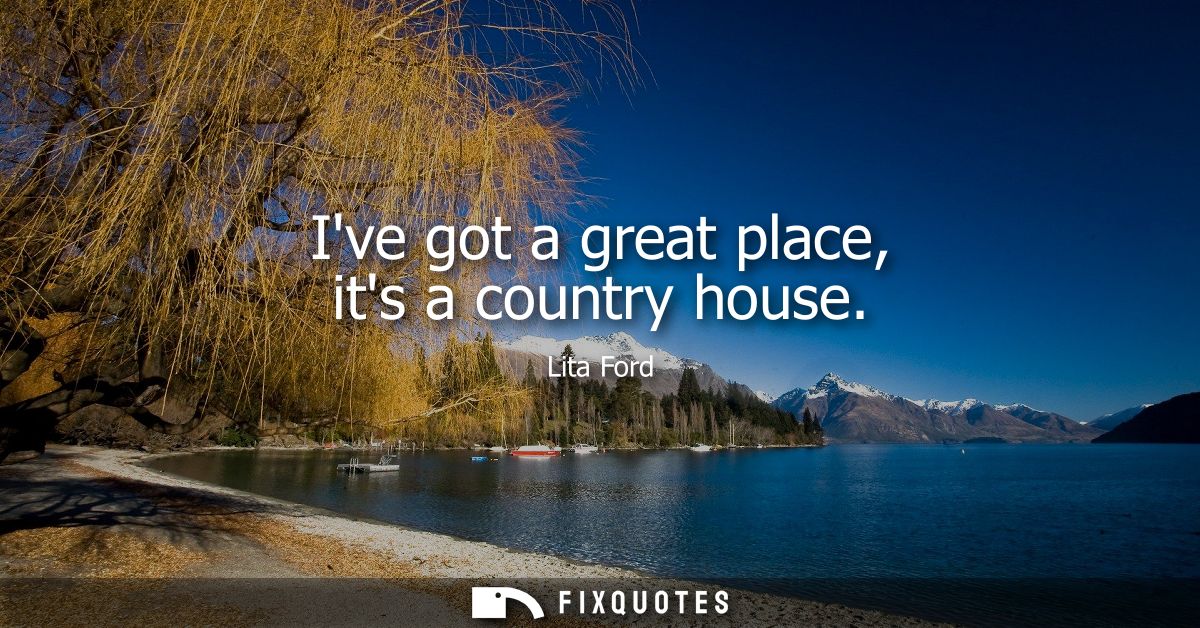
"I've got a great place, it's a country house"
About this Quote
There is something deliciously blunt about "I've got a great place, it's a country house": it sounds like a throwaway brag, but it doubles as a small manifesto about arrival. Coming from Lita Ford, a musician who clawed her way through a male-heavy rock ecosystem, the line reads less like real-estate porn and more like proof-of-life. The "great place" isn’t just a structure; it’s privacy, distance, and control. A country house implies space you can’t be crowded out of, a refuge where the noise of the industry - managers, critics, expectations, the constant appetite for access - can’t easily follow.
The syntax does a lot of the work. Two clauses, no ornament, no apology. That directness carries the rock persona: say it plain, let the implication land. And the implication is status without the glossy celebrity vocabulary. She doesn’t say mansion, estate, or compound; she says country house, a phrase with old-money calm and a faintly domestic, almost pastoral counterimage to the leather-and-amps mythology. It’s a flex that refuses to sparkle.
There’s also a gendered subtext. When women in rock talk about possessions, it’s often framed as vanity or excess. Ford’s line dodges that trap by presenting ownership as sanctuary. The intent feels practical: I have somewhere that’s mine. In a culture that tried to treat her as a guest in her own genre, the country house becomes an argument you can’t heckle - stability as a kind of revenge.
The syntax does a lot of the work. Two clauses, no ornament, no apology. That directness carries the rock persona: say it plain, let the implication land. And the implication is status without the glossy celebrity vocabulary. She doesn’t say mansion, estate, or compound; she says country house, a phrase with old-money calm and a faintly domestic, almost pastoral counterimage to the leather-and-amps mythology. It’s a flex that refuses to sparkle.
There’s also a gendered subtext. When women in rock talk about possessions, it’s often framed as vanity or excess. Ford’s line dodges that trap by presenting ownership as sanctuary. The intent feels practical: I have somewhere that’s mine. In a culture that tried to treat her as a guest in her own genre, the country house becomes an argument you can’t heckle - stability as a kind of revenge.
Quote Details
| Topic | Life |
|---|
More Quotes by Lita
Add to List