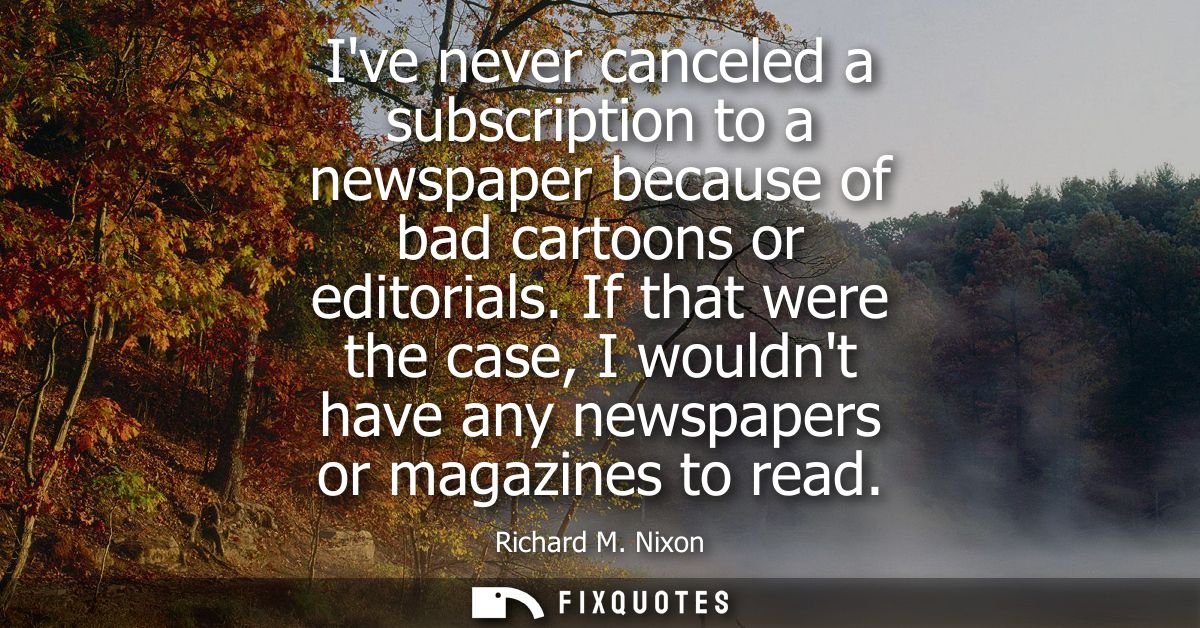
"I've never canceled a subscription to a newspaper because of bad cartoons or editorials. If that were the case, I wouldn't have any newspapers or magazines to read"
About this Quote
Nixon is admitting something most media consumers practice but rarely confess: you don’t read a paper because it’s “right,” you read it because it’s useful. The line lands as a backhanded defense of pluralism, but it’s also a politician’s survival strategy dressed up as tolerance. He’s saying that offense, bias, or bad taste are not defects to be purged; they’re the cost of staying informed in a noisy democracy.
The joke is in the exaggeration. If you demanded consistently good editorials and cartoons, you’d end up with nothing to read. That’s a sly jab at the moralizing impulse to treat journalism as a subscription to one’s own worldview. It also flatters the reader as resilient, grown-up, capable of absorbing irritation without reaching for the unsubscribe button.
Context matters because Nixon had a famously adversarial relationship with the press, one shaped by perceived elite hostility and later cemented by Watergate-era scrutiny. Coming from him, the sentiment isn’t a Hallmark ode to free expression; it’s a pragmatic concession that the press will always needle power, fairly or not, and that retreating into silence is a self-inflicted wound. The subtext is almost transactional: you tolerate the paper’s worst instincts because you need its reporting, its access, its agenda-setting. In a time when partisan media ecosystems and “cancel the outlet” habits have become default, Nixon’s quip reads less like magnanimity and more like a reminder that discomfort is part of the information diet.
The joke is in the exaggeration. If you demanded consistently good editorials and cartoons, you’d end up with nothing to read. That’s a sly jab at the moralizing impulse to treat journalism as a subscription to one’s own worldview. It also flatters the reader as resilient, grown-up, capable of absorbing irritation without reaching for the unsubscribe button.
Context matters because Nixon had a famously adversarial relationship with the press, one shaped by perceived elite hostility and later cemented by Watergate-era scrutiny. Coming from him, the sentiment isn’t a Hallmark ode to free expression; it’s a pragmatic concession that the press will always needle power, fairly or not, and that retreating into silence is a self-inflicted wound. The subtext is almost transactional: you tolerate the paper’s worst instincts because you need its reporting, its access, its agenda-setting. In a time when partisan media ecosystems and “cancel the outlet” habits have become default, Nixon’s quip reads less like magnanimity and more like a reminder that discomfort is part of the information diet.
Quote Details
| Topic | Witty One-Liners |
|---|
More Quotes by Richard
Add to List