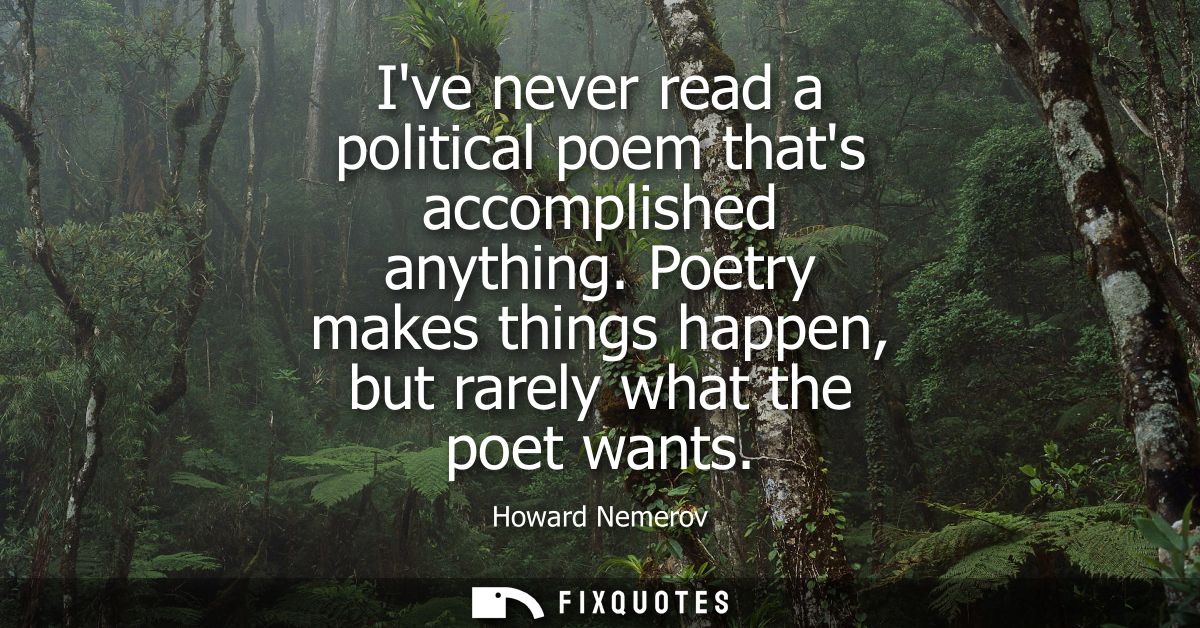
"I've never read a political poem that's accomplished anything. Poetry makes things happen, but rarely what the poet wants"
About this Quote
Then comes the turn that makes the quote stick. “Poetry makes things happen” is not a retreat; it’s a recalibration of what “happen” means. Nemerov draws a bright line between direct, measurable outcomes (votes, laws, revolutions) and the slower, sideways effects poems actually excel at: changing what feels sayable, re-wiring attention, planting metaphors that outlive the occasion that birthed them. Politics wants obedience from language; poetry wants volatility.
The subtext is a warning to poets and readers alike. If you write toward an outcome, you’re likely to be disappointed or, worse, to flatten the poem into a slogan. And if you demand that poems “accomplish” something on command, you’ll miss how they work: by slipping past your stated beliefs, complicating your loyalties, making you inhabit an enemy’s syntax for a moment. That’s why poetry “rarely” delivers what the poet wants. It doesn’t march; it mutates. It’s a force, not a tool.
Quote Details
| Topic | Poetry |
|---|---|
| Source | Help us find the source |
| Cite |
Citation Formats
APA Style (7th ed.)
Nemerov, Howard. (2026, January 17). I've never read a political poem that's accomplished anything. Poetry makes things happen, but rarely what the poet wants. FixQuotes. https://fixquotes.com/quotes/ive-never-read-a-political-poem-thats-61875/
Chicago Style
Nemerov, Howard. "I've never read a political poem that's accomplished anything. Poetry makes things happen, but rarely what the poet wants." FixQuotes. January 17, 2026. https://fixquotes.com/quotes/ive-never-read-a-political-poem-thats-61875/.
MLA Style (9th ed.)
"I've never read a political poem that's accomplished anything. Poetry makes things happen, but rarely what the poet wants." FixQuotes, 17 Jan. 2026, https://fixquotes.com/quotes/ive-never-read-a-political-poem-thats-61875/. Accessed 29 Mar. 2026.