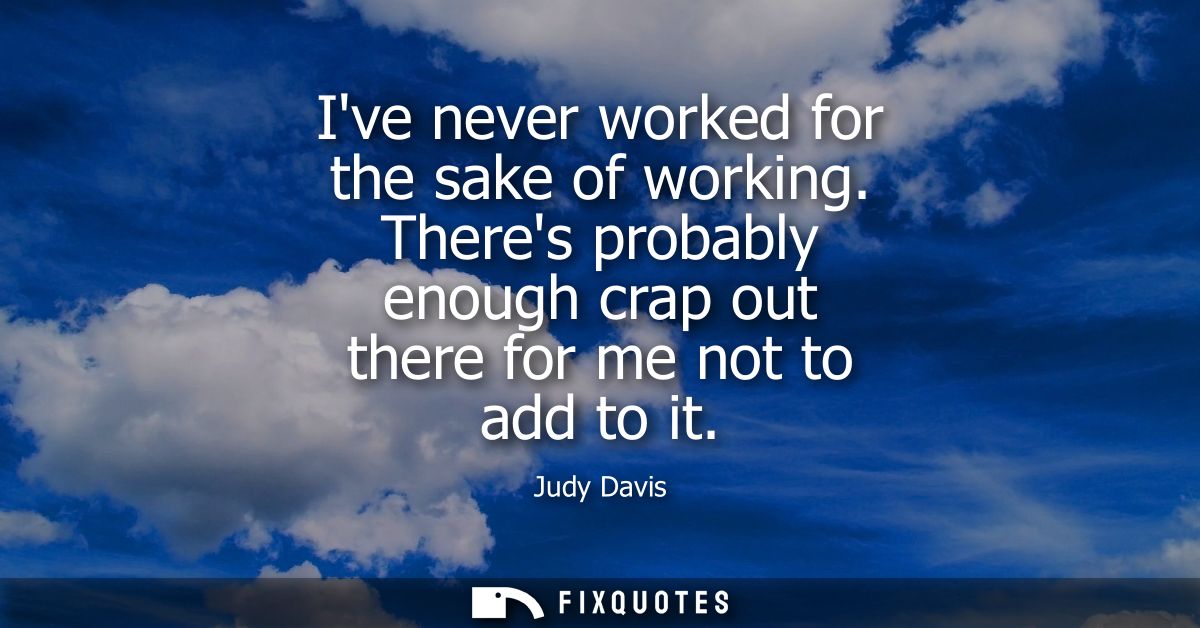
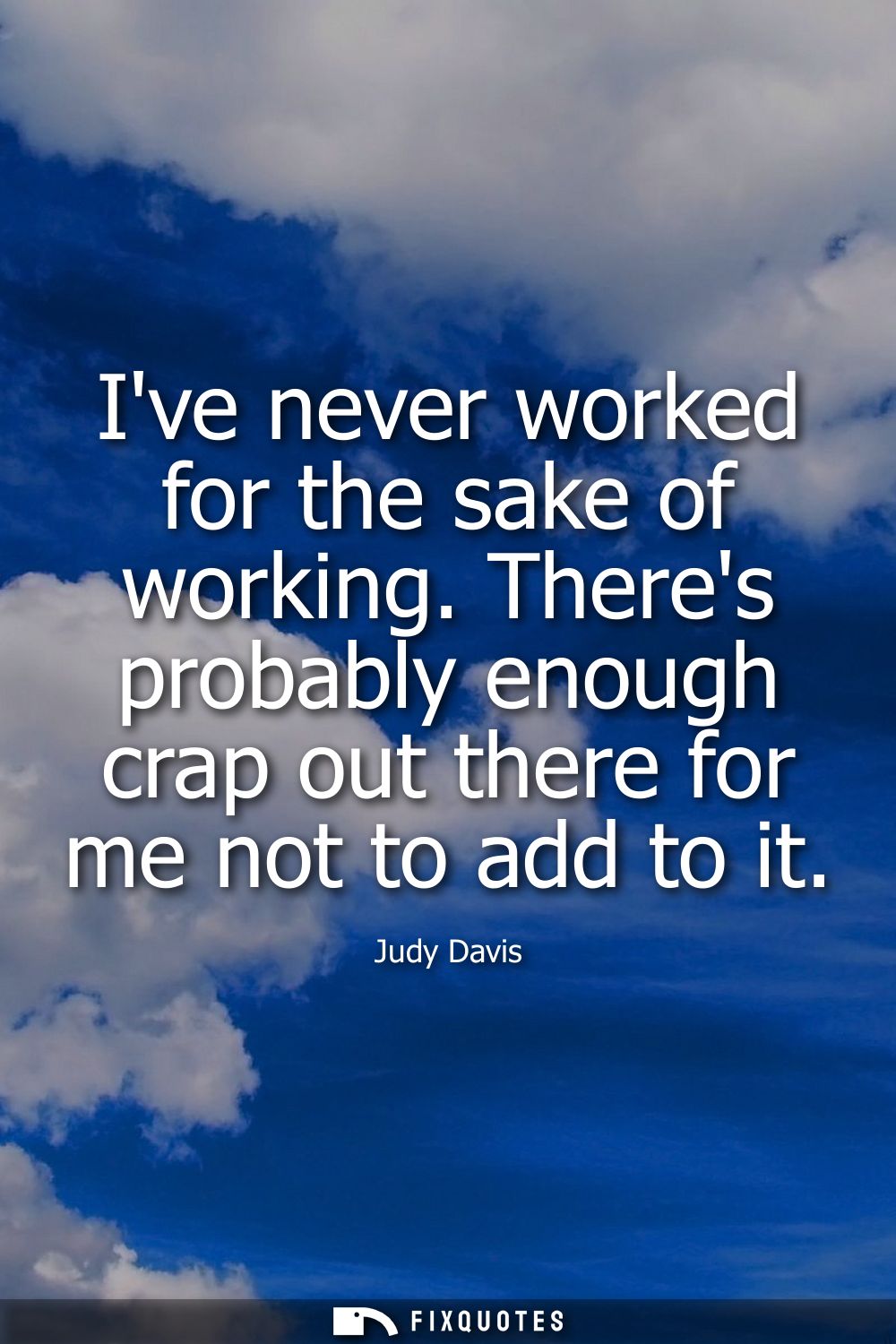
"I've never worked for the sake of working. There's probably enough crap out there for me not to add to it"
About this Quote
The second sentence is the tell: “There’s probably enough crap out there for me not to add to it.” The bite lands because it’s not abstract moralizing. It’s a craftsman’s disgust at cultural overproduction, at the way film and TV can churn out content that exists mainly to fill slots, not to say anything. Davis doesn’t position herself as above the mess; she positions herself as responsible within it. The humility is in the “probably,” the way she avoids sounding like a self-appointed gatekeeper while still drawing a hard line.
There’s also a gendered subtext humming underneath. For actresses, especially of Davis’s generation, the roles on offer have often been thinner, safer, more “useful” to other people’s narratives. Selectivity becomes a survival tactic: protect your instrument, protect your time, protect the parts of yourself that bad work can sand down.
It’s a blunt little manifesto against career-as-content strategy. Davis is arguing for scarcity as integrity: fewer credits, sharper choices, less noise. In a culture that confuses output with worth, that kind of restraint reads almost radical.
Quote Details
| Topic | Work Ethic |
|---|---|
| Source | Help us find the source |
| Cite |
Citation Formats
APA Style (7th ed.)
Davis, Judy. (2026, January 17). I've never worked for the sake of working. There's probably enough crap out there for me not to add to it. FixQuotes. https://fixquotes.com/quotes/ive-never-worked-for-the-sake-of-working-theres-68607/
Chicago Style
Davis, Judy. "I've never worked for the sake of working. There's probably enough crap out there for me not to add to it." FixQuotes. January 17, 2026. https://fixquotes.com/quotes/ive-never-worked-for-the-sake-of-working-theres-68607/.
MLA Style (9th ed.)
"I've never worked for the sake of working. There's probably enough crap out there for me not to add to it." FixQuotes, 17 Jan. 2026, https://fixquotes.com/quotes/ive-never-worked-for-the-sake-of-working-theres-68607/. Accessed 12 Mar. 2026.