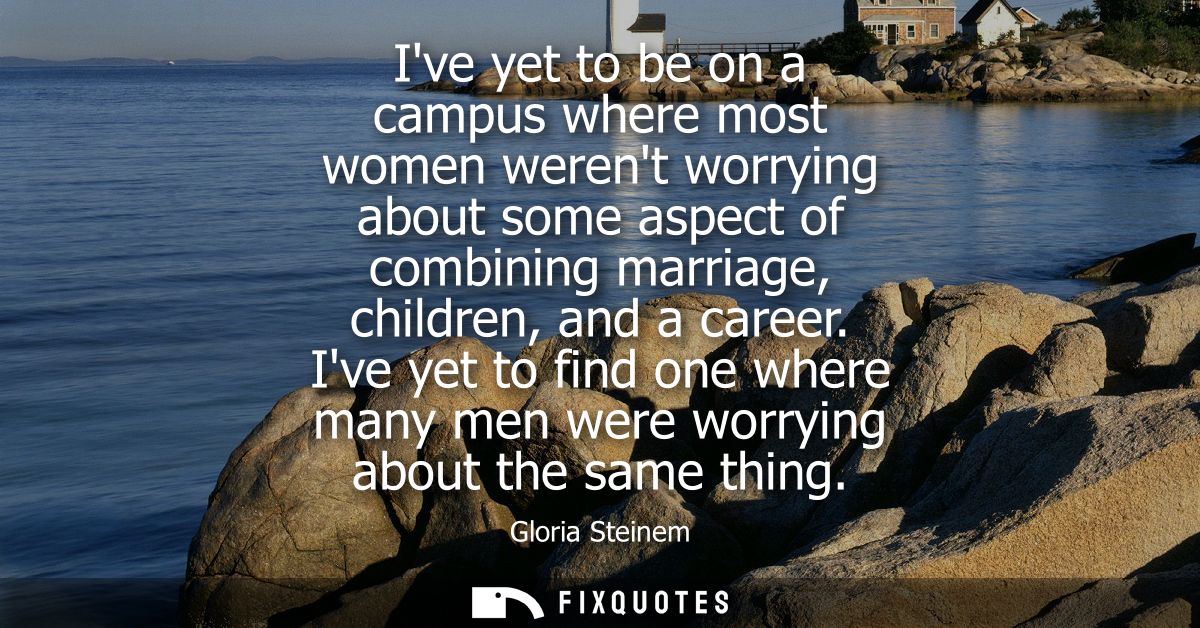
"I've yet to be on a campus where most women weren't worrying about some aspect of combining marriage, children, and a career. I've yet to find one where many men were worrying about the same thing"
About this Quote
The subtext is sharper than the surface complaint. College is supposed to be the meritocratic waiting room: study hard, plan well, and the world opens. Steinem points out the hidden fee women pay for entry: they’re asked to pre-negotiate a life that men are allowed to improvise. Even “worrying” is political in this framing. Anxiety becomes unpaid labor, a private form of strategizing around institutions that won’t bend - workplaces built on an unspoken “wife at home” model, marriages that assume women will absorb the scheduling, the childrearing, the career compromises.
Her contrast isn’t about individual men being careless; it’s about the cultural permission structure. Men are socialized to treat family as additive, women as determinative. Put differently: men imagine a career with a family; women are trained to imagine a family as a career constraint. Delivered by a feminist activist who spent decades translating personal experience into public critique, the quote works as a simple field report that indicts an entire set of expectations without needing a manifesto.
Quote Details
| Topic | Work-Life Balance |
|---|---|
| Source | Verified source: Outrageous Acts and Everyday Rebellions (Gloria Steinem, 2012)ISBN: 9781453250181 · ID: KVHmzw43TgkC
Evidence:
... I've yet to be on a campus where most women weren't worrying about some aspect of combining marriage, children, and a career. I've yet to find one where many men were worrying about the same thing. Yet women will go right on suffering ... |
| Cite |
Citation Formats
APA Style (7th ed.)
Steinem, Gloria. (2026, February 24). I've yet to be on a campus where most women weren't worrying about some aspect of combining marriage, children, and a career. I've yet to find one where many men were worrying about the same thing. FixQuotes. https://fixquotes.com/quotes/ive-yet-to-be-on-a-campus-where-most-women-werent-60385/
Chicago Style
Steinem, Gloria. "I've yet to be on a campus where most women weren't worrying about some aspect of combining marriage, children, and a career. I've yet to find one where many men were worrying about the same thing." FixQuotes. February 24, 2026. https://fixquotes.com/quotes/ive-yet-to-be-on-a-campus-where-most-women-werent-60385/.
MLA Style (9th ed.)
"I've yet to be on a campus where most women weren't worrying about some aspect of combining marriage, children, and a career. I've yet to find one where many men were worrying about the same thing." FixQuotes, 24 Feb. 2026, https://fixquotes.com/quotes/ive-yet-to-be-on-a-campus-where-most-women-werent-60385/. Accessed 8 Apr. 2026.