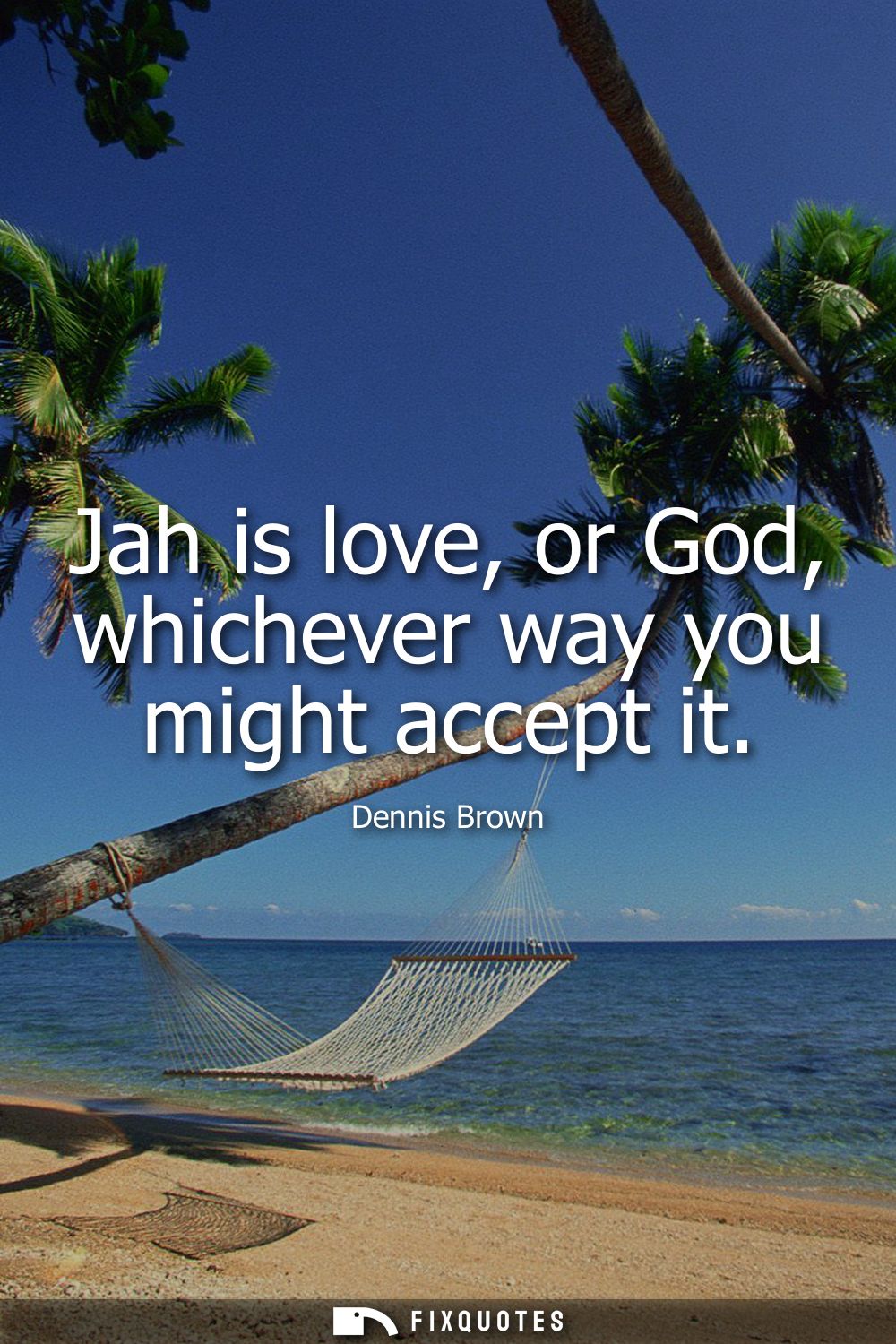
"Jah is love, or God, whichever way you might accept it"
About this Quote
Dennis Brown’s line doesn’t argue theology; it disarms it. “Jah is love, or God” lands like a gentle translation offered mid-song, then he slips in the real move: “whichever way you might accept it.” That last clause is the hinge. It turns what could be a Rasta-exclusive declaration into an open-door invitation, a piece of spiritual diplomacy designed for a mixed crowd - believers, skeptics, Christians raised on “God,” and listeners drawn to “Jah” as a cultural signal.
The specific intent feels practical: keep the vibration intact without demanding conversion. Brown is affirming Rastafari’s central name for the divine while acknowledging the reality of audience diversity, especially in reggae’s global spread. Instead of gatekeeping language, he treats language as a bridge. It’s an artist’s instinct: protect the meaning, loosen the branding.
Subtextually, it’s also a quiet critique of religious factionalism. If the divine can be approached through “Jah” or “God,” then the fight over labels starts to look like human ego, not sacred truth. “Love” is the third term that makes the truce possible - not as a Hallmark sentiment, but as a testable ethic. You can’t hide behind doctrine if the standard is how you treat people.
Context matters: roots reggae carried theology, politics, and survival in the same bassline. Brown’s phrasing fits a tradition where spirituality isn’t abstract philosophy; it’s a way to name dignity under pressure. By making room for “whichever way,” he keeps the message radical without making it brittle.
The specific intent feels practical: keep the vibration intact without demanding conversion. Brown is affirming Rastafari’s central name for the divine while acknowledging the reality of audience diversity, especially in reggae’s global spread. Instead of gatekeeping language, he treats language as a bridge. It’s an artist’s instinct: protect the meaning, loosen the branding.
Subtextually, it’s also a quiet critique of religious factionalism. If the divine can be approached through “Jah” or “God,” then the fight over labels starts to look like human ego, not sacred truth. “Love” is the third term that makes the truce possible - not as a Hallmark sentiment, but as a testable ethic. You can’t hide behind doctrine if the standard is how you treat people.
Context matters: roots reggae carried theology, politics, and survival in the same bassline. Brown’s phrasing fits a tradition where spirituality isn’t abstract philosophy; it’s a way to name dignity under pressure. By making room for “whichever way,” he keeps the message radical without making it brittle.
Quote Details
| Topic | God |
|---|---|
| Source | Help us find the source |
| Cite |
Citation Formats
APA Style (7th ed.)
Brown, Dennis. (2026, January 17). Jah is love, or God, whichever way you might accept it. FixQuotes. https://fixquotes.com/quotes/jah-is-love-or-god-whichever-way-you-might-accept-45293/
Chicago Style
Brown, Dennis. "Jah is love, or God, whichever way you might accept it." FixQuotes. January 17, 2026. https://fixquotes.com/quotes/jah-is-love-or-god-whichever-way-you-might-accept-45293/.
MLA Style (9th ed.)
"Jah is love, or God, whichever way you might accept it." FixQuotes, 17 Jan. 2026, https://fixquotes.com/quotes/jah-is-love-or-god-whichever-way-you-might-accept-45293/. Accessed 28 Mar. 2026.
More Quotes by Dennis
Add to List