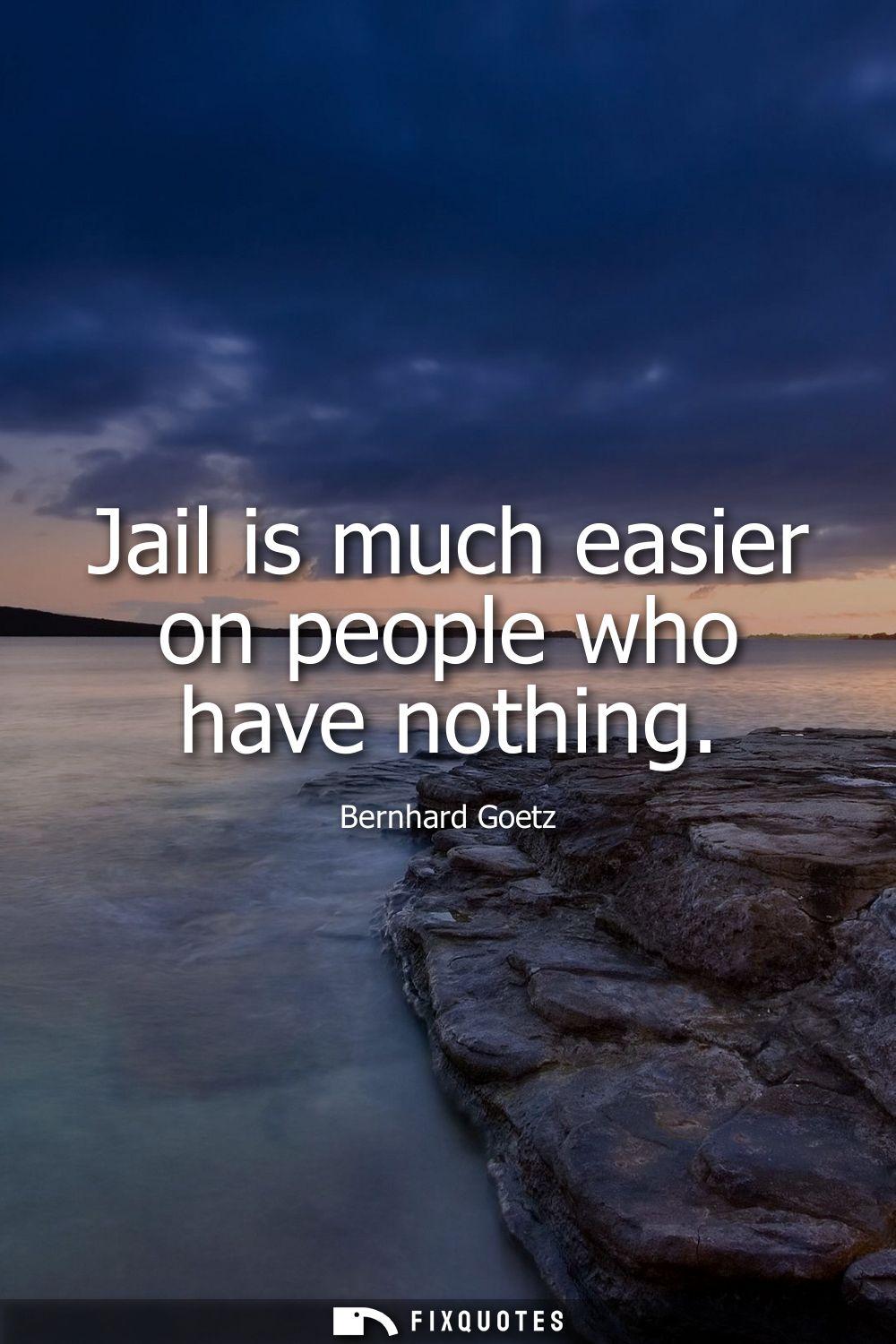
"Jail is much easier on people who have nothing"
About this Quote
“Jail is much easier on people who have nothing” is a line that tries to launder a brutal moral claim through the cool tone of practicality. Bernhard Goetz, forever linked to 1980s New York panic and his own vigilantism case, isn’t offering a neutral observation about incarceration; he’s sketching a hierarchy of whose suffering counts. The premise is economic: confinement is framed as a relative inconvenience, not a deprivation. If you’re poor, the logic goes, you’ve already been stripped of comfort, privacy, and options, so prison is just a change of address. If you have property, status, a career, a reputation, then jail becomes a catastrophic fall.
The subtext is sharper: Goetz is implicitly arguing that the system punishes “people like him” more severely, even when the bars are the same. It’s a rhetorical judo move that turns structural inequality into a kind of advantage for the disadvantaged. That inversion matters because it reframes sympathy. Instead of asking why prisons are built to warehouse the poor, it suggests the poor are somehow insulated from harm. The line also smuggles in a justification for fear: if “nothing” means nothing to lose, then desperation becomes an all-purpose suspicion, and harshness becomes rational.
Coming from an engineer, it reads like a back-of-the-envelope calculation of human value: inputs (assets) determine outputs (pain). That’s exactly why it lands so cold. It reduces incarceration to a ledger, and in doing so, exposes the worldview that made Goetz legible to an era eager to treat social failure as personal threat.
The subtext is sharper: Goetz is implicitly arguing that the system punishes “people like him” more severely, even when the bars are the same. It’s a rhetorical judo move that turns structural inequality into a kind of advantage for the disadvantaged. That inversion matters because it reframes sympathy. Instead of asking why prisons are built to warehouse the poor, it suggests the poor are somehow insulated from harm. The line also smuggles in a justification for fear: if “nothing” means nothing to lose, then desperation becomes an all-purpose suspicion, and harshness becomes rational.
Coming from an engineer, it reads like a back-of-the-envelope calculation of human value: inputs (assets) determine outputs (pain). That’s exactly why it lands so cold. It reduces incarceration to a ledger, and in doing so, exposes the worldview that made Goetz legible to an era eager to treat social failure as personal threat.
Quote Details
| Topic | Justice |
|---|---|
| Source | Help us find the source |
| Cite |
Citation Formats
APA Style (7th ed.)
Goetz, Bernhard. (2026, January 16). Jail is much easier on people who have nothing. FixQuotes. https://fixquotes.com/quotes/jail-is-much-easier-on-people-who-have-nothing-126070/
Chicago Style
Goetz, Bernhard. "Jail is much easier on people who have nothing." FixQuotes. January 16, 2026. https://fixquotes.com/quotes/jail-is-much-easier-on-people-who-have-nothing-126070/.
MLA Style (9th ed.)
"Jail is much easier on people who have nothing." FixQuotes, 16 Jan. 2026, https://fixquotes.com/quotes/jail-is-much-easier-on-people-who-have-nothing-126070/. Accessed 21 Mar. 2026.
More Quotes by Bernhard
Add to List