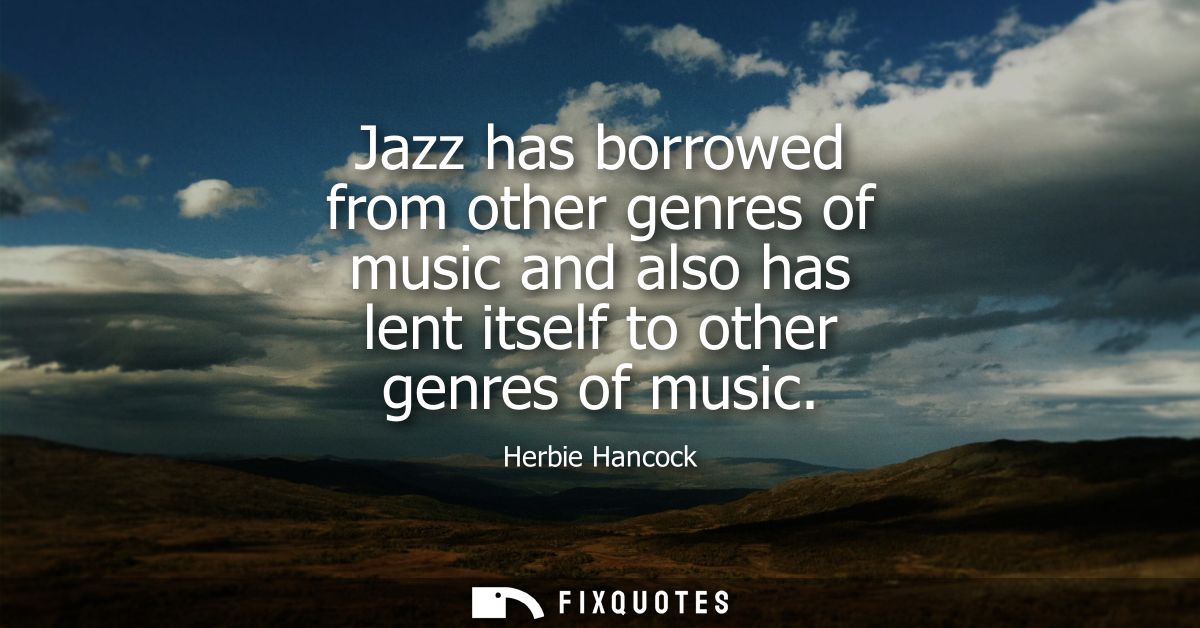
"Jazz has borrowed from other genres of music and also has lent itself to other genres of music"
About this Quote
The subtext pushes back on the reflexive complaint that jazz gets diluted when it touches pop, electronics, or dance rhythms. Hancock’s career is practically a case study in how those collisions can widen the emotional and sonic vocabulary without erasing the core discipline: improvisation, conversation, risk. “Borrowed” acknowledges jazz’s own debts - to blues, ragtime, gospel, Afro-Caribbean rhythms, later to rock and R&B. “Lent” flips the power dynamic: jazz isn’t a niche art begging for relevance; it’s a source code that other genres keep downloading, from neo-soul to film scoring to experimental electronic music.
Context matters here: Hancock came up in the post-bop era with Miles Davis, then helped define fusion and mainstream crossover at moments when gatekeepers drew hard lines around what “counts.” His point lands less like a history lesson and more like an ethic. Jazz survives by staying porous, and its highest ambition might be exactly that: to be durable enough to share itself, and curious enough to take from anywhere.
Quote Details
| Topic | Music |
|---|---|
| Source | Help us find the source |
| Cite |
Citation Formats
APA Style (7th ed.)
Hancock, Herbie. (2026, January 17). Jazz has borrowed from other genres of music and also has lent itself to other genres of music. FixQuotes. https://fixquotes.com/quotes/jazz-has-borrowed-from-other-genres-of-music-and-69355/
Chicago Style
Hancock, Herbie. "Jazz has borrowed from other genres of music and also has lent itself to other genres of music." FixQuotes. January 17, 2026. https://fixquotes.com/quotes/jazz-has-borrowed-from-other-genres-of-music-and-69355/.
MLA Style (9th ed.)
"Jazz has borrowed from other genres of music and also has lent itself to other genres of music." FixQuotes, 17 Jan. 2026, https://fixquotes.com/quotes/jazz-has-borrowed-from-other-genres-of-music-and-69355/. Accessed 4 Apr. 2026.