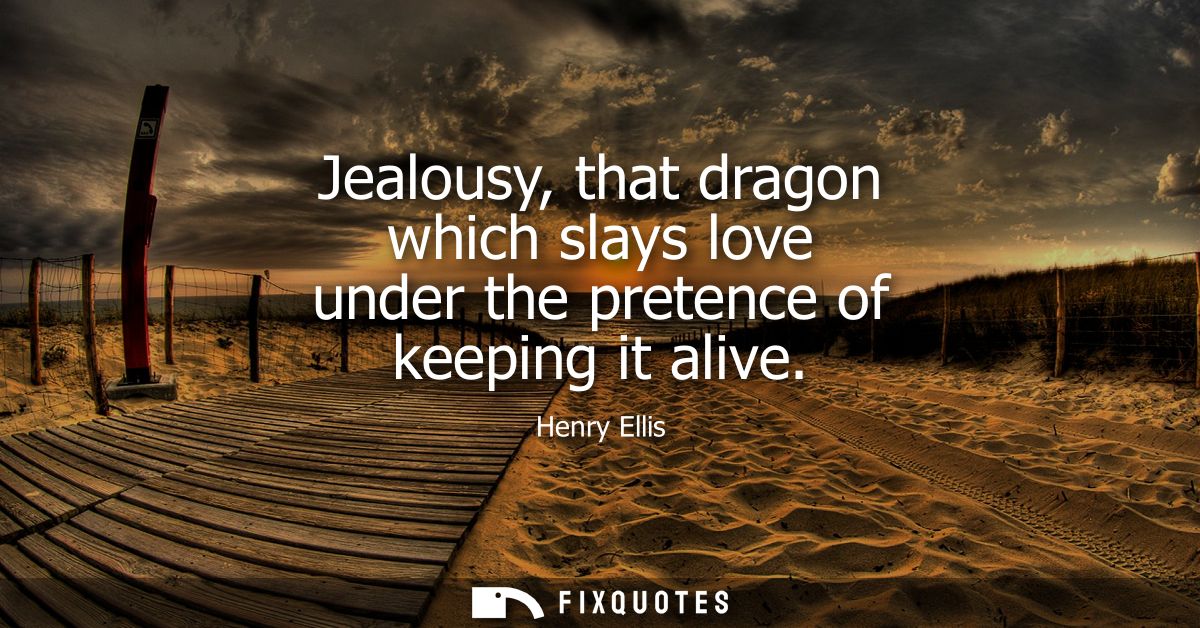
"Jealousy, that dragon which slays love under the pretence of keeping it alive"
About this Quote
Ellis was writing in an era when psychology was trying to sound both clinical and culturally literate, borrowing mythic imagery to describe modern inner life. The dragon lets him dramatize a psychological paradox: the more jealousy tries to “protect” a relationship through control, interrogation, and possessiveness, the more it corrodes the conditions that make intimacy possible. Trust can’t be coerced; desire doesn’t thrive under audit. The slaying is rarely a single act. It’s the slow heat of suspicion, the constant demand for reassurance, the way the jealous person turns their partner into a suspect and themselves into a warden.
The subtext is also a warning about how easily people mistake intensity for proof. Jealousy feels energetic, vigilant, invested. Ellis suggests that’s precisely why it’s so dangerous: it provides emotional evidence for its own necessity while quietly rewriting love as ownership. The dragon survives by claiming it’s the guard dog; love dies because the home becomes a fortress.
Quote Details
| Topic | Love |
|---|---|
| Source | Help us find the source |
| Cite |
Citation Formats
APA Style (7th ed.)
Ellis, Henry. (2026, January 18). Jealousy, that dragon which slays love under the pretence of keeping it alive. FixQuotes. https://fixquotes.com/quotes/jealousy-that-dragon-which-slays-love-under-the-5333/
Chicago Style
Ellis, Henry. "Jealousy, that dragon which slays love under the pretence of keeping it alive." FixQuotes. January 18, 2026. https://fixquotes.com/quotes/jealousy-that-dragon-which-slays-love-under-the-5333/.
MLA Style (9th ed.)
"Jealousy, that dragon which slays love under the pretence of keeping it alive." FixQuotes, 18 Jan. 2026, https://fixquotes.com/quotes/jealousy-that-dragon-which-slays-love-under-the-5333/. Accessed 12 Feb. 2026.