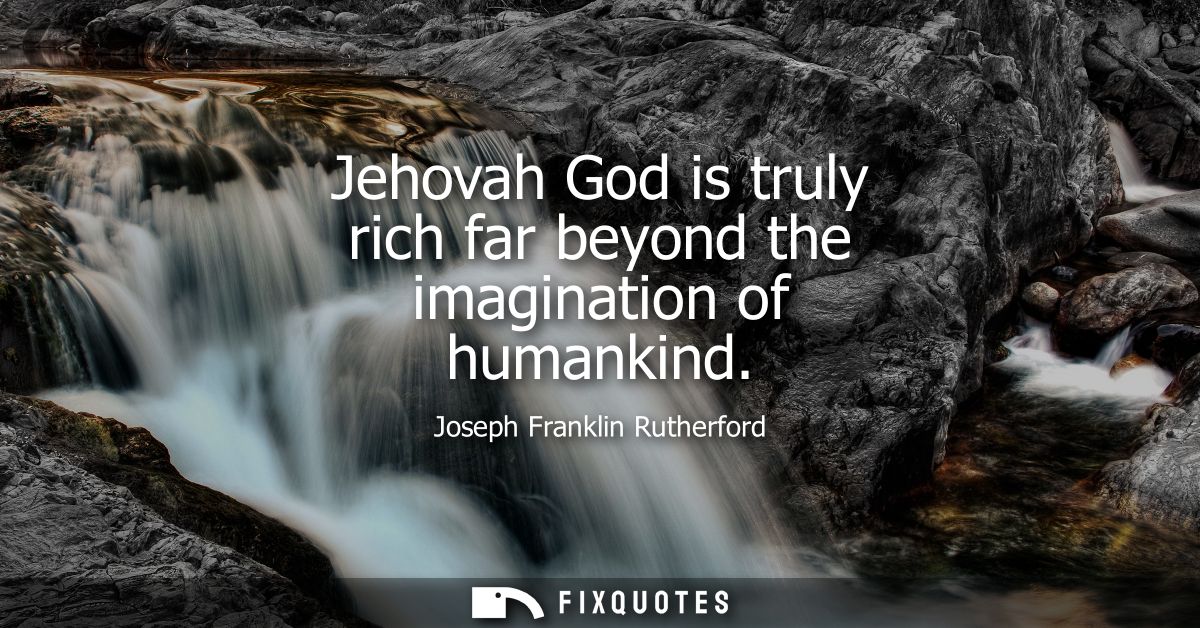
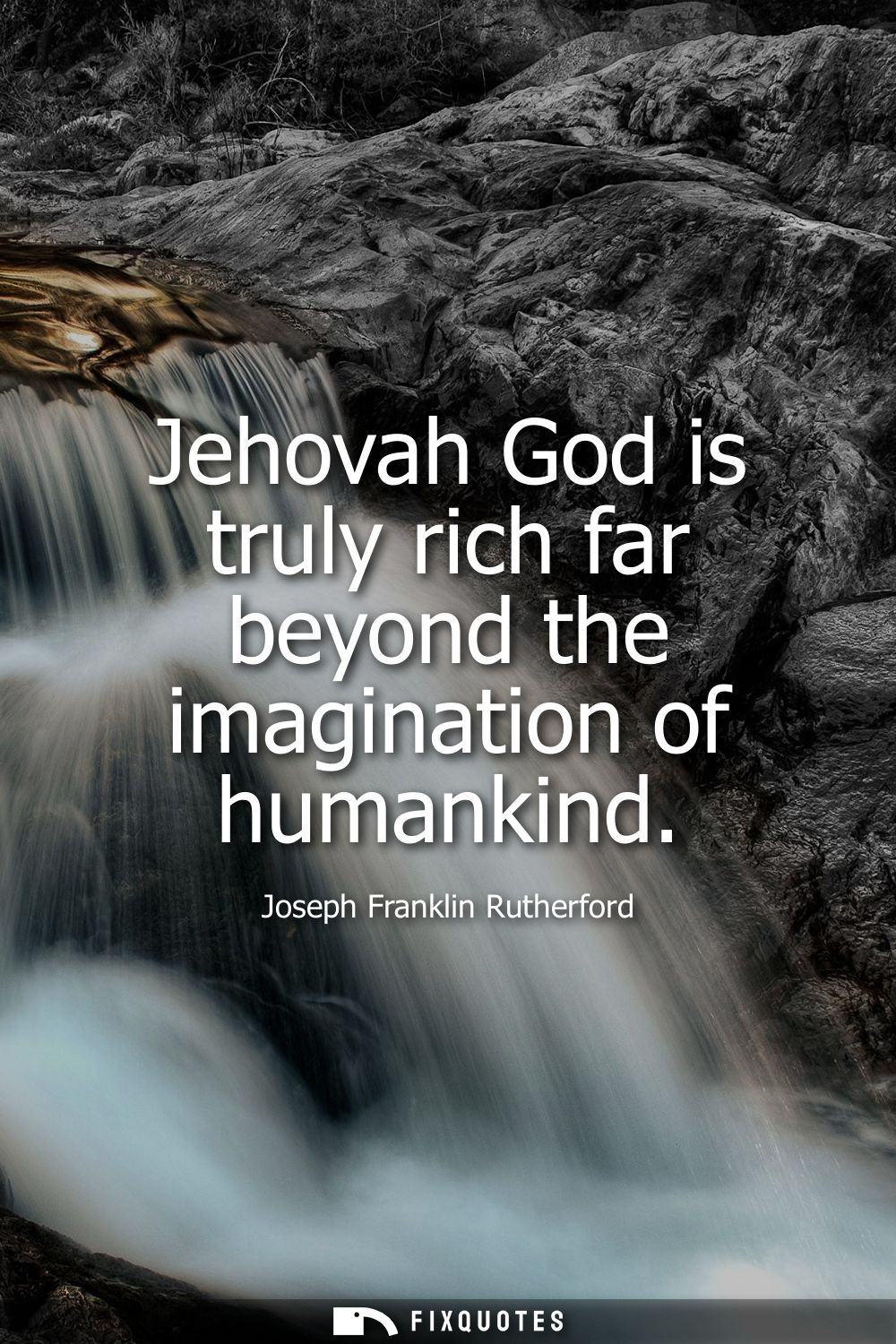
"Jehovah God is truly rich far beyond the imagination of humankind"
About this Quote
Rutherford’s line isn’t trying to dazzle with poetry; it’s trying to discipline the imagination. “Truly rich” borrows the language of money and status, then yanks it out of the marketplace and installs it in heaven. In an era when industrial capitalism made wealth newly visible, newly obscene, and newly envied, that move matters. It redirects a familiar ache - scarcity, insecurity, comparison - into a theological hierarchy where the only real abundance belongs to God, and everything else is secondary, provisional, maybe even suspect.
The phrase “far beyond the imagination of humankind” does double duty. On the surface it’s humility: humans can’t fathom divine resources. Underneath it’s a boundary line. If God’s “riches” are literally unimaginable, then ordinary metrics (comfort, success, material stability) can’t be used to evaluate faith, leadership, or the movement’s promises. That’s rhetorically useful for a clergyman building institutional loyalty: it immunizes belief against counterevidence. If members are poor, persecuted, or disappointed, the “real” wealth is off-ledger, inaccessible to skeptical accounting.
Rutherford, a key architect of Jehovah’s Witnesses’ centralized identity in the early 20th century, often framed God as sovereign and the world’s systems as corrupt and doomed. Read in that context, “rich” becomes less about personal spirituality than about allegiance: the true patron is Jehovah, not employers, politicians, or rival churches. The sentence functions like a spiritual revaluation. It tells listeners not just what to worship, but what not to trust - and why the movement can ask for sacrifice now while promising a different economy later.
The phrase “far beyond the imagination of humankind” does double duty. On the surface it’s humility: humans can’t fathom divine resources. Underneath it’s a boundary line. If God’s “riches” are literally unimaginable, then ordinary metrics (comfort, success, material stability) can’t be used to evaluate faith, leadership, or the movement’s promises. That’s rhetorically useful for a clergyman building institutional loyalty: it immunizes belief against counterevidence. If members are poor, persecuted, or disappointed, the “real” wealth is off-ledger, inaccessible to skeptical accounting.
Rutherford, a key architect of Jehovah’s Witnesses’ centralized identity in the early 20th century, often framed God as sovereign and the world’s systems as corrupt and doomed. Read in that context, “rich” becomes less about personal spirituality than about allegiance: the true patron is Jehovah, not employers, politicians, or rival churches. The sentence functions like a spiritual revaluation. It tells listeners not just what to worship, but what not to trust - and why the movement can ask for sacrifice now while promising a different economy later.
Quote Details
| Topic | God |
|---|---|
| Source | Help us find the source |
| Cite |
Citation Formats
APA Style (7th ed.)
Rutherford, Joseph Franklin. (2026, January 16). Jehovah God is truly rich far beyond the imagination of humankind. FixQuotes. https://fixquotes.com/quotes/jehovah-god-is-truly-rich-far-beyond-the-98769/
Chicago Style
Rutherford, Joseph Franklin. "Jehovah God is truly rich far beyond the imagination of humankind." FixQuotes. January 16, 2026. https://fixquotes.com/quotes/jehovah-god-is-truly-rich-far-beyond-the-98769/.
MLA Style (9th ed.)
"Jehovah God is truly rich far beyond the imagination of humankind." FixQuotes, 16 Jan. 2026, https://fixquotes.com/quotes/jehovah-god-is-truly-rich-far-beyond-the-98769/. Accessed 18 Feb. 2026.
More Quotes by Joseph
Add to List