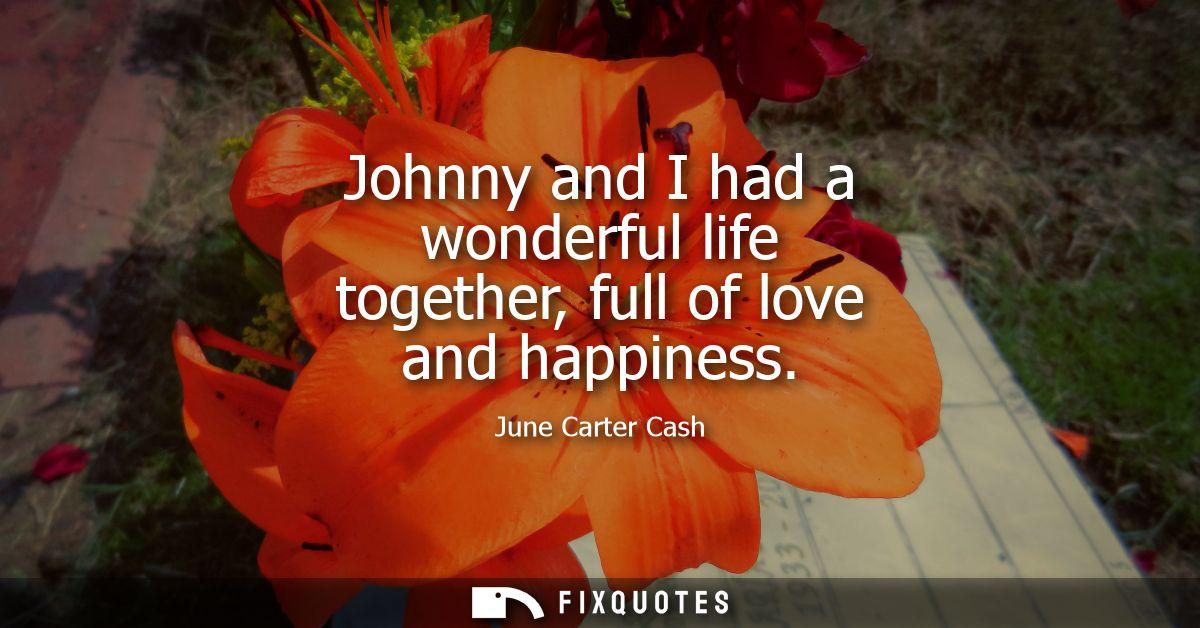
"Johnny and I had a wonderful life together, full of love and happiness"
About this Quote
The intent is protective and controlling in the best sense. By choosing a simple, domestic register - “wonderful life,” “together,” “full of love and happiness” - June pulls the focus away from spectacle and back to partnership. “Johnny and I” matters: not “Johnny,” not “me,” but a unit. The phrase “had a life together” subtly reframes fame as incidental. Their core narrative isn’t the stage; it’s the sustained act of sharing time.
The subtext is that happiness here is hard-won. Coming from a woman who lived inside country music’s public-private blur, the statement functions like a boundary: you can have the legend, but you don’t get to confiscate the marriage. It’s also a kind of gentle defiance against the cultural reflex to fetishize suffering in artists, as if pain is the only authentic credential. June offers a different authenticity - not misery, but continuity.
Context sharpens the line: both Cashes became shorthand for devotion, especially after Johnny’s late-career resurgence turned their love into a public symbol. Her sentence doesn’t romanticize the storm; it simply refuses to let the storm be the whole weather.
Quote Details
| Topic | Husband & Wife |
|---|---|
| Source | Help us find the source |
| Cite |
Citation Formats
APA Style (7th ed.)
Cash, June Carter. (2026, January 15). Johnny and I had a wonderful life together, full of love and happiness. FixQuotes. https://fixquotes.com/quotes/johnny-and-i-had-a-wonderful-life-together-full-172286/
Chicago Style
Cash, June Carter. "Johnny and I had a wonderful life together, full of love and happiness." FixQuotes. January 15, 2026. https://fixquotes.com/quotes/johnny-and-i-had-a-wonderful-life-together-full-172286/.
MLA Style (9th ed.)
"Johnny and I had a wonderful life together, full of love and happiness." FixQuotes, 15 Jan. 2026, https://fixquotes.com/quotes/johnny-and-i-had-a-wonderful-life-together-full-172286/. Accessed 25 Mar. 2026.