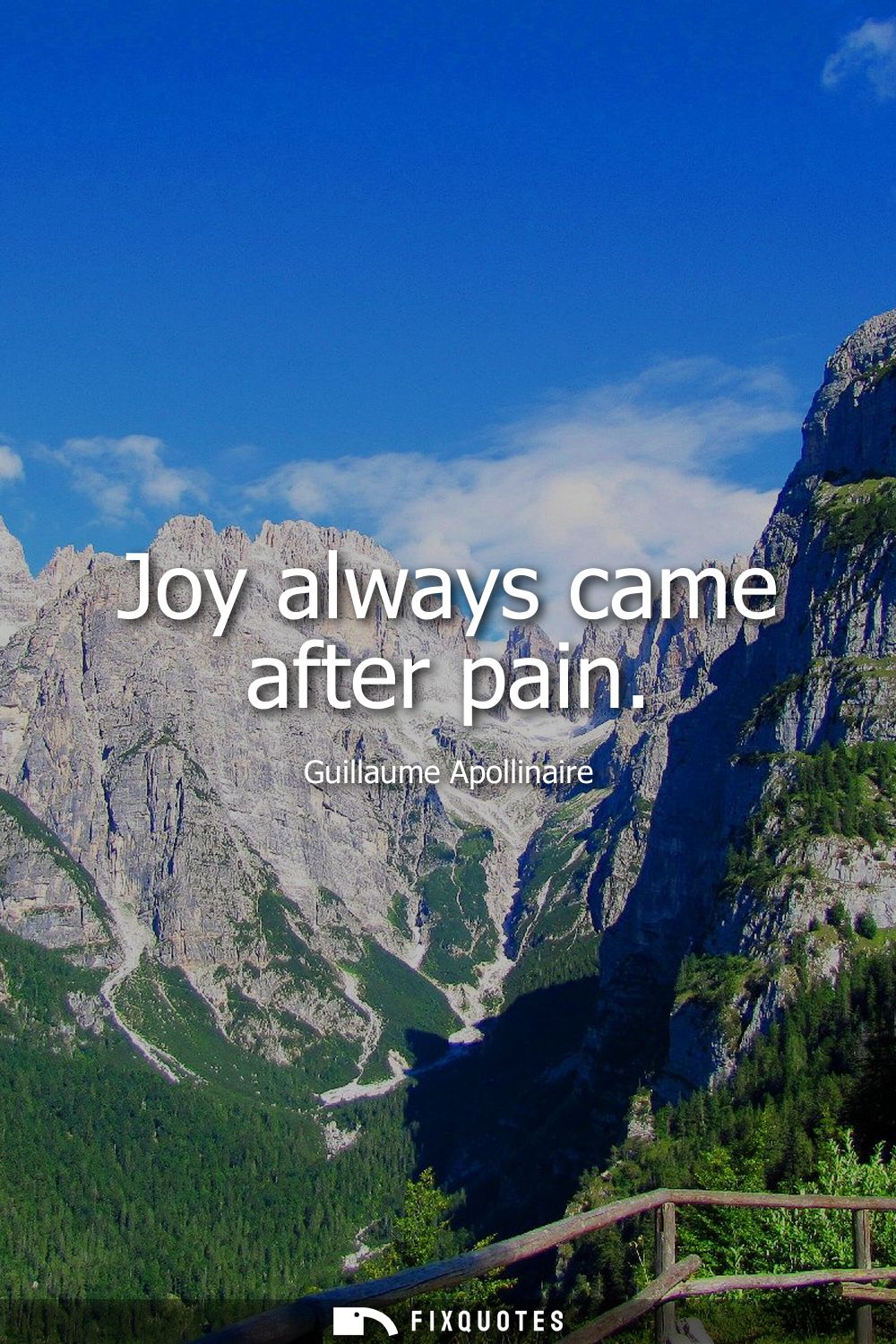
"Joy always came after pain"
About this Quote
“Joy always came after pain” reads like a hard-won law of physics, not a self-help mantra. Apollinaire compresses an entire emotional weather system into five words: the “always” is doing the bruising work. It insists on sequence and inevitability, implying that joy is not an innocent state you stumble into, but a consequence, a rebound, almost a debt paid out by suffering. There’s a quiet provocation here too: if joy reliably follows pain, then pain becomes legible, even usable. That’s not consolation so much as a risky wager.
The subtext is distinctly modernist: experience is fractured, history is violent, and meaning has to be forged from impact. Apollinaire wrote with one foot in lyric tenderness and the other in the machinery of the early 20th century, when art was breaking its own forms and Europe was breaking bodies. His life and work are shadowed by war; he served in World War I and was wounded, living through the era’s brutal proof that “progress” could look like shrapnel. In that context, the line feels less like optimism than like a survival tactic: a way to keep going by treating suffering as a passage rather than a terminal station.
What makes it work is its emotional timing. It doesn’t deny pain or romanticize it; it simply refuses to let pain have the last word. The sentence is spare enough to sound true, and categorical enough to sound like it had to be learned the hard way.
The subtext is distinctly modernist: experience is fractured, history is violent, and meaning has to be forged from impact. Apollinaire wrote with one foot in lyric tenderness and the other in the machinery of the early 20th century, when art was breaking its own forms and Europe was breaking bodies. His life and work are shadowed by war; he served in World War I and was wounded, living through the era’s brutal proof that “progress” could look like shrapnel. In that context, the line feels less like optimism than like a survival tactic: a way to keep going by treating suffering as a passage rather than a terminal station.
What makes it work is its emotional timing. It doesn’t deny pain or romanticize it; it simply refuses to let pain have the last word. The sentence is spare enough to sound true, and categorical enough to sound like it had to be learned the hard way.
Quote Details
| Topic | Hope |
|---|---|
| Source | Help us find the source |
| Cite |
Citation Formats
APA Style (7th ed.)
Apollinaire, Guillaume. (2026, January 18). Joy always came after pain. FixQuotes. https://fixquotes.com/quotes/joy-always-came-after-pain-15280/
Chicago Style
Apollinaire, Guillaume. "Joy always came after pain." FixQuotes. January 18, 2026. https://fixquotes.com/quotes/joy-always-came-after-pain-15280/.
MLA Style (9th ed.)
"Joy always came after pain." FixQuotes, 18 Jan. 2026, https://fixquotes.com/quotes/joy-always-came-after-pain-15280/. Accessed 12 Feb. 2026.
More Quotes by Guillaume
Add to List