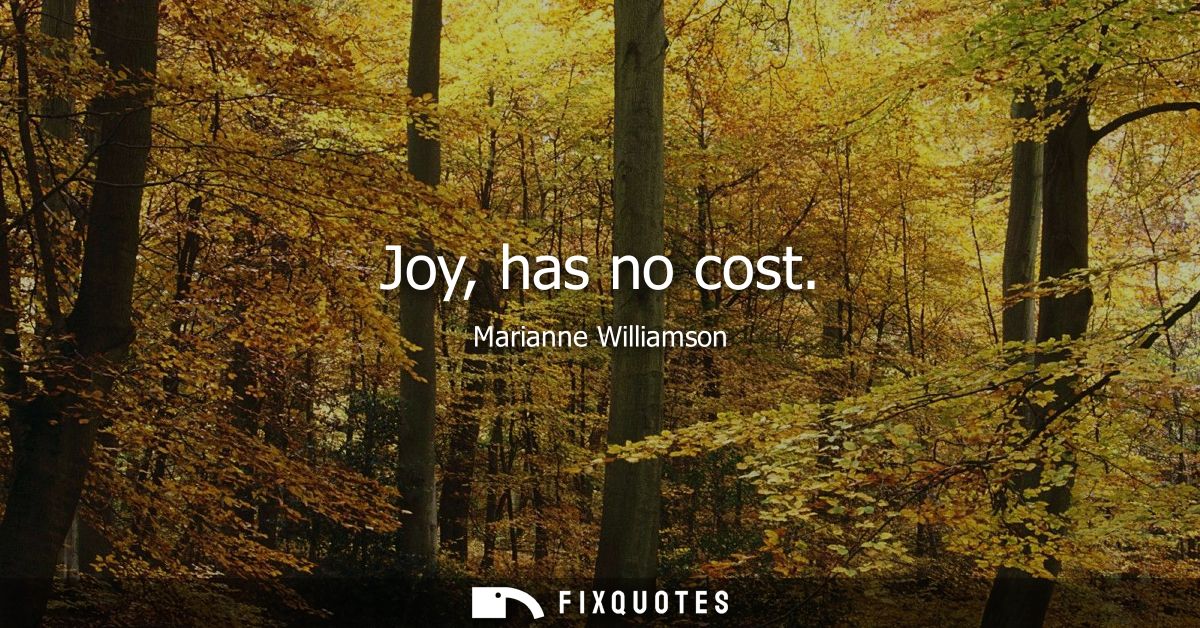
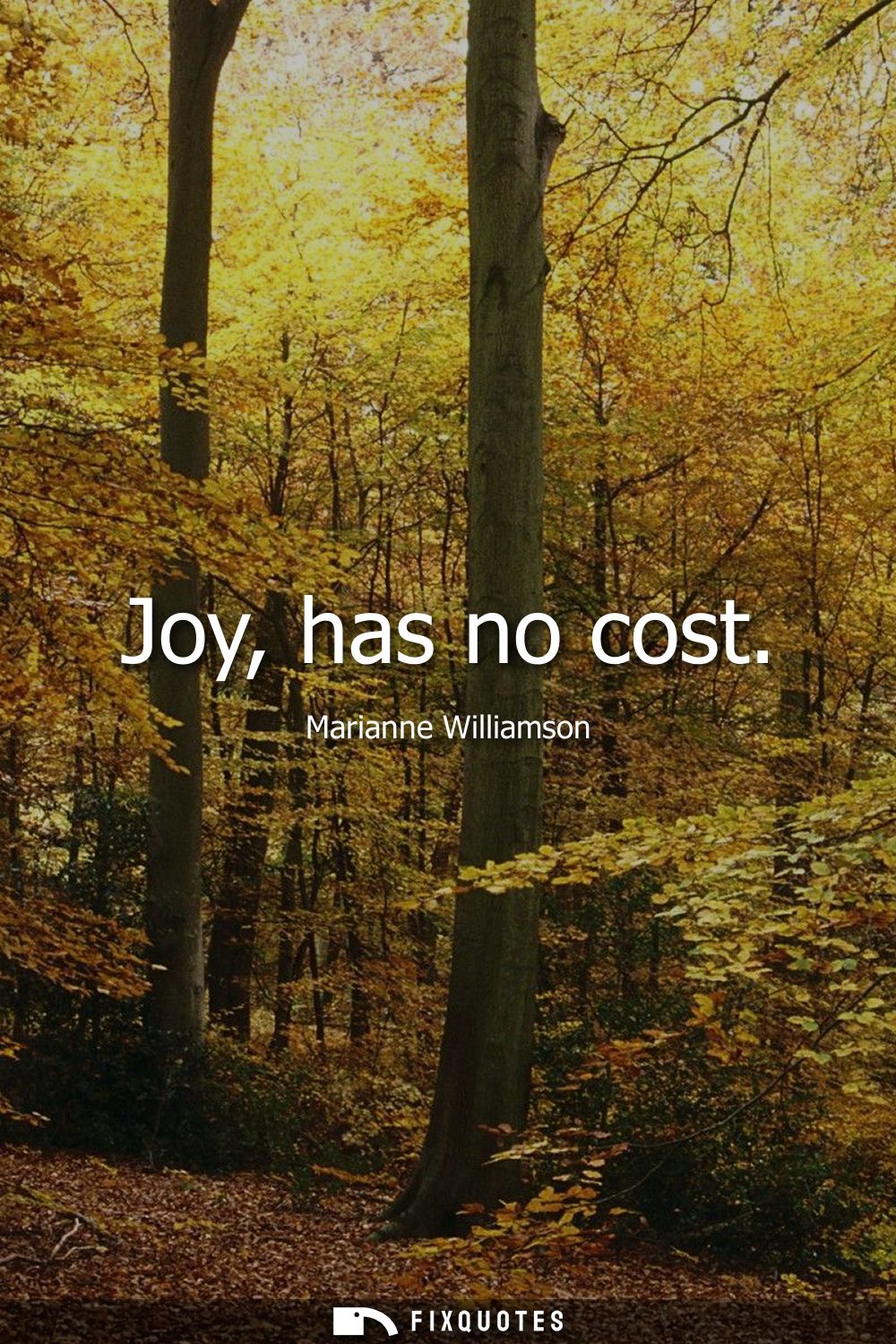
"Joy, has no cost"
About this Quote
A comma where you expect a clean sprint is the first tell: "Joy, has no cost" lands like a hand on your wrist, slowing you down just enough to notice the claim. Marianne Williamson is writing in the self-help-spiritual tradition where language doubles as instruction and permission slip. The line isn’t trying to define joy; it’s trying to deprogram the reflex that treats happiness like a product you earn, buy, or barter for.
The specific intent is disarmingly practical. If joy is free, you don’t have to wait for the promotion, the partner, the repaired childhood, the perfect morning routine. You can access it now, in small doses, without external clearance. That’s why the sentence is so stripped down. It’s a mantra engineered for repetition, the kind of thought you can carry through traffic or grief.
The subtext has teeth: modern capitalism is a machine that monetizes relief, selling you the tools to feel okay while quietly implying you’re not okay without them. Williamson’s line offers a tiny rebellion against that logic. It also nudges responsibility back onto the listener: if joy isn’t gated by money, then scarcity can’t be your only alibi for its absence. That’s empowering, and for some, indicting.
Context matters, too. Williamson’s work often speaks to audiences exhausted by achievement culture and spiritual consumerism alike. The quote functions as a corrective: joy is not a luxury good. It’s a practice, a perception shift, sometimes a refusal. It doesn’t deny suffering; it insists suffering doesn’t get exclusive rights to your inner life.
The specific intent is disarmingly practical. If joy is free, you don’t have to wait for the promotion, the partner, the repaired childhood, the perfect morning routine. You can access it now, in small doses, without external clearance. That’s why the sentence is so stripped down. It’s a mantra engineered for repetition, the kind of thought you can carry through traffic or grief.
The subtext has teeth: modern capitalism is a machine that monetizes relief, selling you the tools to feel okay while quietly implying you’re not okay without them. Williamson’s line offers a tiny rebellion against that logic. It also nudges responsibility back onto the listener: if joy isn’t gated by money, then scarcity can’t be your only alibi for its absence. That’s empowering, and for some, indicting.
Context matters, too. Williamson’s work often speaks to audiences exhausted by achievement culture and spiritual consumerism alike. The quote functions as a corrective: joy is not a luxury good. It’s a practice, a perception shift, sometimes a refusal. It doesn’t deny suffering; it insists suffering doesn’t get exclusive rights to your inner life.
Quote Details
| Topic | Joy |
|---|---|
| Source | Help us find the source |
| Cite |
Citation Formats
APA Style (7th ed.)
Williamson, Marianne. (2026, January 18). Joy, has no cost. FixQuotes. https://fixquotes.com/quotes/joy-has-no-cost-14839/
Chicago Style
Williamson, Marianne. "Joy, has no cost." FixQuotes. January 18, 2026. https://fixquotes.com/quotes/joy-has-no-cost-14839/.
MLA Style (9th ed.)
"Joy, has no cost." FixQuotes, 18 Jan. 2026, https://fixquotes.com/quotes/joy-has-no-cost-14839/. Accessed 31 Mar. 2026.
More Quotes by Marianne
Add to List