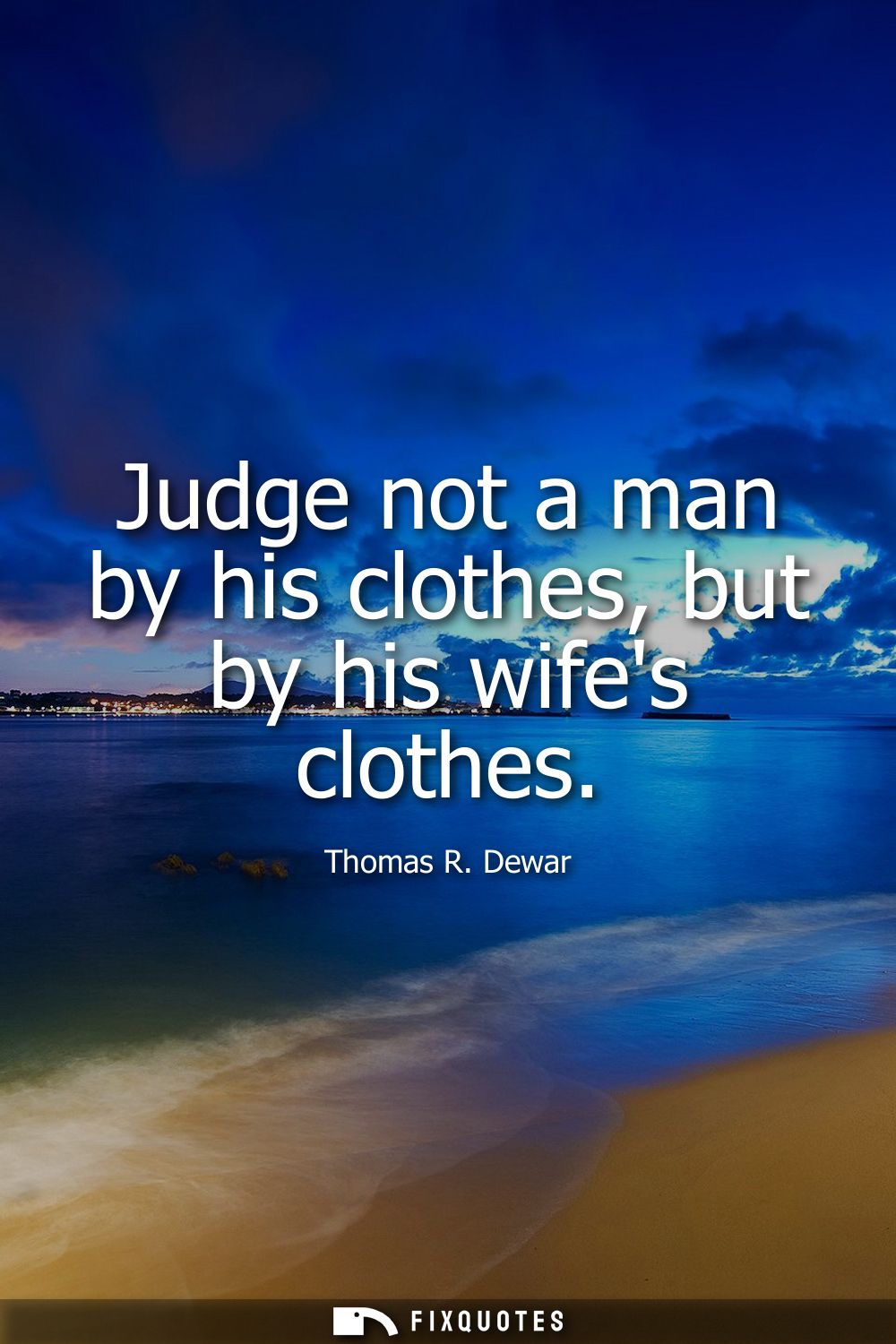
"Judge not a man by his clothes, but by his wife's clothes"
About this Quote
A polite proverb gets flipped into a social X-ray. Dewar borrows the familiar moral instruction "judge not by appearances" and then immediately weaponizes it, relocating the evidence from a man's suit to his wife's wardrobe. The joke lands because it’s meaner than it first appears: it assumes the real ledger of male status isn’t personal character at all, but domestic display - a household’s spending power, taste, and conformity to class codes, outsourced onto the woman nearest him.
The intent is satirical, but not exactly liberating. Dewar is poking fun at the hypocrisy of anti-judgment platitudes while admitting what many social circles practiced openly: status is read, instantly, through surfaces. By choosing "wife's clothes", he sharpens the critique into a commentary on gendered economics. The man is the subject of evaluation; the woman becomes the instrument of proof. Her body is turned into a billboard for his success, his generosity, his control, even his respectability.
Context matters: Dewar wrote in an era when the "respectable" middle and upper classes treated consumption as moral theater, and women's fashion was one of the loudest signals available. Men’s clothing, especially in Anglo contexts, was often designed to look restrained; women's dress carried the burden of ornament and, with it, public judgment. The line’s cynicism is that it names the system without challenging it. It laughs at the social reflex to appraise - while quietly reaffirming that appraisal as the only language the room really speaks.
The intent is satirical, but not exactly liberating. Dewar is poking fun at the hypocrisy of anti-judgment platitudes while admitting what many social circles practiced openly: status is read, instantly, through surfaces. By choosing "wife's clothes", he sharpens the critique into a commentary on gendered economics. The man is the subject of evaluation; the woman becomes the instrument of proof. Her body is turned into a billboard for his success, his generosity, his control, even his respectability.
Context matters: Dewar wrote in an era when the "respectable" middle and upper classes treated consumption as moral theater, and women's fashion was one of the loudest signals available. Men’s clothing, especially in Anglo contexts, was often designed to look restrained; women's dress carried the burden of ornament and, with it, public judgment. The line’s cynicism is that it names the system without challenging it. It laughs at the social reflex to appraise - while quietly reaffirming that appraisal as the only language the room really speaks.
Quote Details
| Topic | Witty One-Liners |
|---|---|
| Source | Help us find the source |
| Cite |
Citation Formats
APA Style (7th ed.)
Dewar, Thomas R. (2026, January 15). Judge not a man by his clothes, but by his wife's clothes. FixQuotes. https://fixquotes.com/quotes/judge-not-a-man-by-his-clothes-but-by-his-wifes-163081/
Chicago Style
Dewar, Thomas R. "Judge not a man by his clothes, but by his wife's clothes." FixQuotes. January 15, 2026. https://fixquotes.com/quotes/judge-not-a-man-by-his-clothes-but-by-his-wifes-163081/.
MLA Style (9th ed.)
"Judge not a man by his clothes, but by his wife's clothes." FixQuotes, 15 Jan. 2026, https://fixquotes.com/quotes/judge-not-a-man-by-his-clothes-but-by-his-wifes-163081/. Accessed 27 Mar. 2026.
More Quotes by Thomas
Add to List