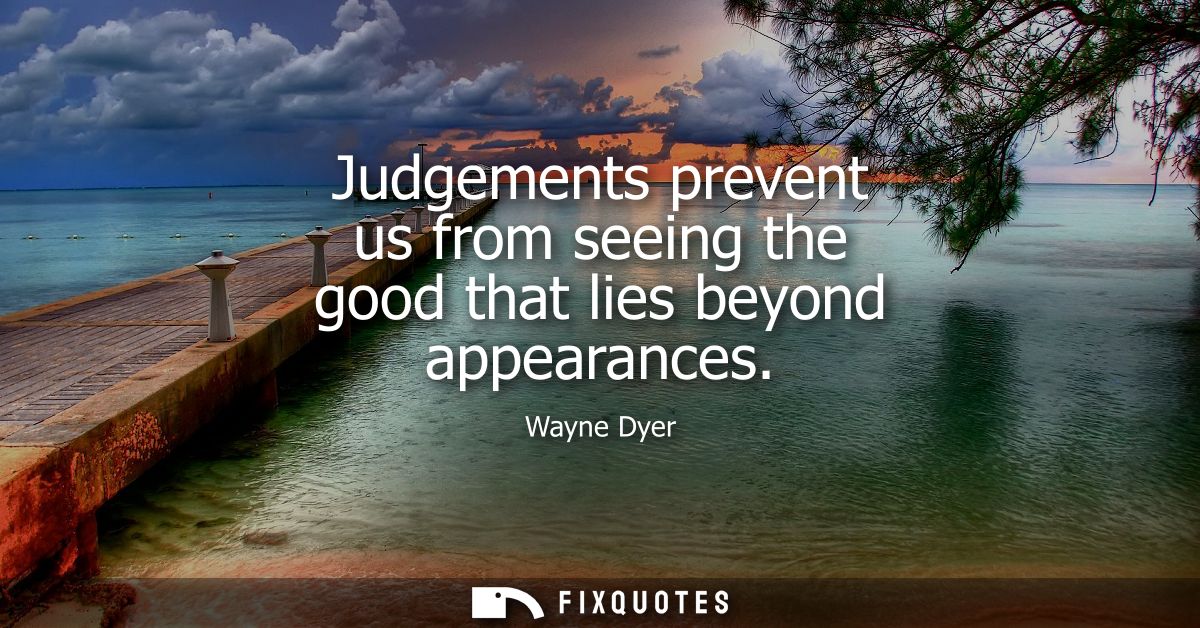
"Judgements prevent us from seeing the good that lies beyond appearances"
About this Quote
The phrase “beyond appearances” does two jobs at once. On the surface, it’s a plea for empathy: don’t reduce people to first impressions, status markers, or defensive behaviors. Underneath, it’s a critique of the ego’s need to categorize. Judgments are presented as protective shortcuts - ways to stay superior, safe, or unchallenged - that cost us access to “the good,” meaning possibility, connection, and even self-respect. In that sense, the quote quietly relocates responsibility: if you’re not seeing goodness, the problem may be your lens, not the world.
Contextually, Dyer emerged from a late-20th-century American therapeutic culture that fused psychology with spirituality and personal agency. His intent isn’t academic nuance about perception; it’s behavior change. The line aims to make judgment feel expensive. It suggests that the real tragedy isn’t that we misread others, but that we miss what could have been available to us - a calmer mind, a wider social world, a more generous life.
Quote Details
| Topic | Kindness |
|---|---|
| Source | Help us find the source |
| Cite |
Citation Formats
APA Style (7th ed.)
Dyer, Wayne. (2026, January 18). Judgements prevent us from seeing the good that lies beyond appearances. FixQuotes. https://fixquotes.com/quotes/judgements-prevent-us-from-seeing-the-good-that-10761/
Chicago Style
Dyer, Wayne. "Judgements prevent us from seeing the good that lies beyond appearances." FixQuotes. January 18, 2026. https://fixquotes.com/quotes/judgements-prevent-us-from-seeing-the-good-that-10761/.
MLA Style (9th ed.)
"Judgements prevent us from seeing the good that lies beyond appearances." FixQuotes, 18 Jan. 2026, https://fixquotes.com/quotes/judgements-prevent-us-from-seeing-the-good-that-10761/. Accessed 12 Feb. 2026.