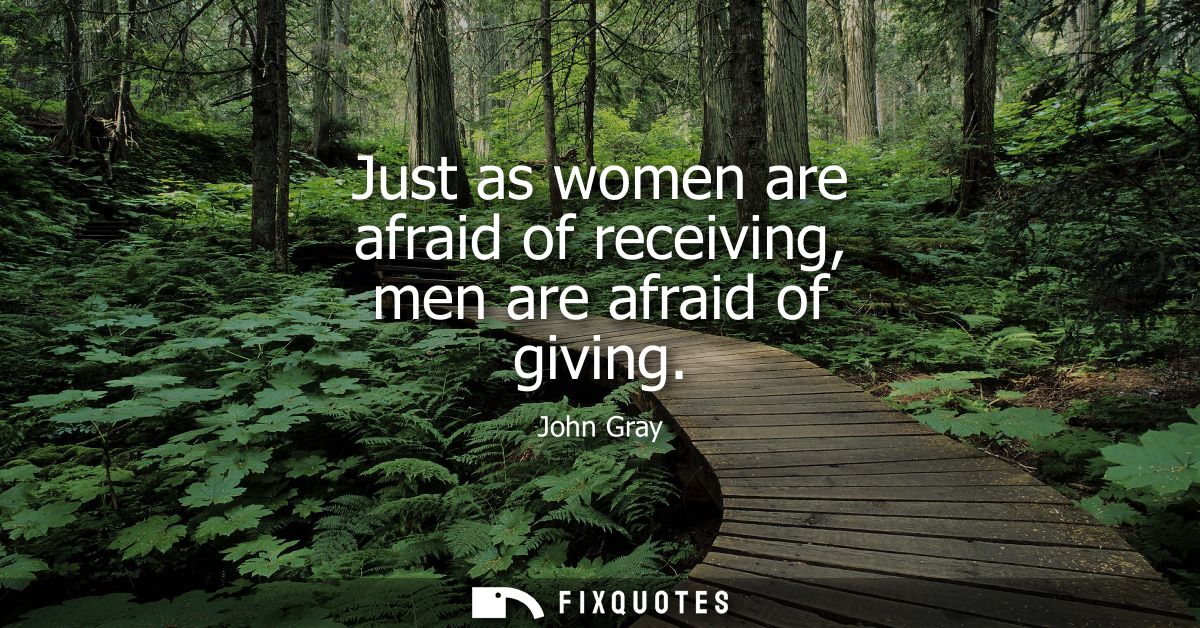
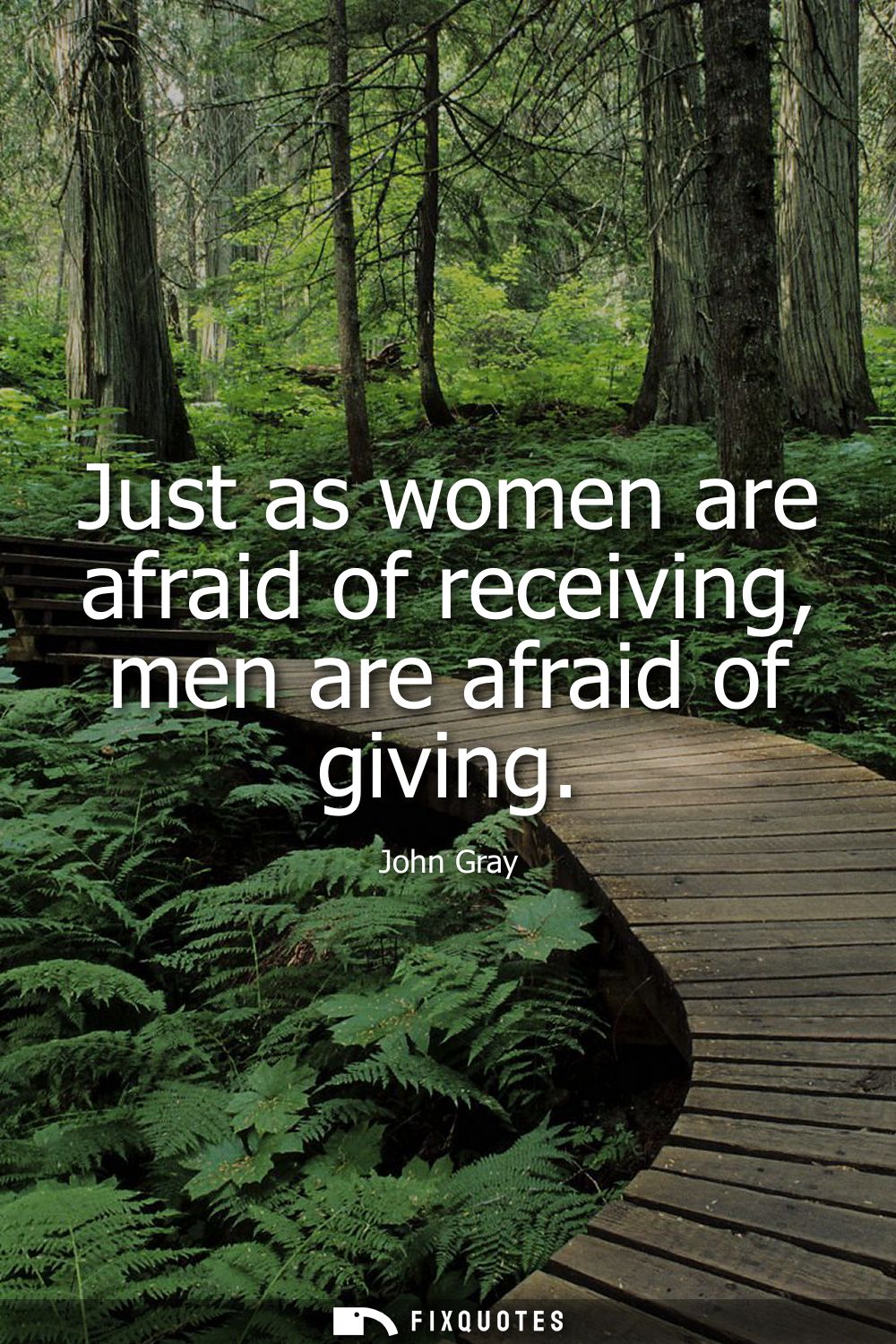
"Just as women are afraid of receiving, men are afraid of giving"
About this Quote
Gray frames intimacy as an economy of fear, not affection. The line’s punch comes from its symmetry: receiving and giving sound like opposites, but he casts them as parallel vulnerabilities. “Receiving” isn’t depicted as a gift; it’s exposure. To accept care can feel like admitting need, letting someone see the soft underbelly you’ve been trained to protect. “Giving,” meanwhile, isn’t generosity; it’s risk. To offer love, time, or tenderness is to gamble status, autonomy, even masculinity itself, especially in cultures that reward men for withholding.
The intent is classic John Gray: translate relationship conflict into a neat, gendered map that makes messy feelings legible. His broader Mars/Venus framework depends on these clean binaries because they create instant narrative traction: if both sides are afraid, then distance and miscommunication stop looking like moral failure and start looking like predictable wiring. That’s comforting to readers who want their fights to have a diagram.
The subtext is more complicated. Gray is smuggling in a cultural critique of how gender scripts punish openness, but he packages it as natural difference rather than social conditioning. That’s why the sentence “works” rhetorically: it sounds like wisdom while sidestepping power. Who gets to be afraid of giving when women have historically been expected to give constantly? Who is permitted to fear receiving when women are often told their needs are “too much”?
In context, it’s a self-help aphorism optimized for recognition. You read it and think of a couple you know. The danger is the same as the appeal: a tidy mirror that can illuminate patterns, then quietly lock people inside them.
The intent is classic John Gray: translate relationship conflict into a neat, gendered map that makes messy feelings legible. His broader Mars/Venus framework depends on these clean binaries because they create instant narrative traction: if both sides are afraid, then distance and miscommunication stop looking like moral failure and start looking like predictable wiring. That’s comforting to readers who want their fights to have a diagram.
The subtext is more complicated. Gray is smuggling in a cultural critique of how gender scripts punish openness, but he packages it as natural difference rather than social conditioning. That’s why the sentence “works” rhetorically: it sounds like wisdom while sidestepping power. Who gets to be afraid of giving when women have historically been expected to give constantly? Who is permitted to fear receiving when women are often told their needs are “too much”?
In context, it’s a self-help aphorism optimized for recognition. You read it and think of a couple you know. The danger is the same as the appeal: a tidy mirror that can illuminate patterns, then quietly lock people inside them.
Quote Details
| Topic | Relationship |
|---|---|
| Source | Help us find the source |
| Cite |
Citation Formats
APA Style (7th ed.)
Gray, John. (2026, January 16). Just as women are afraid of receiving, men are afraid of giving. FixQuotes. https://fixquotes.com/quotes/just-as-women-are-afraid-of-receiving-men-are-120277/
Chicago Style
Gray, John. "Just as women are afraid of receiving, men are afraid of giving." FixQuotes. January 16, 2026. https://fixquotes.com/quotes/just-as-women-are-afraid-of-receiving-men-are-120277/.
MLA Style (9th ed.)
"Just as women are afraid of receiving, men are afraid of giving." FixQuotes, 16 Jan. 2026, https://fixquotes.com/quotes/just-as-women-are-afraid-of-receiving-men-are-120277/. Accessed 15 Mar. 2026.
More Quotes by John
Add to List