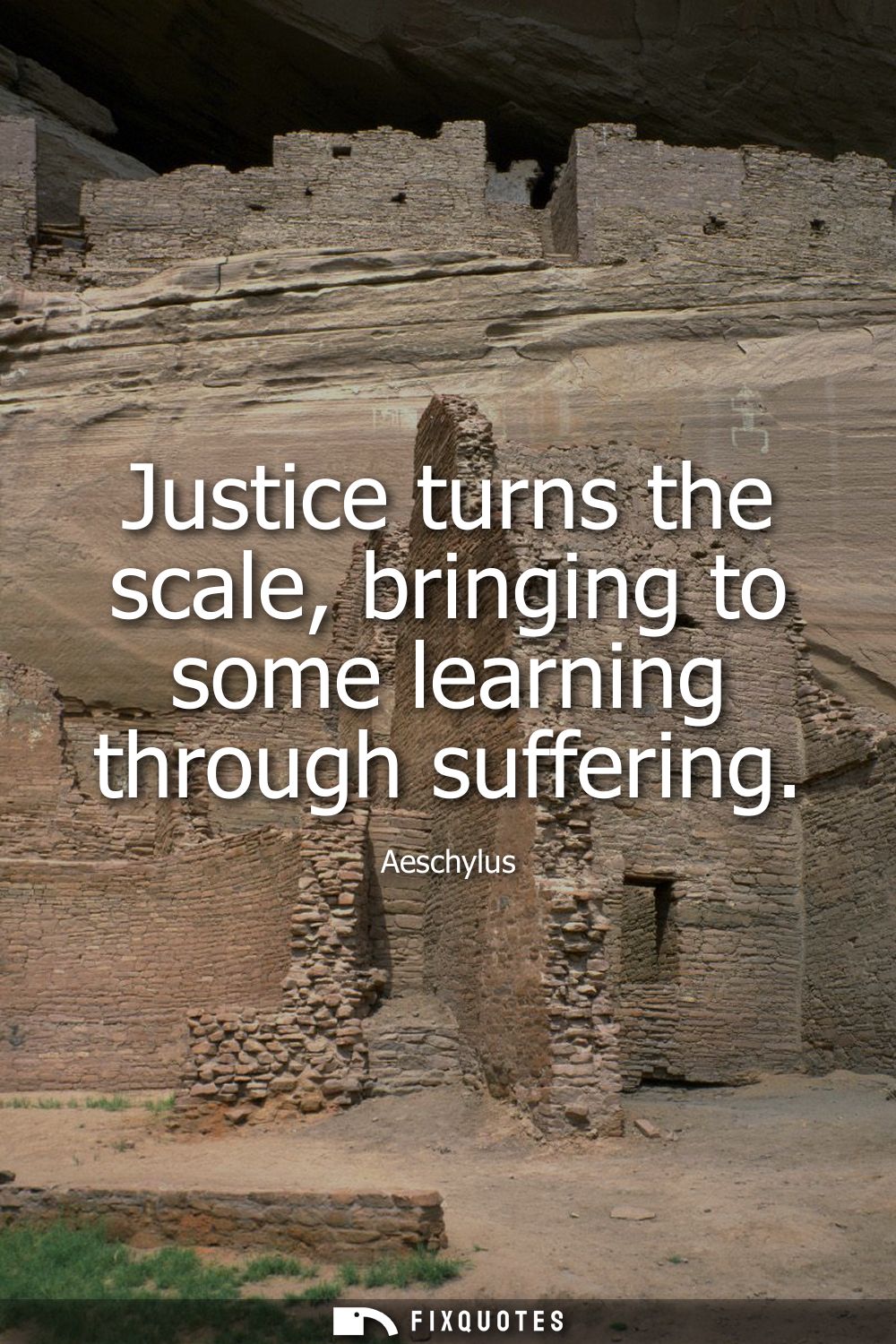
"Justice turns the scale, bringing to some learning through suffering"
About this Quote
Justice here isn’t a blindfolded clerk tallying merits; it’s a force with a grim curriculum. Aeschylus frames justice as something that literally "turns the scale" - an image from commerce and law that makes morality feel mechanical, even inevitable. The balance tips, and what falls out isn’t comfort or redemption but instruction. Learning arrives, but it arrives late, by pain.
The subtext is almost provocatively anti-modern: wisdom is not self-help, not therapy, not even persuasion. It’s consequence. In Aeschylus’ world, people don’t grow because they choose to; they grow because they’re crushed by what they’ve done, what their family has done, what their city has allowed. That emphasis tracks with Greek tragedy’s obsession with inherited guilt and civic rot: suffering is less a personal setback than a public reckoning.
Context matters. Aeschylus wrote for an Athens that had survived war and was inventing new forms of democracy and legal order, while still haunted by vendetta logic. His plays stage the transition from blood revenge to civic justice, and this line sits right on that fault line. "Justice" isn’t gentle reform; it’s the hard pivot from chaos to order, the price of moving from retaliation to rule.
There’s also an unsettling consolation embedded in the phrasing: suffering is not random. It instructs. That’s tragic art at its most effective - it doesn’t deny pain; it gives pain a shape that an audience can endure, and a moral pressure that a society can’t ignore.
The subtext is almost provocatively anti-modern: wisdom is not self-help, not therapy, not even persuasion. It’s consequence. In Aeschylus’ world, people don’t grow because they choose to; they grow because they’re crushed by what they’ve done, what their family has done, what their city has allowed. That emphasis tracks with Greek tragedy’s obsession with inherited guilt and civic rot: suffering is less a personal setback than a public reckoning.
Context matters. Aeschylus wrote for an Athens that had survived war and was inventing new forms of democracy and legal order, while still haunted by vendetta logic. His plays stage the transition from blood revenge to civic justice, and this line sits right on that fault line. "Justice" isn’t gentle reform; it’s the hard pivot from chaos to order, the price of moving from retaliation to rule.
There’s also an unsettling consolation embedded in the phrasing: suffering is not random. It instructs. That’s tragic art at its most effective - it doesn’t deny pain; it gives pain a shape that an audience can endure, and a moral pressure that a society can’t ignore.
Quote Details
| Topic | Justice |
|---|---|
| Source | Help us find the source |
| Cite |
Citation Formats
APA Style (7th ed.)
Aeschylus. (2026, January 15). Justice turns the scale, bringing to some learning through suffering. FixQuotes. https://fixquotes.com/quotes/justice-turns-the-scale-bringing-to-some-learning-42439/
Chicago Style
Aeschylus. "Justice turns the scale, bringing to some learning through suffering." FixQuotes. January 15, 2026. https://fixquotes.com/quotes/justice-turns-the-scale-bringing-to-some-learning-42439/.
MLA Style (9th ed.)
"Justice turns the scale, bringing to some learning through suffering." FixQuotes, 15 Jan. 2026, https://fixquotes.com/quotes/justice-turns-the-scale-bringing-to-some-learning-42439/. Accessed 22 Mar. 2026.
More Quotes by Aeschylus
Add to List