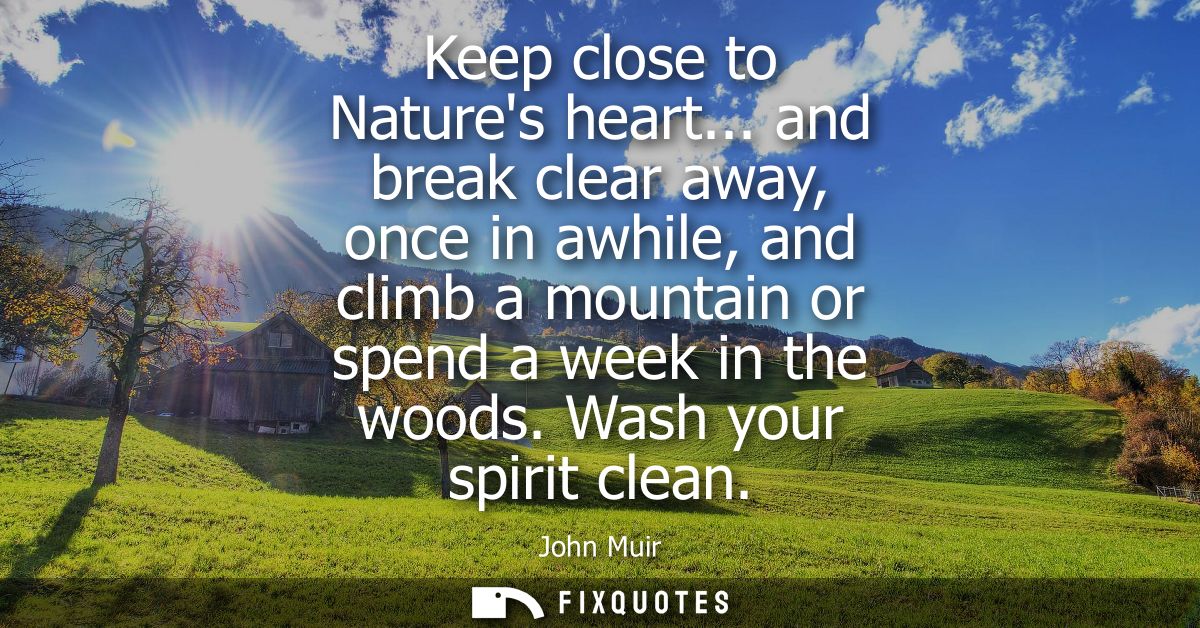
"Keep close to Nature's heart... and break clear away, once in awhile, and climb a mountain or spend a week in the woods. Wash your spirit clean"
About this Quote
The subtext is almost combative. “Nature’s heart” personifies the nonhuman world as something intimate and alive, not a resource pile or a scenic backdrop. In the late 19th century, as railroads stitched the continent together and extraction accelerated, that framing was political: to call the wilderness a heart is to argue it has intrinsic value and a kind of dignity that can’t be priced. Muir’s sentence quietly flips the hierarchy. Civilization isn’t the default; it’s the buildup that needs cleansing.
“Climb a mountain” and “spend a week in the woods” are specific on purpose. This isn’t a stroll in a manicured park; it’s immersion long enough to unlearn your own noise. “Wash your spirit clean” borrows the language of baptism without naming religion, suggesting that contact with wild places can restore an ethical clarity modern life corrodes.
In context, this is Muir building the emotional case for preservation: if wilderness can renew the human spirit, then protecting it isn’t indulgence. It’s maintenance of the national psyche, and a rebuke to the idea that progress should cost us our capacity to feel awe.
Quote Details
| Topic | Nature |
|---|---|
| Source | Later attribution: The Art of Manliness (Brett McKay, Kate McKay, 2009) modern compilationISBN: 9781440308918 · ID: hrDrDQAAQBAJ
Evidence:
... Keep close to Nature's heart ... and break clear away , once in awhile , and climb a mountain or spend a week in the woods . Wash your spirit clean . " -JOHN MUIR Before GPS and even before maps and compasses , man was able to navigate ... |
| Cite |
Citation Formats
APA Style (7th ed.)
Muir, John. (2026, March 23). Keep close to Nature's heart... and break clear away, once in awhile, and climb a mountain or spend a week in the woods. Wash your spirit clean. FixQuotes. https://fixquotes.com/quotes/keep-close-to-natures-heart-and-break-clear-away-14725/
Chicago Style
Muir, John. "Keep close to Nature's heart... and break clear away, once in awhile, and climb a mountain or spend a week in the woods. Wash your spirit clean." FixQuotes. March 23, 2026. https://fixquotes.com/quotes/keep-close-to-natures-heart-and-break-clear-away-14725/.
MLA Style (9th ed.)
"Keep close to Nature's heart... and break clear away, once in awhile, and climb a mountain or spend a week in the woods. Wash your spirit clean." FixQuotes, 23 Mar. 2026, https://fixquotes.com/quotes/keep-close-to-natures-heart-and-break-clear-away-14725/. Accessed 7 Apr. 2026.