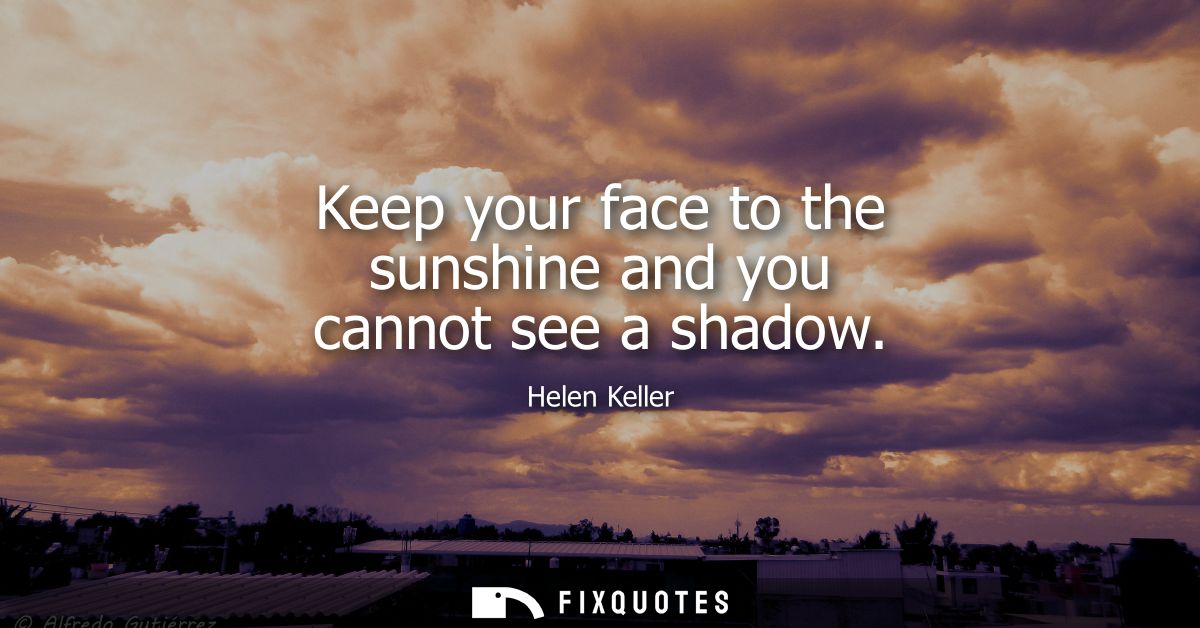
"Keep your face to the sunshine and you cannot see a shadow"
About this Quote
Keller offers optimism as a discipline, not a mood. "Keep your face" makes hope physical and stubborn: a posture you choose and hold. The sentence is built like a little law of nature - if you orient toward light, shadow falls behind you. That pseudo-scientific certainty is the rhetorical trick. It borrows the authority of optics to make resilience feel inevitable, almost mechanical: turn toward the right thing and darkness loses its power to dominate your field of vision.
The subtext is tougher than the greeting-card version. Shadows don't vanish; they're repositioned. Keller isn't promising that suffering ends, only that attention is a scarce resource you can allocate. In a culture that often treats positivity as personality, she frames it as strategy. The second-person "you" is quietly coercive, a gentle command that implies culpability: if you're staring at the shadow, you've turned your head away from the sun.
Context matters because Keller's public identity has long been flattened into inspirational shorthand. As a deaf-blind author and activist writing through interpreters, she understood both literal and metaphorical limits on perception: what you can access, who controls access, and how easily society decides what you "can't see". Read alongside her political work - pro-labor, anti-poverty, sharply critical of inequality - the line reads less like denial and more like triage. When the world insists on defining you by lack, insisting on a direction of gaze becomes an assertion of agency. Optimism here isn't ignorance; it's a refusal to let the shadow set the agenda.
The subtext is tougher than the greeting-card version. Shadows don't vanish; they're repositioned. Keller isn't promising that suffering ends, only that attention is a scarce resource you can allocate. In a culture that often treats positivity as personality, she frames it as strategy. The second-person "you" is quietly coercive, a gentle command that implies culpability: if you're staring at the shadow, you've turned your head away from the sun.
Context matters because Keller's public identity has long been flattened into inspirational shorthand. As a deaf-blind author and activist writing through interpreters, she understood both literal and metaphorical limits on perception: what you can access, who controls access, and how easily society decides what you "can't see". Read alongside her political work - pro-labor, anti-poverty, sharply critical of inequality - the line reads less like denial and more like triage. When the world insists on defining you by lack, insisting on a direction of gaze becomes an assertion of agency. Optimism here isn't ignorance; it's a refusal to let the shadow set the agenda.
Quote Details
| Topic | Optimism |
|---|---|
| Source | Later attribution: Greatness - The Dark Side - (Amr Okasha, 2020) modern compilationISBN: 9781070975887 · ID: PinMDwAAQBAJ
Evidence:
... Helen Keller " Keep your face to the sunshine and you cannot see a shadow . " - Helen Keller . Helen Adams Keller was many things . She was an author , lecturer , and political activist . Note that one of these titles is not " quitter ... |
| Cite |
Citation Formats
APA Style (7th ed.)
Keller, Helen. (2026, February 17). Keep your face to the sunshine and you cannot see a shadow. FixQuotes. https://fixquotes.com/quotes/keep-your-face-to-the-sunshine-and-you-cannot-see-14106/
Chicago Style
Keller, Helen. "Keep your face to the sunshine and you cannot see a shadow." FixQuotes. February 17, 2026. https://fixquotes.com/quotes/keep-your-face-to-the-sunshine-and-you-cannot-see-14106/.
MLA Style (9th ed.)
"Keep your face to the sunshine and you cannot see a shadow." FixQuotes, 17 Feb. 2026, https://fixquotes.com/quotes/keep-your-face-to-the-sunshine-and-you-cannot-see-14106/. Accessed 13 Mar. 2026.
More Quotes by Helen
Add to List